Todd and I were having a beer at the Folsom Grill, and I said, “You know, I saw Angela again today.”
“Yeah?” he said. “Where?”
“At a department store. She was there with some guy named Jim. Scruffy beard. Kind of unkempt. I wanted to wish him better luck than I had with her, but I didn’t. I really should have, though.” I unwrapped a cigar.
Todd nodded and said, “You still carry a torch for that woman, don’t you?”
I smirked. “Not exactly a torch. A cigarette lighter, maybe.” I took a cigarette lighter from my pocket and showed him the flame. It flickered a little. Then I lit the cigar and started to puff.
“Last time we talked, she was pretty important,” he said.
Thin, blue smoke drifted from the end of my cigar. Somewhere behind the bar, bottles clinked together.
“Yeah, well, last time we talked, I was out of my mind. I mean, things were okay with her. She’s cute, kind of interesting, and the sex wasn’t bad. But since then, I’ve decided not to let women get under my skin. There was nothing she and I had that would justify any special effort to get her back.” I blew a smoke ring.
“Love is strange,” Todd said.
“You got that right,” I said as I put out the cigar.
Todd and I were having a beer at the Folsom Grill, and I said, “You know, I saw Angela again today.”
“Yeah?” he said. “Where?”
“At a department store. She was there with some guy named Jim. Scruffy beard. Kind of unkempt. I wanted to find a large rock and break his head open with it, but I didn’t. I really should have, though.” I unwrapped a cigar.
Todd nodded and said, “You still carry a torch for that woman, don’t you?”
I smirked. “Not exactly a torch. A flame thrower, maybe.” I took a flame thrower from under the table and showed him the pilot flame. It flickered a little. Then I ignited the far end of the bar. I took a bite from the cigar and started to chew.
“Last time we talked, she was pretty important,” he said.
Black, oily smoke filled the room. Somewhere behind the bar, bottles exploded.
“Yeah, well, last time we talked, I understated everything. Life with her was paradise. We loved the same books, the same movies, the same music. She was a brilliant conversationalist, and in bed she moved like a cat. Since then, I’ve been unable to touch another woman. Compared to Angela, other women are about as erotic as lumps of clay. There was nothing she and I had that I wouldn’t die to have for five minutes again.” I swallowed the tobacco and took another bite from the cigar.
“Love is strange,” Todd said.
“You got that right,” I said as we were overcome with smoke.
Bruce Holland Rogers has a home base in Eugene, Oregon, the tie-dye capital of the world. He writes all types of fiction: SF, fantasy, literary, mysteries, experimental, and work that’s hard to label.
For six years, Bruce wrote a column about the spiritual and psychological challenges of full-time fiction writing for Speculations magazine. Many of those columns have been collected in a book, Word Work: Surviving and Thriving as a Writer (an alternate selection of the Writers Digest Book Club). He is a motivational speaker and trains workers and managers in creativity and practical problem solving.
He has taught creative writing at the University of Colorado and the University of Illinois. Bruce has also taught non-credit courses for the University of Colorado, Carroll College, the University of Wisconsin, and the private Flatiron Fiction Workshop. He is a member of the permanent faculty at the Whidbey Writers Workshop MFA program, a low-residency program that stands alone and is not affiliated with a college or university. It is the first and so far only program of its kind. Currently he is teaching creative writing and literature at Eötvös Loránd University in Budapest, Hungary, on a Fulbright grant.
We need all the help we can get. For more info on any number of flash-tabulous rewards including extra stories, personalized critiques, and more:
Or…
If you enjoy Flash Fiction Online, consider subscribing or purchasing a downloadable copy. Your donations go a long way to paying our authors the professional rates they deserve. For only $0.99/issue that’s cheaper than a cup of coffee. Or subscribe for $9.99/year.
If you’d like to read his previous columns, you can find a complete list on his author page.
One of the first things I learned about English prose style, far back in the ancient days of grade school, was that I should vary my vocabulary. Repetition of the same word (other than prepositions, conjunctions and articles that have to be repeated often) displayed a lack of art. If I were writing a paragraph about a rose, then I should next refer to it as “flower” and then perhaps refer to its “petals,” rather than writing “rose” in three different sentences.
The requirement that we change words is arbitrary. If I am listening to a story being read aloud and hear the same word used too many times, I may cringe with embarrassment for the writer, but only because I have been taught to detest the same word cropping up too often in my own drafts. A paragraph that says “rose” five times is probably just as clear as one that says “rose,” “flower,” “bloom,” “posy,” and “inflorescence.” In fact, the repetitive version may be clearer than the varied one, particularly if the pursuit of variety leads the writer to scour the thesaurus and find words that aren’t quite right. Inflorescence? Is that really an adequate substitute for “rose”? The thesaurus is a two-faced ally. Pity the poor writer who probably consulted the thesaurus in haste before bringing to class a story containing this riveting action: “He placed the amulet around her cervix.”
There are aspects of art that I think we can call “natural aesthetics.” People from a variety of different cultures will find certain landscape paintings beautiful because the settings depict real or imagined places that appeal to the human animal: fresh water, game, fuel, good weather, and a road or path that connects us to other people. But the demand for varied vocabulary in prose is an example of “invented aesthetics.” I think this preference developed as a method for showing off one’s education. A writer who can say “rose” five different ways probably knows more words than the writer who is limited to saying “rose” five times. So the demand that we vary our vocabulary without sacrificing clarity is just an arbitrary way of making writing harder and keeping the riffraff out of literature. Indeed, you can see just how arbitrary this demand is by comparing the tolerance of different languages for repeated terms. I vary my vocabulary enough to be considered a good writer in English, but my French translator tells me that he has to inject even more variety into his translations. For French tastes, I use the same words far too often.
We demand variety in prose because we can. The variation of vocabulary may make the writing harder to understand, but prose lives on the page. A reader can read the sentence again. The reader also has the advantage of visual signals, the paragraph breaks that show that these sentences are all related to one topic, for example. Prose can afford to be difficult.
Listening is much harder than reading. If we’re hearing a speech or the recitation of a poem or traditional tale, we can’t say, “What was that? Could you say that bit again?” Our attention may wander for a moment, but there’s no going back each time someone in the audience didn’t clearly hear a phrase. In the middle of a long list, we might realize that we’ve forgotten what the things in the list are all meant to have in common. So the style of oral language uses repetition, celebrates it as part of what makes such language beautiful, memorable and clear.
Not repeating yourself is a virtue of good prose, and flash fiction is prose. Therefore, the flash fiction writer will want to avoid repetition. Usually.
By now you should know that flash fiction writers like breaking rules, and there are at least two reasons why you might repeat words, phrases, and even whole sentences in flash fiction. The first reason is structural. There are two kinds of cyclical stories, the contrast and the progression, that depend on repetition. The second reason is stylistic. You may want the story to feel more like a speech, a poem, or a traditional tale than a work of prose. That is, you may want to signal that your story is meant to be read as an oral work.
If you write repetition into your flash, remember this general principle of writing: if you’re going to break a rule, don’t just break it. Snap it in two, throw it on the fire, and dance around it. Hollywood writers know this. If a movie has a huge plot hole, often the best way to deal with is is to point at it, to make it deliberate: “But why didn’t you just shoot him when you had the chance?” “That is a question I’ll be asking for the rest of my life!” If the script points at the plot hole, the audience won’t think of the hole as a mistake.
If you are going to repeat in your prose, repeat often enough so that the reader can see that the repetition is deliberate and part of your design.
In the first kind of cycling narrative, the contrast story, the point is to tell the same story in ways that emphasize some contrast. You might tell the story in two points of view. Or as in the case of my example story, “Love Is Strange,” you might recount the same action but with contrasting character attitudes. What the reader enjoys about the story is the points of divergence. In one telling, bottles behind the bar clink together. In the other telling, bottles behind the bar explode. The two narratives have to be so similar that in reading the second version, the reader remembers what the first version was. There is a lot of repetition of detail throughout both versions to supply the reader with precise reminders of how version A contrasts, point by point, with version B.
In the cycling progression story, the same event or scene is repeated in time. Let’s say that the story is about the conversation that the mailman has with the lady of the house each day when he brings her a package to sign for. The first telling gets the reader up to speed in a way that a story usually has to create the context in the beginning. But in a story of progression, what matters is what details are different in each of the subsequent scenes. So the second scene where the mailman is delivering a package has to say just enough to get the reader to think: “Oh, that again.” The emphasis is then on what is different. Perhaps the packages are a little bigger each time. Perhaps there is a new piece of scientific equipment on the roof of the house with each delivery. Each repetition starts with just enough “that again,” followed by the newest set of changes.
An important principle about the use of repetition is that variety still matters. One of the pleasures of all sorts of literary repetition is that good repetition manages to surprise us at the same time that it gives us more of the same. In the example of the mailman, the packages keep getting bigger. A nice surprise would be for the final package to be tiny (with a good reason for being tiny). Or the surprise can be in the same direction, but different in scale. In “Love Is Strange,” I tried to keep the extremes and exaggerations in the second narrative wilder than what the reader might be anticipating next.
In a story with an non-repetitive structure, your repetitions might be only a matter of style. There are a number of rhetorical patterns that poets and speech writers use. They can seem self-conscious and ostentatious in longer prose, but as with other techniques, you can be finished with your flash before the reader begins to object to your technique. Be dazzling, and be gone!
Here are a few patterns to consider.
Anaphora. This is beginning each clause with the same set of words. One of the most famous examples if from Winston Churchill’s address to Great Britain after the disastrous fall of France in World War II: “We shall not flag or fail. We shall go on to the end. We shall fight in France, we shall fight on the seas and oceans, we shall fight with growing confidence and growing strength in the air; we shall defend our island, whatever the cost may be. We shall fight on the beaches, we shall fight on the landing grounds, we shall fight in the fields and in the streets, we shall fight in the hills. We shall never surrender.” Note that variation is part of what makes the pattern beautiful. Churchill said “in the fields and in the streets” instead of “we shall fight in the fields, we shall fight in the streets.”
Epiphora. This is the same re-use of a phrase, but now at the end of clauses: “Although I was born in Arizona, Oregon is my home, it has long been my home, and I hope that will always be my home.”
Conduplicatio. This simply means using the same word again and again even though our style rules say that we don’t do this in English prose. In other words, this is “rose” five times. Like any kind of repetition, you have to show that you’re doing it on purpose, so the word you repeat should be one that you want the reader to dwell on.
Anadiplosis. The “word loop” form that I wrote about earlier is one long exercise in anadiplosis. This is when you end a clause with one word and then begin the next clause with that same word. “Today I feel a little blue, but blue becomes me.” Or, to separate the clauses into their own sentences: “Today I feel a little blue. Blue becomes me.”
I don’t think there is a formal name for this, but in many storytelling traditions, there will be a sentence or two that repeats exactly throughout the telling. “Porcupine sharpens a quill and puts in in his tail. He sharpens a quill and puts it in his tail.” In one Native American story I have heard told, the story teller says these sentences every time someone doubts that porcupine can really be successful at hunting buffalo. The repeated action shows us something about Porcupine’s steady personality, but this repetition also invites the audience to take up the chant with the storyteller. Eventually the storyteller just has to say, “Porcupine…” and mime sharpening. The audience will chant “sharpens a quill and puts it in his tail.” Readers of a flash would recognize such repetitions as part of the experience of an oral story even if they are reading that story in silence.
There are other forms of style repetition. Perhaps you can think of, or invent, some more of your own. I will close with one more repetition pattern from classical rhetoric, one that I hope to use one day but have not yet found occasion for.
Commoratio, useful especially in humor, is the repetition of phrases that all mean the same thing. Perhaps the greatest example was spoken by John Cleese: “He’s passed on! This parrot is no more! He has ceased to be! He’s expired and gone to meet his maker! He’s a stiff! Bereft of life, he rests in peace! If you hadn’t nailed him to the perch he’d be pushing up the daisies! His metabolic processes are now history! He’s off the twig! He’s kicked the bucket, he’s shuffled off his mortal coil, run down the curtain and joined the bleedin’ choir invisible! This is an ex-parrot!”
Bruce Holland Rogers has a home base in Eugene, Oregon, the tie-dye capital of the world. He writes all types of fiction: SF, fantasy, literary, mysteries, experimental, and work that’s hard to label.
For six years, Bruce wrote a column about the spiritual and psychological challenges of full-time fiction writing for Speculations magazine. Many of those columns have been collected in a book, Word Work: Surviving and Thriving as a Writer (an alternate selection of the Writers Digest Book Club). He is a motivational speaker and trains workers and managers in creativity and practical problem solving.
He has taught creative writing at the University of Colorado and the University of Illinois. Bruce has also taught non-credit courses for the University of Colorado, Carroll College, the University of Wisconsin, and the private Flatiron Fiction Workshop. He is a member of the permanent faculty at the Whidbey Writers Workshop MFA program, a low-residency program that stands alone and is not affiliated with a college or university. It is the first and so far only program of its kind. Currently he is teaching creative writing and literature at Eötvös Loránd University in Budapest, Hungary, on a Fulbright grant.
We need all the help we can get. For more info on any number of flash-tabulous rewards including extra stories, personalized critiques, and more:
Or…
If you enjoy Flash Fiction Online, consider subscribing or purchasing a downloadable copy. Your donations go a long way to paying our authors the professional rates they deserve. For only $0.99/issue that’s cheaper than a cup of coffee. Or subscribe for $9.99/year.
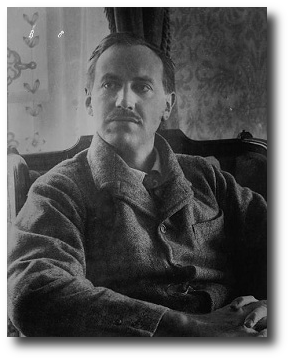
Edward John Moreton Drax Plunkett, 18th Baron of Dunsany. Artwork : This photo is in the public domain.
All along the farmyard gables the swallows sat a-row, twittering uneasily to one another, telling of many things, but thinking only of Summer and the South, for Autumn was afoot and the North wind waiting.
And suddenly one day they were all quite gone. And everyone spoke of the swallows and the South.
“I think I shall go South myself next year,” said a hen.
And the year wore on and the swallows came again, and the year wore on and they sat again on the gables, and all the poultry discussed the departure of the hen.
And very early one morning, the wind being from the North, the swallows all soared suddenly and felt the wind in their wings; and a strength came upon them and a strange old knowledge and a more than human faith, and flying high they left the smoke of our cities and small remembered eaves, and saw at last the huge and homeless sea, and steering by grey sea-currents went southward with the wind. And going South they went by glittering fog-banks and saw old islands lifting their heads above them; they saw the slow quests of the wandering ships, and divers seeking pearls, and lands at war, till there came in view the mountains that they sought and the sight of the peaks they knew; and they descended into an austral valley, and saw Summer sometimes sleeping and sometimes singing song.
“I think the wind is about right,” said the hen; and she spread her wings and ran out of the poultry-yard. And she ran fluttering out on to the road and some way down it until she came to a garden.
At evening she came back panting.
And in the poultry-yard she told the poultry how she had gone South as far as the high road, and saw the great world’s traffic going by, and came to lands where the potato grew, and saw the stubble upon which men live, and at the end of the road had found a garden, and there were roses in it — beautiful roses! — and the gardener himself was there with his braces on.
“How extremely interesting,” the poultry said, “and what a really beautiful description!”
And the Winter wore away, and the bitter months went by, and the Spring of the year appeared, and the swallows came again.
“We have been to the South,” they said, “and the valleys beyond the sea.”
But the poultry would not agree that there was a sea in the South: “You should hear our hen,” they said.
All along the farmyard gables the swallows sat a-row, twittering uneasily to one another, telling of many things, but thinking only of Summer and the South, for Autumn was afoot and the North wind waiting.
And suddenly one day they were all quite gone. And everyone spoke of the swallows and the South.
“I think I shall go South myself next year,” said a hen.
And the year wore on and the swallows came again, and the year wore on and they sat again on the gables, and all the poultry discussed the departure of the hen.
And very early one morning, the wind being from the North, the swallows all soared suddenly and felt the wind in their wings; and a strength came upon them and a strange old knowledge and a more than human faith, and flying high they left the smoke of our cities and small remembered eaves, and saw at last the huge and homeless sea, and steering by grey sea-currents went southward with the wind. And going South they went by glittering fog-banks and saw old islands lifting their heads above them; they saw the slow quests of the wandering ships, and divers seeking pearls, and lands at war, till there came in view the mountains that they sought and the sight of the peaks they knew; and they descended into an austral valley, and saw Summer sometimes sleeping and sometimes singing song.
“I think the wind is about right,” said the hen; and she spread her wings and ran out of the poultry-yard. And she ran fluttering out on to the road and some way down it until she came to a garden.
At evening she came back panting.
And in the poultry-yard she told the poultry how she had gone South as far as the high road, and saw the great world’s traffic going by, and came to lands where the potato grew, and saw the stubble upon which men live, and at the end of the road had found a garden, and there were roses in it — beautiful roses! — and the gardener himself was there with his braces on.
“How extremely interesting,” the poultry said, “and what a really beautiful description!”
And the Winter wore away, and the bitter months went by, and the Spring of the year appeared, and the swallows came again.
“We have been to the South,” they said, “and the valleys beyond the sea.”
But the poultry would not agree that there was a sea in the South: “You should hear our hen,” they said.
Ed listened to the six o’clock news on the booking officer’s small radio. The reporter described him as remorseless, a cold-hearted murderer. He slumped in the hard plastic chair, cuffs pinching his wrists.
According to the reporter, Ed’s twenty acres was a killing field containing “massive piles of dog carcasses and bones clearly visible from the air.” She described from her helicopter scorched patches in the dirt yard and obvious mass burial sites. She made his property sound like a war zone.
For thirty-five years he bred hunting dogs and disposed of retired greyhounds. For twenty dollars a dog Ed saved an industry millions of dollars a year, maybe billions. This was illegal?
The reporter ended her segment by calling Ed a ghoul awaiting justice, “a warning to those who sought to profit or benefit from the abuse of any animal.”
“It’s just a business,” he mumbled to the booking officer.
“No one wants to see it, Ed,” Tappert replied. “The ones that aren’t adopted at the shelter are gassed and cremated. No one sees that. Their bodies don’t make the news.”
Ed said to the booking officer, “This morning I fed the six I got yesterday, let them race around the kennels. What else’ve they got?” He lifted his cuffed hands. “Can these come off?”
“Regulations, Ed.”
What he did was no secret. People always looked the other way, pretended he wasn’t doing it. They wouldn’t adopt them, wouldn’t fund the “rest home” proposed by the shelter and the dog track.
He did for the dogs what he could. They didn’t look at him any different when he fed them than when they saw him with a gun. Greyhounds are like that.
None of the breeders had come to his defense yet. He’d been here for five hours, breathing in the manufactured cool air in the booking room, the funky foot odors in the holding cell, and whatever waited to assault his lungs in lock up.
“Can I make another call? Randy may be home now.”
“You think he’s going to put himself on the line for you?”
Ed nodded, “We’ve been friends for years. He’s helped me out with them dogs more than once.”
Officer Tappert leaned back in his squeaky chair. “Ed, Randy has the most popular veterinary business in this town and the next. He’s not going to risk that for you and wouldn’t appreciate you implicating him in front of an officer of the law. If you want to think about that for a moment, I’ll forget I heard you say it.”
Ed clamped his mouth shut.
Randy raised greyhounds. He was a successful breeder and adopted retired dogs right out of his office. He understood Ed’s business because he cared about the dogs.
That reporter and all the others like her were phonies. They spoke up when they had a cause that was easy to get behind, or popular. They didn’t get behind the hard work. Self-righteous and cowardly.
He tried to take a deep breath. “I can’t breathe in here. Don’t you have a yard or something for prisoners?”
The officer laughed. “No. This ain’t a movie, and you aren’t in prison. This is a county jail.”
“I let the dogs run. That’s what they do. Run real fast for a short time, then lay around like lazy cats all day.”
“Sounds good to me.”
This boy in his uniform with his gun strapped to him and a badge on his chest didn’t understand. Not everything kind always has a light shining on it. Sometimes it’s dark and unpleasant. Ed was sure the boy, that reporter and everyone else still believed kindness had to feel good. They were too wrapped up in their own sensibilities to see the truth in what Ed had to do for the dogs.
He had five large runs back of his house. He cut away a tunnel of trees between the runs and the bay, so that the breeze off the bay would funnel through the trees right onto the dogs.
They got out four times a day to do their business and twice to run. They had a clear three acre pasture to themselves. The dogs would race each other in great circles around the field, then roll in the grass. Stretched out on their backs in the sun, they gave off happiness.
He’d keep them for two weeks, just like the shelter. If no one called with a home lined up, he’d shoot the group. He’d burn them in a sheltered field on the other side of the property separated from his house and the runs by an acre of trees. He kept the death smell of the killing field far from the dogs. They died one at a time with his hand on their haunches and the gun at the back of their head..
He was careful about the dogs’ happiness in their last days. They deserved a pleasant retirement and he gave it to them. There was always a new batch of dogs right behind them.
“Can I get some water?” Ed asked the officer still immersed in punching stuff about Ed into his computer.
“Just a minute. Sandy’ll be back in and I’ll get her to escort you to the cooler.”
“I can find it myself.”
“Sit down, Ed. You can’t go unescorted.”
“More rules?”
“Life’s full of them.”
Lots of rules, yes. Few made much sense to Ed. Don’t steal. Don’t murder. Be kind. Be honest. These were all the rules we needed. Most of the rest were just people trying to make sure those dumber than themselves understood how these rules worked in different situations. Made things more complicated.
Sandy escorted Ed to the water cooler in the hall. She walked behind him with her hand on his shoulder. “Sorry about the cuffs, Ed. He could take them off. Nobody’d say anything. We know you aren’t dangerous.”
Submissions lorem ipsum dolor sit amet consectetur. At dignissim neque amet proin sodales vulputate dolor elit. At dignissim neque amet proin sodales vulputate dolor elit.