Issue March 2011 Flash Fiction Online March 2011

Cutting Down

February 2015

Punch, September 23, 1914

“Everybody’s doing it,” I said, “so as to have more for the Funds. Also for other reasons. The only question is what?”

“Well,” said Ursula, “let’s make a beginning.” She produced a silver pencil and some celluloid tablets that are supposed to look like ivory. “What first?” she asked, frowning.

I reflected. “Clearly the superfluities ought to go first. What about my sacrificing sugar-cakes for afternoon tea? And burnt almonds?”

“M’yes,” said Ursula. “I was thinking myself about giving up cigars.”

“Heroine! But let us be temperate even in denial.”

“As a matter of fact,” she said, “I’m getting to detest almonds.”

“And I simply loathe — I mean, I’m sure pipes are ever so much better for one than cigars.”

“Good!” observed Ursula. “Cigars and almonds go out. Only if you have your pipe there ought to be some cheap and filling substitute for my almonds.”

“Turkish delight,”I suggested, “supposing it turns out all right about the Goeben.”

“And, if not, I could get along with Russian toffee. That settles tea. How about other meals?”

“We’re at the end of that Hock.”

“I’m glad of it,”said Ursula. “Nasty German rubbish. I wonder it didn’t contaminate the cellar. Now we must drink something patriotic instead.”

“What about good old English water?”

“My dear! With all those spies simply picnicing round the reservoirs! Goodness knows what they’ve put in. My idea was a nice, not too-expensive, champagne, like what they get for the subscription dances.”

“Dearest! Ask me to go out into the road and sing the Marseillaise. Ask almost anything of me to display my pride and affection for our brave allies, but do not, do not ask me to drink sweet champagne at lunch!”

“You shall choose it yourself,” said Ursula, “and it isn’t for lunch, but dinner. At lunch you will continue to drink beer. Only it will be English, not German.”

“Glorious beer! C’est magnifique!”

“Mais ce n’est pas lager!” said Ursula quickly.

This was rightly held to constitute one trick to her, and we resumed.

“About clothes,” I said.

“There was an article I read in some paper,” observed Ursula, “pointing out that if everybody did without them no one would mind.”

“Still, even in war time — — ”

“Of course I meant new clothes and fashionable things.”

“An alluring prospect!” I agreed wistfully. “Fancy reading in the frock-papers that ‘Ursula, Mrs. Brown, looked charming in a creation of sacking made Princess fashion, the chic effect being heightened by a bold use of the original trade-mark, which now formed a striking décor for the corsage.’”

Ursula did not smile. “No man can be amusing about clothes except by accident,” she said coldly. “The article went on to advise that if new things were bought they should be specially good. It called this the truest economy in the long run.”

When Ursula had sketched out a comprehensive wardrobe on truest economy lines, and I had mentally reviewed my pet shades in autumn suitings, there was a pause.

“What about the green-house?” I asked suddenly. “Do we need a fire there all winter just that John may swagger about his chrysanths?”

John, I should explain, is the gardener who jobs for us at seven-and-six weekly, and “chrysanths” is a perfectly beastly word that we have contracted from him. In summer John mows the lawn (fortissimo at 6.30 A.M.) and neglects to weed the strawberries. In winter he attends to what auctioneers would call the “commodious glass.”

“M’yes,” said Ursula reflectively. “But what about John himself?”

“My dear girl, surely it is obvious by the simplest political science — — ”

“Sweetheart!” interposed Ursula anxiously, “John isn’t going to have anything to do with the Moratorium or hoarding gold, is he? Because, do remember how cross you got trying to explain that!”

“I remember nothing of the sort!”

“And, anyhow,” she continued, “now we’re saving in so many other things, I intend to pay John an extra half-crown, in case food goes up.”

There was obviously only one thing to do, and I did it. I retired in fair order, abandoning to Ursula the task of preparing the schedule of our domestic retrenchment. At lunch she produced it.

“The bother is,” she observed, “that what with truest economy clothes and champagne, and John, and some other things, it seems to work out at about two pounds a week more than we spend now.”

“That,” I said cuttingly, “is at least a beginning!”

However, since then I have discovered an article in another paper denouncing panic economies as unpatriotic. So we shall probably return to the old régime, plus John’s half-crown. Even with this, it will mean a distinct saving of thirty-seven-and-six on Ursula’s proposals. It is not often that one gets a chance of serving one’s country on such easy terms.

Leave a Reply

The Whole of the Brush

by T.D. Edge

February 2015

I found Uncle Jim in his workshop at the end of his garden.“You’ll have to talk while I work,” he said... “The Church needs this tomorrow, for the new Vicar.” Artwork by Melanie Tata, coming to us via and used under a Creative Commons license.

“Hello, Paul,” he said, “what’s the problem this time?”

I blushed at this but he was smiling so I sat on a three-legged stool next to his bench and said, “Julie wants a divorce.”

“You’ll have to talk while I work,” he said, nodding at the white-painted board perched on the easel before him. “The Church needs this tomorrow, for the new Vicar.”

“She thinks I’ve been having an affair.”

Uncle Jim pulled a length of string out from a ball, wrapping the end around the little finger of his right hand. “Have you?” he said, tightening the string then rubbing blue chalk along its length.

My stomach churned. “It was only once,” I said. “Last February, when I was in London with the firm and we had a bit too much to drink, and well, there was this girl…”

Uncle Jim cut off the string and wrapped it around his other hand. He pushed his little finger against one end of the board, near the top, then rested the knuckles of his other hand on it, finally plucking the string with his free thumb. He took away the string and a perfect, straight line of blue chalk dust remained on the board. Then he repeated the process to make another line about six inches below the first.

“The trouble with you, Paul,” he said, putting down the string and picking up the chalk, “is that you do everything so tentatively.”

“What do you mean?”

With the chalk, he lightly sketched the words St Michael’s Church in between the lines. Then he poured black paint into a cup which he balanced on the easel.

“Well, you married Julie because you thought it was what everyone else wanted, especially your father. Then you had a couple of kids because it was the thing to do.”

“Jesus…”

With his left hand, he picked up a short stick with a bulbous end, and with his other selected a brush from the box beside him.

“Then you decide to sort of have an affair. Except you let the booze make up your mind for you. Now, you want me to decide how to handle Julie.”

“But I apologized; told her how much I regretted it. I mean, it’ll never happen again.”

“Oh, it’ll happen again. Because you never do anything definitely. You just take baby steps with everything you do.”

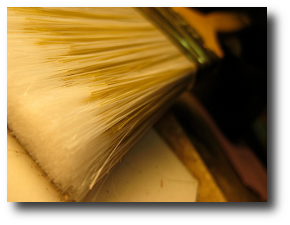
He dipped the brush into the pot then leaned the end of the stick against the board. He rested his brush hand on the stick and with one smooth, confident motion of the brush started by using its edge to make the serif at the top of the ‘S’, then brought his wrist around, gradually flattening the whole of the brush so now its edges perfectly formed the two sides of the letter, finally ending with a narrowed edge again for the bottom serif.

“Are you saying I should just agree to the divorce?”

He moved the stick slightly to the right and in just a couple of fluid seconds, finished the small ‘t’ in St. Michael’s.

“No, I’m saying you should either love Julie fully with all the simple devotion that means. Or get the hell out — tell her you don’t love her; never did — and go live dangerously. Screw lots of women and don’t give a damn.”

I sighed. “I can’t believe it only took you twenty seconds to do those two letters.”

He turned to face me. “Actually, Paul, it took me fifty years.”

Leave a Reply

Ring Worlds

by Peter Fisk

February 2015

“Oh, a barter? My pocket watch for this — ring?” Artwork : An artist’s impression of the supernova 1987A, based on data from the European Southern Observatory. Brought to us via and used under a Creative Commons license.Sir Charles Wilton had just poured himself a glass of brandy and flipped open a book he’d been looking forward to reading, when a sudden whooshing sound made him look up in time to witness a demon materializing in the library.

For a moment Sir Charles considered running out of the house and then down the road to the church to fetch Father Berlioz — but he soon dismissed the idea. His familiarity with otherworldly creatures such as demons was poor indeed, but he realized that the demon might very well take offence at a priest bursting in, waving a crucifix in its face. Under no circumstances would he have his home turned into a battlefield between the forces of light and darkness.

So instead he cleared his throat and simply said: “Good afternoon!”

The demon aimed two pairs of eye-stalks in his general direction, studied him with an inscrutable expression in its hideous face and took two long strides towards him. A scale-covered hand latched out and made threatening movements in the air.

“Is there anything I can get you?” Sir Charles asked, putting his glass of brandy down with a trembling hand.

The demon took another stride forward, carrying with it a smell of rotting fish. It pointed a claw-like finger at his chest.

Sir Charles shielded his heart with his hand, felt cool metal press against the palm of his hand and sighed with relief.

“Oh, is it this you want?” he said, holding out the heavy pocket watch in gold he’d left hanging out of his vest pocket.

The demon let out a muffled gargle.

“I take that as a yes.”

Sir Charles unhooked the watch from the pocket lining and the demon instantly snatched it from his outstretched hand and quickly stuffed it into a pouch of some kind that seemed to grow from its trunk. Then it reached out with its hand again.

“You want something more?”

But already as he spoke Sir Charles realized that he’d misunderstood the gesture. The demon meant in fact to give him something.

“Oh, a barter? My pocket watch for this — ring?”

Sir Charles took the small, pale green ring from the demon’s outstretched hand. It felt strange to the touch, as if coated with something that wouldn’t allow his skin to come in contact with the metal. He also noted that it had some small knots on it, which on closer examination turned out to be eight tiny gearwheels.

A sudden rush of air made him look up, only to discover that the demon had vanished, as abruptly as it had appeared.

He let out another sigh of relief. Admittedly, the demon had behaved in quite a civilized manner, but he was still happy to see it go. Now he could focus his attention on examining the strange ring. After twisting and turning it for a while, he decided to simply put it on. It appeared to be too narrow at first, but to his surprise the gentle pressure of his finger made the ring widen until he could slide it on quite easily. He was equally surprised to discover that the finger had vanished in thin air.

He jerked the ring off, and the finger reappeared instantly.

“Ah, I see.”

In exchange for his watch the demon had given him a ring with the power to make its wearer invisible — or more precisely, to make the wearer’s ring finger invisible, a limitation that probably had a somewhat inhibiting effect on the number of possible uses.

“Unless — ”

He held the ring between his thumbs and index fingers and started pulling it gently. It widened smoothly. Soon he’d made an aperture twenty-five centimeters across. Taking a deep breath he stuck his head through the ring.

At once he realized he’d altogether misapprehended the nature of the ring. Before him stretched an endless plain, covered with high, red grass that swayed in a calm breeze. A huge, orange-coloured sun balanced on the horizon, and three small, silver-white moons chased each other across a purple sky where alien stars glowed. There was a faint smell of cinnamon in the air.

He raised the ring and there was his library again, with its familiar scents. His hands were shaking with excitement as he widened the ring even more, making it big enough to allow his shoulders to pass through it. He took another deep breath, held the ring over his head and carefully brought it down all the way to his knees. He climbed out of it and felt the soft grass under his feet.

Straightening his back he clutched the ring firmly to his chest, suddenly afraid that it might just disappear, like something out of a dream. He felt the small gear-wheels under his fingers and turned them slowly, thoughtfully as he gazed across the billowing plain, contemplating the implications and the seemingly endless possibilities.

A sudden, irresistible desire for a cup of steaming hot tea compelled him to climb into the ring again. But as he raised it he found himself standing on a shore of blue sand by a sluggish, black sea. The air was thin and harsh to breathe. A strange, almond-shaped vessel, gleaming like gold, cut across the cobalt-blue sky.

He put his ear close to the ring, turned a gear-wheel a notch and heard the faint, ominous click. A cold hand squeezed his heart. He got down on his knees and began drawing numbers in the sand. When he was finished he stood up and stared in dismay at the calculation.

Eight wheels and twelve possible positions for each meant four-hundred and twenty-nine million nine-hundred and eighty-one thousand six-hundred and ninety-six possible combinations.

Since he’d traded his watch for the ring he couldn’t tell the exact time, but he had a strong suspicion he’d be late for his afternoon tea.

Leave a Reply

Naming the Baby: Titles (Part II of II)

This is the third column in Bruce Holland Rogers’s new writing series, Technically Speaking. The first column, and the entirety of his Short-Short Sighted columns (dedicated to writing very short fiction), visit his author page.

In part one of this article, Bruce explained some theory and then wrote: The title pulls the reader in. Then the story delivers on the title. This column goes from theory to practice.

Enough theory. What a writer lacking a title can really use is some Things to Try. Here are a few.

1. Look at your bookshelf. What are the patterns of the titles you see there? From where I’m writing this, I can see The Road to Gandolfo; Nip, Tuck, Dead; Shore Leave; The Dark Queen; Before Women Had Wings; Picturing the Wreck; Charity Ends At Home and Six to Break Even. Applying these patterns to a story that I’m writing about a perfumer named Olivia, I come up with these titles: The Formulary for Hollywood; Spritz, Sniff, Punch; Sniff Test; The Blood Perfume; Before Olivia Was Somebody; Punching the Diva; Celebrity Breeds Contempt and… Well, I can’t come up for anything at all for that last one. Not every pattern will be useful, and the pattern itself probably won’t survive this brainstorming process. But the patterns force my hand, make me think of words I wouldn’t otherwise consider. I like the word formulary. I like the dramatic action of punch. Some of these titles are giving away more of the story or theme than I want to telegraph. My favorite is “The Blood Perfume,” which is an unexpected combination that refers to something in the story and perhaps provides a nice parallel to the idea of blood money. That fits the action of the story. I would take out the article: “Blood Perfume.”

2. Scour poetic texts, starting with poems but also considering the plays of Shakespeare, books of the Bible or other scripture, the text of well-known speeches. In each of these, the language is compressed and full of symbol, metaphor, and simile. If the text is well-known, then you might use it to obliquely title your story. For example, Sylvia Plath’s poem, “Metaphors,” is a widely reprinted poem about pregnancy. Ray Vukcevich and I were looking for a title for our collaborative story about pregnancy, and we turned to this poem for ideas. The most obvious metaphor, which we also liked, was “A Riddle in Nine Syllables,” but we searched for other uses of this title and found that three story writers had already used it. There’s no copyright on titles. We could have given our story the same name. But we turned to another line of the poem and called our story “The Train There’s No Getting Off.”

Some well-known poems have been raided many times for titles. Andrew Marvell’s 17th-century poem “To His Coy Mistress” has yielded World Enough and Time, “Vaster Than Empires and More Slow,” “Our Vegetable Love,” “Time’s Winged Chariot,” and A Fine and Private Place, with variations such as World Enough and Space-time, Worlds Enough and Time, “Vegetable Love,” and Fine and Private Place. Every time I re-read the poem, I see promising phrases that are begging for the right story: “Deserts of Eternity,” “Till the Conversion of the Jews,” “Thy Marble Vault,” “Amorous Birds of Prey,” “The Iron Gates of Life,” “Yet We Will Make Him Run.”

When I use a well-known poem, one that appears in most university survey textbooks, for example, I expect many readers to recognize the poem that I’m borrowing from and to think of my title in relation to the poem. However, I also look for titles in the lines of contemporary poets. Few readers will know these sources, so I can’t count on anyone making a connection. In such cases, I choose a phrase from the poem because the image or language are arresting and suit the story. My story title “These Shoes Strangers Have Died Of” is borrowed from Galway Kinnell’s The Book of Nightmares, one of the better-known poetry books of the last half century, but still not likely to be recognized. Sadly.

3. Search the story for a title you wrote down without knowing it. Is there a line of dialog that sums up the central concern of the story? Is there a central metaphor in the story? These things make good titles, especially if the utterance or metaphor is something you want to call the reader’s attention to.

4. Consider the main situation or problem of the story. Can you come up with an oxymoron or some other image that suggests some sort of appropriate conflict or contradiction? Here’s one off the top of my head: “Barefoot in Ski Boots.” There’s a contrast between a foot that is bare and vulnerable and a foot in the stiffest, most armored footwear most of us will ever try on, but in addition to the contrast, there is the apparent impossibility of both at once. This title is intriguing, and if it will seem meaningful or symbolic after reading the story, it will seem apt. (But readers had better be able to figure out why this is an apt symbol!)

5. Play with familiar phrases by substituting with one surprising word. You Only Live Twice, A Hearse of a Different Color, Give Me Liberty or Give Me Monticello.

6. If the story is about one central character and that character has an interesting name, the character’s name may be all the title you need. But if the name alone isn’t enough, consider adding an attribute, as in The Talented Mr. Ripley. If the story’s setting has an interesting name, and if the setting is central to the story, then you might name the story with the setting, or at least including the setting. Cold Mountain, “An Occurrence at Owl Creek Bridge,” Out of Africa. One of these days, I want to write a story set in Rifle Gap just so I can use the name as a title.

7. Try the sound effects of poetry such as alliteration, assonance or rhyme. I see rhymes often in song titles: “Bring Your Daughter to the Slaughter,” “Advance Romance,” “I Can’t Drive Fifty-five.” Sleepless in Seattle alliterates.

8. Consider whether the title can contribute something to the structure of the story. For instance, there are some poems that have lead-in titles where the title is treated as the first words of the poem. A story called “The First Commandment” could begin “…was the only commandment that Clarence failed to keep. He had no trouble honoring his parents, shunning false idols, or keeping the sabbath holy. But he had spent his whole life so far killing, and he didn’t see how he could stop now, even though he knew he should.”

But the title can also provide all sorts of symmetry with the ending of a story. For example, my story “The Dead Boy at Your Window” is written almost entirely in the third person. The story only refers to you in the title and in the very last line. Putting you in the title helps me to prepare the reader for that intimate shift in the last line. If you want something tricky to happen in the last line of the story, perhaps you can prepare the reader for this in the title.

9. Steal a title. If your story deals with the same thematic material as a famous story, or if your story is in some way an argument against that other story, consider appropriating the title. There is no copyright on titles. If you call a story or a novel The Dead, a great many readers will be thinking of the James Joyce story of the same title when they read your work. Of course, you are inviting an unflattering comparison if your story isn’t up to the comparison. And if you lift a title that is more idiosyncratic, such as The Last Picture Show, many readers will think you’re unimaginative or a copycat or a cheat. Stealing a title, or even using one by mistake when someone else has already attached it to a different work, certainly has drawbacks. But there may be stories for which it’s the right move.

10. Perhaps all you need is the right word. One-word titles will work well if they name a topic that is both central to the story and suggests strong emotion or drama. My students have recently published stories called “Jitters” (Kim Lundstrom) and “Buccaneers” (Stefanie Freele).

11. Finally, get into the habit of just noticing good titles and considering why they make you want to read further. Sometimes you won’t be able to say why a title is good, but just appreciating good titles will make you better at coming up with your own. David Wagoner’s poems are nearly always brilliant: “My Mother’s Nightmare,” “Disorderly Conduct,” “The Stone Dreamer,” “The Shooting of John Dillinger Outside the Biograph Theater, July 22, 1934.” That last one is a good example of a title that is arresting for being so long. Usually, short titles are best, but a longer title can be memorable or amusing simply because it is so long. The poet James Wright made such titles one of his signatures, is in the well-known “Lying in a Hammock at William Duffy’s Farm in Pine Island, Minnesota.” Such titles aren’t limited to poetry. “How I Contemplated the World from the Detroit House of Correction and Began My Life Over Again” is a Joyce Carol Oates story, and I love the title of a movie I have never seen: Oh Dad, Poor Dad, Mama’s Hung You in the Closet and I’m Feeling So Sad. Don’t you want to know what that’s about? And the meter and rhyme help to make the title memorable so you can pass it on to your friends even at fifteen words.

That last consideration — whether readers can remember and say your title to others — should be a filter through which all prospective titles must pass. Are there any words in the title that readers won’t know how to pronounce? If so, then even if they read a positive review of the book, how will they remember a title they can’t say? How will they ask for it in the book store?

It’s useful, too, to think about how memory works. Sounds help us to remember, and so does image. The concrete is better than the abstract. You’d think that a phrase in common usage would be easy to remember as a title, but I know moviegoers who have seen Something’s Gotta Give, As Good As It Gets, and Nothing In Common, along with similarly named films, and have trouble matching the title to the movie. Familiar though these phrases may be, the abstractions don’t provide much glue for sticking the title to the remembered scenes. It’s much easier to attach a nice concrete title such as Steel Magnolias to remembered characters or scenes.

Hollywood usually gets titles right, and even titles on various “worst movie title” lists are actually pretty good. But even Hollywood gets it wrong now and then, and so will you. At the very least, every writer should be able to come up with better titles than the first one that came to mind, and every once in a while, we can hope to come up with a title that will be on everyone’s lips.

Leave a Reply

Deconstructing the Nihilist

by Iris Macor

February 2015

I asked Evan once what he believed. He paused, scissors in one hand, photograph in the other.

“Everything,” he said. He touched his tongue to his lip, all his focus flowing to a point, and he snipped a near-perfect circle out of the picture.

“What did you do that for?” The picture had been taken by my father when we all went skiing two months before. He’d told me that Evan seemed like a real put-together sort of guy.

“It wasn’t quite right.” He handed it to me with an unapologetic shrug.

I tucked the picture into my purse, to put with the others when I got home.

I met him a year ago in Palo Alto. Clean shaven with a he’s-had-work-done smile. He always wore a three piece suit and carried a briefcase, even though it was mostly empty. I bumped into him on the sidewalk when I was taking a picture of my apartment to send home to my folks.

He told me I was almost perfect. The first time he said it, I blushed, hid my face behind my hands. He pulled them away and kissed me. I was sold.

The second time he said it, we were in his bed, his arms around me, finger tracing a scar on the small of my back. Emphasis on almost.

For most of our relationship, he remained an enigma. I’d ask him about his past; all he’d tell me was that he was born in Detroit, where things were ugly. I’d ask him about his goals and he’d tell me he meant to find the best there is, but he wouldn’t elaborate. I’d ask him his plans for tomorrow and he’d shrug and ask my point. I would give up and trudge back downstairs to my cluttered, chaotic apartment. I’d be alone there. He never came in.

I looked through the pictures. Evan in his swimming trunks, shirtless body tanned to perfection. Faceless. Evan at the foot of a redwood, trunk and trunk. Evan at a party in his three piece suit, drink in hand and no mouth. Evan in his bed, just an outline beneath the sheets. Always an excuse — there was something on his nose, his eyes were crossed, his smile was on crooked.

I asked him once what everything meant. He had that air about him, like he might actually know.

“Why don’t you tell me?” he’d said.

“To me, or you?”

He stared into my left eye, and I knew what he was looking at. A discolored spot where the pigment couldn’t decide if it wanted to be blue or hazel. A tiny circle, no bigger than a pencil tip. He’d said he had to go, swinging his briefcase as he walked down the hall. He didn’t have a job, just the look of a man with one. The only place he had to be was nowhere.

I slipped a note under his door to tell him we were through. When I woke the next morning there was a picture on my welcome mat. Two bodies, no faces.

I’ve been thinking a lot about what everything means to me.

Leave a Reply

On the March

February 2015

This month we’re a little more mainstream than usual.

Our first story, “Deconstructing The Nihilist” struck me as interesting because of the development of the narrator, who is essentially seeing the lack of development in her lover. His assessment of her becomes more disconcerting over time, and the not-with-a-bang-but-a-whimper result seems just right for this story.

I enjoyed our second story, “Ring Worlds” by Peter Fisk, for a variety of reasons: the detached British attitude of the protagonist (the author himself is Swedish), the dry humor, and the multiple misdirections contained in a mere 1,000 words. This is definitely not a mainstream story.

I confess to liking any story that combines blunt relationships and skillful typography, but that’s not the only reason I liked our third story. “The Whole Of The Brush,” by T D Edge, is a good example of a simple story that’s still very solid. One of the things that made it interesting for me was the choice of perspective: The narrator is essentially being told why he’s weak. And clearly he is weak; I find myself not liking him. Hearing this in his voice feels a little like talking to a friend that you want to smack upside the head and say, “Are you listening to yourself? Are you listening to your uncle?” The ending, though abrupt, is at the right place. This story wasn’t one of my favorites at first, but it grew on me quite a bit.

I felt we needed a little humor, so I included a Classic Flash from Punch called “Cutting Down”. And honestly, it somehow seemed appropriate during a month in which President Obama started a third war in the Arab world, continue to live through the so-called Great Recession, and yet still have signs of excess all around us.

Bruce Holland Rogers continues his Technically Speaking column with the second installment of “Naming The Baby,” which is, as you might guess, about titles.

April will be a bit foolish, as is our wont; although we’re publishing stories later in the month these days, we’ll still keep the foolishness coming.

Thanks for joining us! We’ll see you in April!


Leave a Reply

Join the 
Community

Support

Support lorem ipsum dolor sit amet consectetur. At dignissim neque amet proin sodales vulputate dolor elit ipsum dolor sit amet.

Subscribe

Subscribe lorem ipsum dolor sit amet consectetur. At dignissim neque amet proin sodales vulputate dolor elit.

Submit a Story

Submissions lorem ipsum dolor sit amet consectetur. At dignissim neque amet proin sodales vulputate dolor elit. At dignissim neque amet proin sodales vulputate dolor elit.