Mother’s Day is a celebration of mothers, motherhood, and the profound influence women have on shaping the world of the future. The holiday is observed in over 40 nations worldwide, with well over three-quarters of those nations celebrating in the month of May.
When I was a child, Mother’s Day was an affair rife with flowers and a simple dinner (not always made by Dad), so we could pack up in the Chevy Suburban after church for an hour-long drive to visit my only surviving grandparent–my mother’s mother–because that’s where my mother wanted to be.
This photo was probably taken on one of those early Mother’s Day excursions.
That’s my mom, standing on the left. Her sister is standing beside her. The seated woman on the right is my grandmother; the other is her mother. That chubby baby in my great grandmother’s arms is my oldest brother. I was still 11 years away from being born–the youngest of six.
Now, as a mother myself, my Mother’s Day is spent at home with my husband and children–because that’s where I want to be.
So, Mothers, wherever you go or whatever you choose to do this Mother’s Day, we hope you have a lovely day–and we hope someone else will cook dinner for you.
In honor of mothers, this month’s issue is packed with powerful motherhood.
And, a special treat that isn’t necessarily about mother’s but involves a wonderfully talented mother, “Sparrows,” by Gary Chandler, with gorgeous artwork by his mother, Lura Schwarz Smith.Also enjoy an essay by Gary–a lovely tribute to his family.
Finally this month, a recycled story from our FFO staffer, Stewart C. Baker.Originally published in Nature Physics, September 2015, “Love and Relativity” is an achingly beautiful story of love and loss and motherhood.
The psychiatrist assigned by Headquarters suggested I start a diary to help me cope with your ship’s disappearance.Instead, I’m going to write you a bibliography.
I won’t write every day, and maybe you’ll never read this anyway, but it helps to think that someday I’ll be able to show you what I’ve written here.To think that somehow, someday, we will bring you home.
Can’t write any more today.
I miss you.I love you.
Indira
* * *
Source: Special Relativity, The Universe, and You (New Beginnings Press: London, 2028)
Date Read: December 3, 2036
Summary:Time is not an absolute, but depends on your location in the “hypersurface of the present”–a map of all physical space.The speed of visible light limits observations to events already past, so the past is all there is.
Notes: While reading, I discovered I was pregnant.It’s strange to think that once she’s born, I’ll only ever be able to see what she was–even if it’s only a few nanoseconds difference.I wonder if someone is inside you, can you still connect at the speed of “now”?
Ravi from mission control keeps calling, but they are no closer to learning what became of your ship.
Be safe.I love you.
Indira
* * *
Source: Finding Life Elsewhere: An Introduction to the Fermi Paradox (New Beginnings Press: London, 2017)
Date Read: June 21, 2037
Summary: The Fermi Paradox questions the apparent lack of extra-terrestrial life.Explanations range from the pessimistic (there is no extra-terrestrial life) to the fanciful (we are a world-sized zoo kept for alien amusement).Realistic possibilities include technological limitations and delays caused by the speed of light.Even if someone is trying to reach us, we may never be able to see it.
Notes: If it is so hard to find an entire civilization, how can we hope to find a single experimental ship, adrift in interstellar space?How can I ever find you, how can I help bring you home?
I am choking.I am drowning.I can barely breathe.
Ravi tells me I should stop worrying so much and wait for them to bring you home, but he is not the one who has lost a husband.He is not the one who is alone.
Our daughter kicks and turns inside me.Please, please, come home.
Indira
* * *
Source: Is There Anyone Out There? Qubit-Enabled Sky Searching in Your Back Yard (Disruptive Technologies, Inc.: Mountain View, CA, 2039)
Date Read: August 3, 2039
Summary: Describes a method for building a simple quantum computer and software to use in finding astronomical anomalies.I took out a loan against our house and built an array of antennae in our garden where the mandara tree we planted once stood.
Notes: Chandri turned two yesterday.She runs and giggles through the garden, knocking over the antennae, and bursts into tears when I shout at her.She loves the way the quantum computer clicks and squeals through its analysis of long-vanished stars.Do’phin! she laughs, over and over.Do’phin!
For a moment, I dared to dream that I would see you again.But Ravi now says the ship never jumped through space at all.
In time?I ask.
No, Ravi says.The ship stayed where and when it was.Or, rather, it jumped to another set of “wheres” and “whens” altogether.We will never find a trace of Adhi here in our own universe.
He says there is still hope.That they are developing a new understanding of the multiverse from data they received in the moments before the jump.He says they will send someone else one day when they are ready.You will come home then, perhaps.
I cannot do this any longer.
I love you, Adhi.Goodbye.
Indira
* * *
Source: Saptapadi
Date Read: June 1, 2050
Excerpt: Now let us make a vow together. We shall share love, share the same food, share our strengths, share the same tastes. We shall be of one mind; we shall observe the vows together.
Notes: It’s been over ten years since I looked at these letters, and yet today I find myself returning, pen in hand.
Tomorrow Ravi and I are getting married.He is the closest thing to a father Chandri ever knew, and still, she has not forgiven me for betraying you.She spends all her time locked up in her room, reading the research logs you left behind, writing out equation after equation.I tell her you would want her to be happy, but she does not listen.
Ravi smiles sadly whenever she shouts at him.Give her time, he tells me.It will be okay.
I’m sorry, Adhi.I hope you’ll understand.I have never stopped loving you.
Indira
* * *
Source: Towards a Working Model of Inter-Universal Transjunction (PRL Press: Ahmedabad, 2067)
Date Read: June 23, 2067
Summary: Our daughter’s dissertation.It is amazing how much she has grown.
Notes: Chandri stopped by yesterday with a mandara sapling and a copy of her book.After we had planted the tree in our garden, she told us she was certain she could follow the trail your ship left all those years ago.That she loves us both, but is determined to make the jump herself, and soon.
Ravi and I are worried, but we did not try to stop her–we both know how important this is to her.To all of us.To everyone.
I have given her these pages to pass on to you.Even though it’s been so long, there are still times I miss you so intensely it is hard to breathe.
With warmth and hopes of seeing you again,
Indira
Previously published in Nature: Physics, 2016. Reprinted here by permission of the author.
“Love and Relativity” by Stewart C Baker is a story that is
made up of multiple small letters written by Indira (an expecting mother to the
daughter we will know as Chandri) to Adhi (the father, and space
explorer) and there is Ravi the step farther. The story is based in the
near future. The family live a fairly average
life in India except that Adhi is lost in space. Trying not to lose hope Indira
begins to write what she calls a biography for Adhi for if he returns. She talks
about how their daughter is moving around inside of her. The story jumps ahead
to when Chandri is about 10 years old. At this point Indira has desided to
marry Ravi because he is the closest person to a Father to Chandri. When Indira
marries Ravi, Chandri is not happy about it because she beleves that her mother
have betrayed and given up on her father. At the end Chandri has a Plan the
follow in the father’s footsteps in hopes of finding him.
The sparrows left my chest the day I brought you home from the hospital. At first, I thought it was the crying–you were a loud, red-faced little thing–but they didn’t come back even after you quieted down. I began to miss the brush of wings against my ribs, the soft prick of little beaks and claws as they hopped around inside me. It wasn’t that the sparrows were a point of pride or anything–I’d kept them for the same reasons as the electric guitar gathering dust in my bedroom closet or that half-finished screenplay I’d always meant to get back to. Those derelict dreams held, if not hope, then at least nostalgia. I thought I wanted to keep you, too, but maybe I was wrong.
“It’s almost winter, hon,” Alec said. “Maybe they flew south?”
I told him my sparrows didn’t migrate, but he just gave the little straight-faced nod that meant he was agreeing to agree. Still, I did feel colder. It made me wonder if you’d done something to me, somehow turned the aimless roil of clouds in my chest to sleet and snow.
“They’re just birds, love,” said my mother when I called her raw-eyed and sniffling in the middle of the night. “You can’t expect them to be supportive. Babies change your life, but things will get better, you’ll see.”
They didn’t, though.
Alec’s paternity leave ran out. The firm had given me months off, so it was just you and me alone in the house for most of the day. You slept while I watched Netflix until the edges of the flatscreen lingered in my vision when I looked away. Sometimes, we went for walks, stopping at the small park at the end of Haite Street to search for movement in the barren trees–squirrels, cardinals, even great murmuring swirls of starlings. I don’t know what I expected; everyone knew sparrows only lived in people, now.
“It doesn’t mean you stop being you,” Haruka said over curry and drinks at Café Mumbai. She had two babies, children now, I suppose, and still managed to land gallery shows now and again. “Just make space for what’s important and let everything else fall away.”
It wasn’t like I hadn’t done anything with my life–Alec was wonderful, I loved my house, my friends, the hot, sweet burn of bourbon on my tongue after a long day at work. I even still got that little, fluttery thrill every time I marched into a courtroom, brief in hand. How much was me and how much was just filling time?
I went home and reread my screenplay. It was terrible. You seemed to enjoy the guitar, though. The chords were more than a little blurry and I couldn’t hit the high notes, but “Changes” made you smile for the first time. We laid down on the couch after that, you sleeping tight against my chest, warm and soft. For some reason, I cried.
I filled all the feeders in a mute offering. I even tried swallowing some bird seed.
It rained almost every day, but I didn’t mind. I loved watching them come–goldfinches, chickadees, robins, and blue jays, bright points of color in a world of muted grays and browns. Alec bought you a fleece-lined poncho so we could sit out on the porch together. I would point out a bird, then say its name slow like I was telling a campfire story. You would laugh and babble, pressing your hands against the porch screen like you wanted to flutter out to join them. Once, I thought I saw tiny shapes flit through the trees, brown on dappled brown, but they were probably just starlings.
That night, I coughed up a nest, flecks of mud and tiny twigs clicking against my teeth as I hugged the bathroom garbage can. You started screaming in another room. I didn’t know what to do, but Alec changed your diaper, and everything quieted down.
When it was over, I tossed the garbage bag, stopping to sweep my screenplay in for good measure. It was never going to be anything, anyway. I brushed my teeth then sat in the shower for a while, head down and arms around my knees like people always do on TV when they’re sad about something. Even after I’d toweled off, water bled from the little knot holes between my ribs to leave dark spots on my bathrobe.
You were in your crib, asleep. You’d rolled onto your stomach, but when I turned you over, my fingers curled into empty space. Barely daring to breathe, I unbuttoned your onesie to see the hole that hadn’t been there before. Your chest was open, warm and soft, and inside, a little nest with three brown-flecked eggs.
She begins with the grass that runs along the border near the bottom. She’s careful, as the tea-stained linen cloth is beginning to fray from the hundreds of times she’s pulled it in and out of the canvas shopping bag where she keeps her sewing. She pulls each stitch carefully, her movements a kind of mirror to the rhythm she’s developed over the months of creating the design. One after another, the tiny x’s are removed, row by row. Row by row the meadow disappears.
“You need something to keep you busy,” the nurse said, her eyes kind and full of sympathy. Belinda didn’t want her sympathy, but she bought the kit anyway. It beat staring out the window of the hospital room, watching the same oak tree day after day, its grey-green leaves shivering in the endless wind. It beat staring at her daughter on the bed.
Beneath the stitches the cloth is clean, protected from the oil on her fingers, the worrying that worked to unravel the parts not protected by the embroidery hoop. A Beautiful Day was the name of the design, and Belinda has worked to make it so. Stitch the sunshine and it will come. Sometimes weeks went by when the bag sat still when Emmy was allowed to come home, don a baseball cap, and play in the sun of her own back yard. Then would come the pain, and the fever, and Belinda would grab the sewing bag on the way out the door to the hospital.
Next come the flowers, the scattered clumps of blue and orange with tiny yellow centers. Belinda snips the knots along the back, pulling out the petals one after another, shearing leaves from stems, then stems to nothingness. It’s a ritual, this act of undoing. Funny, she thinks, how the unmaking of a thing takes so much less time than its creation.
From the direction of the bed comes a stirring and a soft moan. Belinda looks over, still somehow expecting the thin, emaciated form to sit up and ask for ice cream, but there are only the long, deep breaths of medicated sleep. She wants with all her heart to shake her child, to wake her up and look into her eyes for each and every ticking second she has left, but becoming a mother has always meant putting someone else’s needs before your own. And what Emmy needs now is a respite, however brief. Belinda looks down and pulls out another stitch.
The grief counselor at the hospital checks in from time to time, frowning but saying nothing as she takes in Belinda’s work. “Forgive yourself,” she is fond of saying. “Forgive yourself for being angry.” But the thing inside Belinda doesn’t feel like anger; it feels like a vacuum, a great blind nothingness that threatens to swallow them both. How could she carry the power within her to weave together a human being, to knit cells and organs into a living, breathing system, and yet not have the power to stop those same cells from consuming what she’d made? She mumbles something vaguely acceptable to the grief counselor and removes another stitch.
The great tree standing upon the bright green hill comes next, first the roots, then trunk with the small knot that Emmy always thought was just the right size for a squirrel. Outside the wind scrapes branches against the glass. It’s an irritating sound, and in her annoyance, Belinda rips the threads faster until the tree outside is silent. Then go the leaves, one at a time, each separate from the others. This had been the part that had taken the longest: single, independent X’s that had to be severed and tied off individually. Weeks and weeks Belinda had spent, drawing the threads through the fabric once, twice, then cutting and tying and starting again. The unmaking is far quicker, a few minutes of shearing off the firmament of knots on the back followed by pinching off the green scraps on the front. In minutes, the tree is gone, and there is no sound outside now but the wind.
The breaths on the bed grow more shallow, and Belinda imagines Emmy as a bird, skimming the tops of trees or the crests of waves in the ocean. Weightless, only connected to the ground as an afterthought.
The last to go is the sky; a scattering of blue stitches meant to give the suggestion of an atmosphere, punctuated by small, puffy white clouds. Three birds made from black thread fly in running stitches. Last of all is the sun, a swirl of oranges and yellows surrounded by wedge-shaped rays. The winking eye and upturned mouth are the final cuts, the last pieces of thread dumped into the sanitary metal trashcan at Belinda’s feet.
On the bed, Emmy’s breaths have become so faint that it’s hard to hear them at all now. Belinda drops the empty and frayed linen cloth into the trash can and lies down next to her daughter, holding her small, cold hands in her own.
Growing up, I didn’t have television; I had books. Our house was tucked away in the mountains, down a mile and a half dirt road. From there, it was a fifteen-minute drive to the pit stop of a town stamped on our home address. I wouldn’t have chosen any of that (I envied the other children who talked about The Simpsons each day in class — who had neighbors to play with), but I’m grateful for it now.
It was a quiet childhood, spent mostly in my head. My earliest memories are of the books my mother read aloud: The Hobbit, Earthsea, Harry Potter. I owe my imagination and ear for language to her for that. To this day, I see the mountains Bilbo (and later Frodo) traveled through as the view outside my old window. When I visit, I recall how different it is to live in the silence of the mountains. It is serene there: the gentle tick of old clocks; birds in chorus with chimes; the burbling patter of the Fresno River in the distance.
I was lucky.
Illustration by Lura Schwarz Smith
Still, we were never wealthy. As a child, it seemed we were always on some financial edge. First and foremost, my mother is an artist. But art — for most artists, for a long time — doesn’t result in much of a cash prize. My family owes a great deal to my father, who hopped from job to job to support our family, as my mother pursued her art career.
It was never easy, but it began to pay off in greater dividends when my mother was awarded Best of Show at Quilt Expo V in France in, 1996, for her textile art piece “Seams a Lot Like Degas.” To watch her work at her art for years without giving up — and to meet with such a massive success — was formative for my process, years later.
We might tell ourselves otherwise, but success (in any professional capacity) is a vital part of the craft. To know that our work will be seen — for our art to mean something to someone else — is crucial.
At the end of 2012, I moved back home in optimistic pieces. I was deeply in debt from college, single for the first time in four years, and coming off the failure of an online magazine I’d tried to launch all year without a hint of business sense or startup capital (RIP, The Angry Luddite). And yet, I was hopeful. I adopted a kitten, and decided I was going to hermit away in my childhood home Hemmingway-style — do that whole “writing thing” for real.
Over the nine months that followed, I left the house perhaps five times, perhaps less. When I wasn’t working (from home in pajamas, with a cat nearby, as always), I was writing stories and sending them to magazines. As the year progressed, the pile of rejections grew, but I remained positive and driven.
Halfway through that year, things began to crumble. My beloved kitten Pixel (who would ride about on my shoulder) was diagnosed with a terminal disease; my grandmother entered hospice, and passed away; other health issues in my immediate family appeared without warning, and took their toll.
Earlier that year, I’d booked a trip to visit my best friend in Hawai’i. When it came, the timing felt like some cosmic joke. By then, my cat had lost the function of his legs almost entirely and spent most of the day sleeping in my lap, placing small fractures in my heart as each day passed. My grandmother’s funeral, too, could only be scheduled for the week of my trip. My parents encouraged me to go, regardless. I had been there “in the trenches,” as my mother put it, during the hospice months.
It was not the trip I had imagined; in the first few days, I came down with a brutal cold, cut my foot deeply on coral, and drank myself from hangover to hangover. The day before my grandmother’s funeral, my parents called: my cat couldn’t hold on any longer, and had to be put down. I remember drifting in the water that night, drunk, watching the sun set as vibrant fish darted about my body, feeling only guilt and emptiness.
When I returned from that trip, I was not in a good place, and my parents were there to pick up the pieces. I’ll always be grateful for the support they gave me then, in the midst of their grief.
Soon after, with the help of my family, I moved to Portland with a backpack and a suitcase — a city I had never been to, where I had no friends — determined to start over. Several months later, I received a story acceptance for the first time — and that moment felt like the first breath of air after an era underwater.
In recent years, I’ve had countless conversations with my parents about the process of art, and it always strikes me how similar that process is, regardless of the medium: the anxiety, the stress, the joy, and the triumph. Sometimes, sure, you’ve got to bleed for your art — but having a network of support is crucial. Honestly: If my parents hadn’t said “NEVER GIVE UP” each time I received a rejection, I might have.
Last month, I stepped into an art opening at a tiny, crowded studio in Portland. Instantly, a woman beckoned to me and began pointing to the art on the walls, explaining in a thick Russian accent that it was the work of a mother and son — relatives of hers. It was their first show, and though they spoke no English, their entire extended family was in attendance. Her pride was clear, familiar, and moving.
In my experience, it’s not the moments of success alone that matter; what truly counts is the joy in sharing those victories with the people you love, who helped you along when you needed it most.
I’m not used to good news. I have no blueprint for what to do with it. In fact, my workaholic tendencies want me to nod, then just get back to work, and ignore anything akin to celebrating the achievement because that would mean I’m not working.
BARF.
Other reasons to not celebrate including thinking yourself undeserving, unworthy, suffering from imposter syndrome or depression, and other mental gymnastics we play to deny ourselves the pleasure of taking a moment to say “Huzzah!”
Because celebrating is bad.
It’s big-headed.
It’s righteous.
One should be humble, carry on as if nothing happened, and die without ever having fun.
You know, like all writers.
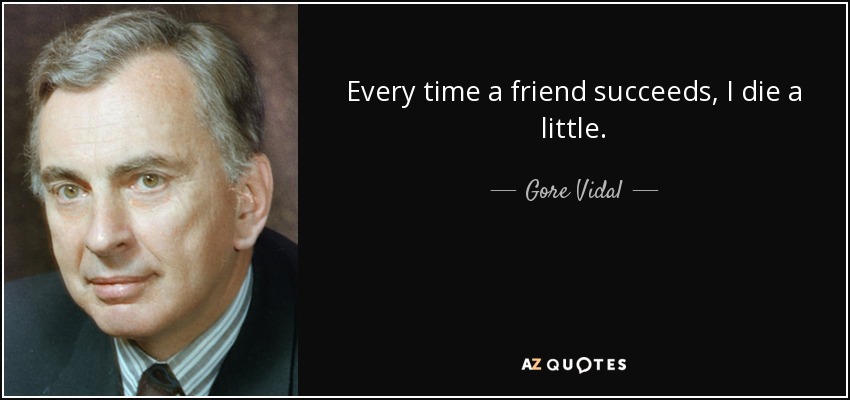
But here’s the thing: if your friend had a party to celebrate a publishing milestone, you’d go, right? You’d have fun, say congrats, and unless you’re a voraciously talented and bottomless needy type like Gore Vidal, you won’t “die a little” because something good happened to your friend and colleague. And if you do, who cares? It’s about them today, not you, ya narcissistic jackass!
So, I’m vexed. My news got lots of “likes” on FB. Some friends went out of their way to congratulate me. Does wanting to celebrate more reveal the depths of my own ego’s need for validation?
Maybe.
But I think I’m gonna have a party anyway. I will eat the shitty food I crave, like BBQ chips and Moosehead beer, (they’re exotic in America, though I won’t have them for breakfast, as in my punk rock days of yore), and hang with my friends. There are worse reasons to have a party. Like, ya know, dying.
Another reason I want a celebration: there’s a theme in some writing advice about never making a big deal out of what you just did, that celebrating accomplishments can blind you to the real purpose: doing the work.
There’s truth there. I share some of it. And Steven Pressfield and his ilk hammer this lesson at beginner, pushing them past anything that might become “resistance” to completing the next task. But once you’ve learned to be persistent, such relentless attacks on anything becoming “resistance” becomes dogma, and can lead you think that “the work” is the end all being of existence. How noble. How righteous. How defensible. And stupid.
Resistance no longer concerns me. My work ethic is strong. Thus I’ve erred on the side of exhaustion, burnout, and overwork instead of finding joy beyond the grind. And, unlike some writers, I’m not a pure introvert. Let’s face it, I’m a goof, a ham, a class clown, and an improv actor. I like shooting the shit for hours at bars and restaurants and on the street until the street cleaners give my care a shine. And it doesn’t make me any less committed to my craft to those who prefer a more solitary life.
I used to love the need to be alone. Why? For years, I was a self-hating, very lonely putz thanks to the usual bad psychology from enduring hardship in childhood. I was deadly alone for most of my life (even when a social beast). Writing gave me justifiable cause for never being social. And I did great work for years, in fiction and history, with justifiable loneliness. But when all my pre-conceived notions were shattered in 2013, I realized that the “need” to be alone was 75-80% “fear” about being who I was without art as the core part of my identity. After my conception-of-self went through the shredder, I soon realized how often I justified the shrinking of my world of friends, social engagement, and more by saying “well, that’s fine. I’m a writer. And I’m writing a fourth novel this year, so no need to make new friends, go outside, see a movie, take a walk, smell the roses, take a class, or do anything other than toil at the machine, because that’s what all the bullshit tough-guy messages preach.”
And thus, without any conscious intent, I turned the love of writing into a recipe for perpetual loneliness.
Sigh.
I’m not that guy anymore. I balance the need to work alone and have some kind of social life to avoid hiding from the world. But I am the inheritor of his old “solitaire engine.” When the good news came down this month, the engine started up . . . don’t do more than acknowledge it happened, just get back to work, finish three books this year, this is the only chance you will get, do not take your eyes off the prize, if you do you are self-aggrandizing asshole who thinks he’s big stuff when nothing’s been proven in sales or acclaim, you have no reason to celebrate until someone else validates you, which is the only kind of validation that is legit, but then again most people validate you because they like you so they are ruled by bias and can’t be trusted and thus the only salve to these issues is to chain yourself to your desk and work until you die and only then, when you can no longer influence with world with your Canadian charm and Latvian good-looks, with you receive fitting acclaim-
The Sparrows fly today, but this time it’s different; I’m not in the audience. This time I’m standing with my brother’s troupe at the edge of Mexico City’s Olympic Stadium, as the world watches and waits.
But I can’t jump. I can’t even move.
One by one, I watch as the others approach the edge and tumble off: Eli, Natasha, Xien, Adam.
All I can think about is my brother, David: his body darting about in a flash of green, perfect in every movement; then, after the car accident, his body crushed and broken — unfamiliar as it lay on a cold table, in a cold room.
I was training as David’s understudy when he was killed. Even then, I couldn’t fly like him — no one could.
Erin pauses at the edge and turns to me, smiling.
“You can do this, Jacob,” she says, placing a hand on my shoulder. “I know you can — we all do.”
Then, arching a yellow neocite wing to the sky, she drops into the wind and vanishes from sight.
In the distance, my brother’s face grins back at me from memorial posters held by grieving fans — somewhere, by our parents.
It was supposed to be my brother standing here today — not me. And I just keep thinking that I’ll crash into the safety net below; that I’ll fail.
What sort of Sparrow hesitates before the fall?
* * *
The first time I watched a troupe of Sparrows perform, it was at an abandoned granite quarry in my hometown. I was twelve, and David was still alive.
Summer came early, shattering every temperature on record, and our parents nearly kept us home, citing reports of heat stroke on the news.
“It’s just a silly air show, for god’s sake,” my mother said, exasperated.
But it was so much more than that to us. My brother and I shared a room, and Sparrow action figures hung suspended from the ceiling, parallel to posters of Alice Zheng — the first American Sparrow to become an Olympic champion.
We had grown up watching the miracle of human flight, but this was our first chance to see it with our own eyes — not on the internet, or the television.
In compromise we arrived caked in sun block, armed with a liter of water each. We waited in line, then squeezed into a spot on the sun-scorched aluminum bleachers.
When the show began everything else seemed to vanish around us: the Sparrows burst into the sky, diving and looping about the quarry in a pinwheel of color.
It looked effortless, the way they danced through the wind. One moment they were soaring. The next they were hurtling back to the granite below, only to extend their wings an inch above the ground, returning to the sky above the quarry.
It was mesmerizing; after that, there would be no keeping us from the wind.
* * *
What we learned from our first flight test:
Homemade neocite is a poor substitute for the real thing; the space from the roof to the ground is much further than you’d think; broken bones take months to heal; a parent’s trust takes longer.
When my collarbone shattered after that first jump, I thought I’d never fly again. David was four years older than me, and my parents blamed him for the accident.
“Grounded for life,” he said when he came to see me in the hospital. “Want to trade places? Can’t be worse than the way Mom keeps looking at me. And Dad…”
I laughed and reached out to punch him in the shoulder, but there was a flash of pain, and I cried out.
“Oh man,” he said, grimacing. “I really messed up, didn’t I? I just thought you’d want the first go at the wings — honest. I thought they’d work.”
And I never doubted that — not for a moment.
* * *
I didn’t get the chance to try a real set until David came back from his first semester at college.
“Do you miss it here?” I asked after he had settled into his old bed across the room.
I lay there in the silence, watching one of the action figures turn slowly in the air.
He didn’t say anything. Instead, he hopped out of bed and put a finger to his lips, motioning for me to follow.
We crept outside to his pickup and drove for a long time without talking.
“I don’t miss it,” he said at last. “All the heat and dust. How nothing changes. But I do kind of miss you.”
I smiled and watched the headlights bounce along the back roads.
We parked near the quarry and David hopped out, tugging a large bag behind him. After a moment he tore it open and held a Sparrow’s uniform up against his body.
“How did you get that?” I asked, gawking at it.
It looked like a bobsledder’s suit, except for the decorative plumage at the top, and the long, flexile wings that extended from the arms. It was green, and it reflected the moonlight like a lantern.
“Student loans,” David said with a shrug.
He stripped naked and began fitting himself in.
“Wait,” I said, panicking. “It’s dangerous.”
At that, David just laughed.
“Everything is dangerous, little brother. Besides, it’s easy. Just like walking in the air.”
Grinning, he stepped off the edge of the quarry and let the wind take him in its hands.
* * *
I look at the world below — at our troupe soaring through the sky — and think of David.
Everything is dangerous.
David spent his life plunging through the air, but it was a car that ended it. Just one careless moment on the road.
Closing my eyes, I picture him in the quarry, fearless, darting about like a small green flame. It was the most beautiful thing I’d ever seen — and all I ever wanted to be.
“Just like walking in the air,” I whisper.
Then, lifting two green wings above my head, I take a breath and fall into the wind.
Submissions lorem ipsum dolor sit amet consectetur. At dignissim neque amet proin sodales vulputate dolor elit. At dignissim neque amet proin sodales vulputate dolor elit.


made up of multiple small letters written by Indira (an expecting mother to the
daughter we will know as Chandri) to Adhi (the father, and space
explorer) and there is Ravi the step farther. The story is based in the
near future. The family live a fairly average
life in India except that Adhi is lost in space. Trying not to lose hope Indira
begins to write what she calls a biography for Adhi for if he returns. She talks
about how their daughter is moving around inside of her. The story jumps ahead
to when Chandri is about 10 years old. At this point Indira has desided to
marry Ravi because he is the closest person to a Father to Chandri. When Indira
marries Ravi, Chandri is not happy about it because she beleves that her mother
have betrayed and given up on her father. At the end Chandri has a Plan the
follow in the father’s footsteps in hopes of finding him.