Issue 25 October 2015 Flash Fiction Online October 2015

An Interview with Sylvia Spruck Wrigley

by Stanley Lee

October 2015

Read Sylvia Spruck Wrigley’s “Space Travel Loses Its Allure When You’ve Lost Your Moon Cup.” 

Stanley Lee: Why do you write?

Sylvia Spruck Wrigley: Well, I’ve always written since I was a child. I was always surrounded by books. I saw writing as important, something that one should do. And so I wrote. Diaries, essays that were twice as long as the next kid in class. I did journalism in college. But I convinced myself that I was a non-fiction sort of person.

SL: How did you come to that conclusion?

SSW: I’m not quite sure actually.

SL: How did the fiction start?

SSW: Well, for about the next ten years after college, I didn’t write any fiction at all. Until. Until, I met this guy, and I wanted to impress him, so I wrote him a short story.

SL: Tell me about that story.

SSW: Back then, at that time, I was a tour guide in Scotland, and I worked primarily taking German tourists around. At one point, in one of those tours, someone took me aside and said, “I need you to call this number.” It turns out that he was a German prisoner of war in World War II and back then, they didn’t keep them in camps because it was unlikely that they were going to swim their way back to Germany. Instead, they were put to work and on this farm that he worked, he fell in love with this farmer’s daughter. The war ended, he was sent back, and he loses all the information he has on her. Fast forward to the year 1992, our German hero is married, has his life, and he’s digging through these things, and he’s found an old photograph that has the house address in the background. So he writes a letter, hoping maybe it will still get to her.  Turns out that the mother of the girl he fell in love with recently died and the family is in the middle of selling that house. She wrote back and told him her new address and number. So I phoned her to say that he was here and would she see him. I sat there and translated while the two of them got on like a house on fire while his wife just sat there and watched the whole time dourly. My story became less inventing something out of nothing but narrating this amazing sequence of events.

SL: And how did that turnout?

SSW: I was very, very nervous when I was sending it to him. I was thinking, “My God, I don’t have an ending to the story.” There was no real resolution. In the story, I ended up getting rid of the wife. But considering that the person I wrote it for is in the other room right now and we’ve been together for the past fifteen years, I’d say it went very well. He’s very supportive.

SL: And how did that progress into the career you have today?

SSW: I initially wrote super short flash fiction to post on a photography blog. It wasn’t a speculative blog, but all my stories were speculative. They had banshees in them. I knew about selling writing because I sold my non-fiction regularly. And eventually, the stories became longer and longer.

SL: Tell me more about your writing.

SSW: All my writing is fairly well grounded in the world of today. Frankly, I don’t believe my imagination is that good. I take real things and put this small twist on them. The power of a photograph. It’s the real world and a touch of speculative. A girl going through adolescence. But on a space colony.

SL: Menstruation. But IN SPACE!

SSW: Exactly. I think every woman is frightened of “What if I have nothing when it all goes wrong? What if I sit down on this white sofa and it all goes wrong?” I have this one friend who does not wear white for ten days out of the month. Whatever technique a woman uses, there is always a failure rate of 0%.

SL: Did you feel like there was a need for this story and stories like this?

SSW: I do try to write about grandmothers and mothers. I feel like all these coming-of-age stories are centered around these twenty-year-olds who are changing the world, but where are their parents? Where are they coming from? I always felt that it was important to write about women, older women, overweight women, women who were not represented in fiction or mainstream fiction. Look at all these women getting cooties over our really nice science fiction. So I sat and thought about what would most frighten a man who’s scared of women writing. It came to me: MENSTRUATION! I usually don’t start with a message, but in this case, I did. I began reading about menstruation in space. When Sally Ride went up for a week, one of the male engineers came and said, “We put one hundred tampons on board, is that enough?” This has been such a historical issue. The first Russian cosmonauts said that women shouldn’t go into space on their period because there’s no controlling that blood. So the women tested it. They agreed amongst each other to try and get up into space and support each other. They’d fight back together. And now here we are, all enlightened. That’s how I ended up with the idea. Space is at a premium in space. They’re not going to pack in one hundred tampons. It has to be a menstrual cup. So what would happen if you lost yours?

SL: Given the recent climate for writers of color and women writers in science fiction and fantasy lately, it’s very timely.

SSW: I had to do a lot of work to get through my own misogyny. As a child, I always hung out with the guys and was considered “one of the guys”, and for me, that was a point of pride. I didn’t realize that I felt that way because I internalized this belief that men were inherently superior to girls. But that belief would have never satisfied me.

SL: What has your experience in the industry been like?

SSW: I’ve been very lucky. It has never been awful. I’ve never been directly attacked. No one ever told me “You didn’t write this well because you are a woman.” But on the other hand, I have a novella coming out, and it’s about faeries, and men have come up to me and said, “You write these really nice Tinkerbell fairy stories. I like my faeries nasty.” But then I don’t write Tinkerbell stories. These faeries don’t care about us. They’re not wandering around trying to spring wishes upon us or throw their pixie dust around. They will snatch your child. People are obstacles for these creatures. The concept that men write the dark stories and women write these pretty pink princess stories came as a shock to me.

SL: Is that the case in sci-fi as well? We don’t have many pixie dust throwing princesses in sci-fi.

SSW: For sci-fi, it’s all tentacle erotica.

SL: Naturally.

SSW: I actually did write one piece of erotica. I sent my mom a link to the anthology where my piece appeared. She said, “I knew immediately which one was yours. It was so tame.”

SL: Tell me about your day job.

SSW: I work for a multinational defense company, and my job is to write sci-fi about the technology they’re developing. A powerpoint would make the most exciting technology boring, so my job is to help these brilliant engineers dream and imagine. So I get to go to all these amazing sites and see all these amazing things that I can’t talk about.

SL: Final question. With Iggy Azalea’s departure from the rap scene and Nikki Minaj between albums, the rap throne is ripe for the taking. Is this your moment?

SSW: So, there is this rap song that came about after, quite possibly, too much drinking and irresponsibly browsing Fiverr. Someone was saying that they’d write a rap song about anything on the spot. So I showed him my moon cup story. He said he’d need a little more time. He came back to me in a few days with THIS.

Leave a Reply

In Old October

October 2015

Author Thomas Wolfe (1900-1938) wrote, “All things on earth point home in old October; sailors to sea, travelers to walls and fences, hunters to field and hollow and the long voice of the hounds, the lover to the love he has forsaken.”

That’s all well and good if home is a place worth going home to.

In a couple of this month’s stories, you might be better off heading to Timbuktu.

To celebrate that odd Christian/Pagan crossover festival we call Halloween, we have some deliciously creepy stuff.

Like “Daisy” by Paul DesCombaz. The title sounds innocuous enough. Kinda cute. No, no. Be prepared for those tingles up your spine. And lock the dog in the bathroom tonight. Trust me. You’ll want to.

And from Shannon Peavey, a little story called “White Elephant” that gives a whole new meaning to exchanging stuff you don’t want anymore.

In addition, we have “Thirty-two Years in the Cooler” by Alter Reiss, a great little noir-esque sci-fi tale.

In our Previously Published Fiction box, we offer “Space Travel Loses Its Allure When You’ve Lost Your Moon Cup” (originally published at Crossed Genres in 2014) by Sylvia Spruck Wrigley. Before you decide to read, you might want to know what a Mooncup is. So Google it, then read the story anyway. It’s worth it.

Be sure to click over to an interview with Sylvia by FFO Staffer, Stanley Lee (unfortunately not THAT Stan Lee, but we like him anyway).

Last up, FFO Staffer, Jason Ridler, gives us an article called “Carlin’s Way,” about fearlessly choosing your way, using George Carlin as an example. I loved George Carlin!  

Enjoy! And Happy Halloween!


Comments

  1. latchiloya says:
    I happened to drop in to check for examples of shortest form of literature and made me smile when I saw  the article of this suzanne vincent. ^^
  2. Tiana says:
    Good Artcle..thank’s

Leave a Reply

Thirty-two Years in the Cooler

by Alter S. Reiss

October 2015

Some jobs want a reference from your last place of employment or things like that. Adeckar had spent the previous thirty-two years in the Avisan-Taish prison, and before that, he’d worked for people like Big Odacai Naim, “Stumpy” Sein, and Jaccon “Whistling” Fair. They didn’t give references, as they were dead, dead, and serving life in prison respectively. So he didn’t get jobs which wanted references.

The breaking yard in North Falls didn’t care. Adeckar hadn’t been strong enough to break ships even before spending thirty-two years in the cooler. But the breaking yard needed a guy to keep an eye on things at night, and he was a guy.

He had the artificer’s gift, and he’d used it before he’d gotten locked away. Industrial work, at first; pulling silver and stone and brass and steel into the shapes he’d dreamed, and filling them with life, to dig and build and plow. Then work for Big Odacai; pulling things into shape, and filling them with life. Things that ran glim, and broke legs; different sorts of building, different sorts of digging. After Odacai had gotten gunned down, Adeckar had done the same thing for Stumpy Sein, and when Stumpy had got stabbed a few dozen times, Adeckar had gone to work for Whistling Fair.

Conditions of his parole meant that Adeckar wasn’t allowed even to apply for an artificer’s license, and since his release from Avisan-Taish, Adeckar hadn’t done anything that his parole officer would’ve objected to. No artificing, no contact with his old associates. Didn’t even stay in New Tinarius; cities had gotten too big, too loud, and he couldn’t understand them anymore. He’d gone out to North Falls instead and went to work. There were artifacts, sure—the hulks came in with their broken down crews, rusting iron and tarnished brass, and Adeckar would disconnect the leads, powering them down, so there wasn’t any life in them when the breaker’s torches took them apart. There wasn’t any harm in that. Didn’t even go out to see Lefty Braice when he passed through North Falls, as broken down as one of those old hulks.

There was one thing that Adeckar did which might have raised an eyebrow. There were times when he was walking his rounds when he’d pick up bits of wire, or bronze, or steel. He wasn’t allowed to practice the artificer’s art, and what he made of those scraps could’ve been called an artifact. But it didn’t do anything illegal. He hung it below the waterline at one of the docks and left it to chime soundlessly with the waves and the tides.

When Adeckar had worked for Big Odacai and the rest, he wore suits with golden cuffs, drove cars that purred like kittens, and never left New Tinarius, queen of cities, the center of the world, where ten million people lit the nights as bright as day and made the winters warm as summer. North Falls was a long way from New Tinarius, so it took a long time for the soundless chimes to get there, and penetrate thirty-two years of mud in Tinarius Bay.

During his rounds, Adeckar would stop at that dock and smoke a pipe–tobacco, nothing but tobacco, nothing to upset the parole officers. He’d stand there, and enjoy the tobacco, and the smell of the water, and if the night was clear, the stars and the moon. Every night, until one night, they answered the call. Hundreds of them, gold and black jade, each with a dozen tiny golden legs.

He put his hand down, and they swarmed over it, linking together. Whistling Fair had been the Glim King of Tinarius City for five years, longer than anyone before or since. And he did that with a thing of black jade and gold. Strong as any construct, but fast and clever, the way constructs never were. They’d never found it, and Adeckar’s failure to turn it over to the authorities or explain how it’d been made had added twenty years to his sentence.

It was warm, wearing them again, and Adeckar could feel the life he’d given them, the life that had spent thirty-two years at the bottom of Tinarius Bay, dark and wet and eternally cold. When he closed his hand, the old power was there. The border wasn’t ten miles off, and there wasn’t anything around to stop him from crossing over to where glim was legal and buying up a store. He could run glim to North Falls, build a crew, buy a suit with gold cuffs and a car that purred like a kitten.

But all the glim in the world wouldn’t make him young again, or keep him from getting gunned down like Odacai, or locked away like Whistling Fair. The things of black jade and gold had been whirring with life that whole time, but they were as fine as the first time Adeckar had powered them up. Artifacts weren’t like people; they didn’t wear down, doing nothing. He pulled the control, and the armor broke back down to parts. They’d dumped it, but that hadn’t been right, leaving the bugs alive and trapped like that, thirty-two years of waiting, thirty-two years of thrumming life, and nothing to do with it. It took hours to cut the leads on every segment, dropping them off the dock when he was done. But he finished before dawn, with time to make his last rounds. Night watchman for a breaking yard wasn’t being the Glim King of Tinarius City or even the Glim King of North Falls, but it was a clear night; he had the stars and the moon, anyway.

Comments

  1. Ray Otus says:
    Beautiful story, Alter! 

    BTW, I love old time radio too. I’ve been keeping a blog lately at http://radiorevival.blogspot.com.

Leave a Reply

White Elephant

by Shannon Peavey

October 2015

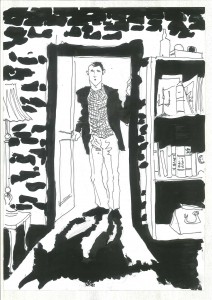
12082816_10206616611006749_498186591_o
Illustration by Dario Bijelac

The hole in my mouth goes deeper than the missing tooth. It burns and then is numb, like rubbing alcohol on a wound, and it radiates down my jaw and into my throat and stretches fingers through my lungs, and it’s obvious that a part of me is missing, has been pulled out with pliers and dropped into a sterile envelope.

It’ll grow back, they say, once the trade is done — but I’m not counting on anything.

The envelope sits in the pocket of my coat, crumpled from the pressure of my palm. I’ve been standing here too long. The party is at an oversized suburban house, an Arts & Crafts menace too big for its lot, and I’ve been here nearly a minute without knocking, just standing in front of the door listening to people talking behind it.

Go in, I think, Jesus, you’re paying for this time — because the kids are at home with their usual cheap, oblivious sitter, barely more than a warm body to call 911 in the case of real emergency. They don’t like her, but they’re not scared of her the way they’re occasionally afraid of me. So it’s worth it to come here, worth the $60 I’ll end up giving the girl at the end of the night.

I stand very still on the front step. I’ve never been to one of these things before.

The latch clicks, and a sharp-edged man in a sports coat opens the door and smiles down at me. Must have seen me through the window. Standing here like an idiot.

“Hello,” he says. “First time?”

I nod, and he ushers me in. The house is all polished wood and oiled bronze, and the people in the living room are talking quietly over vegetable platters and artichoke dip. My host offers to take my coat, but I refuse. My blouse is well-made but worn at the cuffs.

I eat carrots with single-minded determination, saying nothing but watching everyone, trying to decide whose envelope I might want to take. There’s a woman in the corner who looks calm and unlined like her face has never seen the sun or a violent expression. There’s an old man with a brilliant smile.

“It’s time,” our host says, and everyone reaches for their envelopes.

They make an unremarkable pile, there in the middle of the coffee table. A heap of letter-sized envelopes or small boxes.  Some people have wrapped theirs, but many have not. Some aren’t even sealed.

I draw a late number, so I have plenty of time to watch. The old man goes first, and he takes a small folded-paper box that I saw a pretty blonde girl slip onto the table. It’s a good choice — she has a sweet face.

The packages dwindle and then it’s my turn. All my first choices are gone. There are a little earring box and a crisp white envelope and a soft bundle of faded newsprint. That one was our host’s — he set it on the table and stepped away like he’d just dropped dogshit into the waste bin. His face in a little sneer.

I scoop up the newsprint bundle and sit there watching him. He only smiles at me, a meaningless professional smile I’ve seen on so many faces before I’m sorry, there’s nothing more I can do. The money’s just not there.

A man like that, in a house like this. What could he possibly want to be rid of? Maybe softness, maybe mercy. Things like that, I’ve found, have no place in business.

He takes my envelope when it’s his turn, and his smile drops as he does it.

After everyone has chosen, our host cracks a bottle of Malbec and passes everyone a glass. We shake the contents of our packages out onto our palms, and I’m left staring at a little flat tooth, a man’s back molar.

“Cheers,” he says, and I slam the tooth back and swallow it with a mouthful of wine.

The pain in my mouth goes away. The pain in my chest, the sense of something missing: it goes away. I’m whole again like I was when I was angry, but my anger’s been pulled out at the root. That’s gone, given away, and a new piece has settled into the gap.

For a moment I think, ­what is it? And I wait to feel laziness or sentimentality or whatever emotion a sharp suitcoated man like that might cast off. For a moment, I feel nothing.

But I’ve never felt nothing before, not like this. I feel heavy, slow and blank like my limbs are weighted down with lead. There’s a pain in the small of my back and right around my eyes and I’m blinking back tears, sudden and absurd.

“Are you sad for me?” my host says, stooped by my elbow.

“Why should I be sad for you,” I say because he has my rage now but what do I have instead — this lethargy, this crushing weight. This feeling like nothing will ever be right again.

“Did you really think everyone had it so much easier than you?” he says, and the spark of my anger is in the pinch of his lips, his bloodless knuckles. I know those signs.

“I just wanted to be better,” I say, the words raspy in my throat. “I wanted to be someone who could be happy.”

This time, the smile he gives me is pitying. “We meet twice a year,” he says. “Maybe you’ll find what you’re looking for.”

I brush out the door without talking to anyone else. There’s nothing more to say. I’ll go home to my apartment and my children, and for once, I won’t worry about snapping, about hurting them. That has to be worth something. Anything will be better than that — anything at all. It will.

“See you in six months,” the man says, and shuts the door behind me.

Leave a Reply

FXXK WRITING: CARLIN’S WAY!

The debut novel of a writer can make or break a career (not true, but that’s how it often feels). Writers work hard to get their first deal, so it appears as rare as ambrosia. This means the book launch is a massive ordeal. Numbers generated from this first book set a metric, largely at Barnes and Noble but also Amazon and elsewhere, that saying how much you sold. These numbers determine other metricssuch as ranks, recommendations, and returnswhich forever control your destiny. Sell poorly (say, not earning out your advance, which is most books), and less of your future work is stocked or promoted. Sell worse than your last book? Might not get to book three. Even ebooks that are “new” or from “new” authors have a sheen and magic compared to crap covers from the year the ebook revolution failed to finish, before fading into the void of obscurity. Your first shot feels like your last chance. Fuck it up? Better to create a thousand pen names to fool the publishing world you’re new. Or young. Or a different gender. Or maybe co-opt a minority identity that you think will sell and prove just what kind of asshole you really are.  

Mostly, people think there’s only one chance of “making it” (AKA: big porn-dream success where wishes come true because you worked hard and are talented and other lies we often need). Therefore, being a successful first time novelist matters most! Which makes me think of rockstar debut novelists as akin to the people who made high school their golden years. Seeing these idiots at reunions is bad enough. Imagine living like that . . . FOREVER!

Wait, it gets worse!

Once you have an audience, you’re frozen by success. You’re encouraged to stay in the same genre, the same mode, the same medium, to keep your audience. “The same, but different” is the oxymoron dejour novelists grapple with during their sophomore effort (even Joss Whedon had to make the same Avengers movie twice, just with a different villain). So, what’s worse than being a nobody? Being a nobody with something to lose! Perhaps it’s not so bad if you only love one kind of story, genre, mode, etc., then maybe “the same, but different” forever is great.

Here’s the flipside.

By only doing one kind of novel, say, “high fantasy adventure stories set in secondary worlds that appeal to young adult readers, especially the grown-ups who read young adult and dislike swear words and love the social dynamic of high school re-written a million times but with elves or demons or whatever as the beautiful “misfits” who finally get to win”, you will deny yourself the chance to become different.

Why would you ever want to be different?

Gosh, this really is high school analogy season!

You must be different to get better. And I know I am assuming a fuckton right now, especially that a writer might want to get better, beyond becoming competent enough to get published. But let’s all agree, for the sake of argument, that as much as you want “success” as a writer (the porn-dream you shouldn’t have), you also want to get “better” at writing. Herein lies the rub.

You can’t get better by doing the same thing in perpetuity. To improve and innovate is to mutate. You need change to be creative, and external judgement, including how your work will do commercially or judged by audiences, can cripple creativity (except mall test audiences: they are always right). Big changes over time can be mondo good for your writing, and maybe even your career (see? I’m not anti-success at all!). But only if you ignore the “must get it right the first time” mythology, and consider two things most people avoid: viewing your work in terms of a long career arc, and taking risks, especially when you have something to lose.

Sacrilegiously, our case study today is comedy instead of fiction.

Why?

Comedy is a harder gig than writing fiction. Odds of even limited success are horrific, and the cost of travel (integral to most comedians) makes it a losing proposition for years. And as awful as author readings are (and most are heinously bad), they pale in comparison to the immediate rejection and iron skin needed to learn your craft as a storyteller in front of drunk audiences and bachelorette parties and angry locals who just want to hear Kid Rock butcher awful songs by Lynyrd Skynyrd because they had a shit day at a blue collar job you’d probably sneer at.  Even with the differences between a performance and solitary art, similar foibles, creative traps, and allures abound. Plus, I think it’s valuable to view other arts so we don’t get calcified into thinking of writers as so different, so special, so unique that we need the same old advice from the same old sources (see previous FXXK WRITING post!).

Now cram it and read the story of George Carlin (1937-2008).


CARLIN’S WAY

“What I found over time is that I’m a writer who performs his own material.”

George Carlin

George Carlin began his performing career as a DJ for the US Air Force Strategic Air Command. You know, the frontline of nuclear armageddon! Having zero time for military discipline and rules, he was discharged and became part of a nightclub act with fellow Air Force washout Jack Burns. They did goofy and snappy comedy just as “Boomer Humor” took off: comedy about the self, issues, and ideas that were pioneered in fifties with the likes of Mort Sahl and Lenny Bruce. Burns and Carlin fit in, did well, and made good scratch. Carlin knew he could make serious dough if he stuck with nightclub racket and early TV hits like the Tonight Show, but after two years his heart dropped. He started identifying with the counterculture audience in coffee shops, not the starched shirts and high balls of The Copa. And he wanted to do it solo.

The duo split. Carlin took the last of their momentum for some TV spots, and he did well, but he hadn’t found his new material. His career drifted. To be successful in “mainstream” comedy meant adhering to fixed boundaries, and for three years he bounced around TV and national spots doing “Vanilla American” guffaws, including some successful bits and characters. But the counterculture was growing, and spoke to Carlin’s attitude. In the late sixties he’d had enough and actively dissed the old racket at the Howard Hughes Invitation Golf Tournaments and its ilk by doing sets that peed in the cornflakes of the rich and powerful that had nothing in common with him, or their long-haired, reefer smoking kids. Bridges burned, he told his wife that if all he ever played was coffee houses from now on, he’d be cool. So long, big money.

In bars and coffee houses he tried to use characters and ideas from his “middle class” set, but crashed into a new look: long hair, hippie style with goofy clothes shooting first-person stories and critiques from the hip. New material that was antithetical to his other work hit the scene. He was finding his new voice.

The immediate result?

Carlin tanked.

His career income dropped an estimated 90%.

His new look killed TV bookings, a major source of income for his peers. He was back to playing tiny clubs while Burns was doing guest spots on TV.

Carlin had worked with two talent managers who warned him this initial loss was unavoidable. But . . . the losses could be recouped over the long haul. He had to revamp, reach out, and win his new audience with new sets, tours, albums, media coverage and more, and let the new material generate heat.

The comedy album FM & AM is a transition. Literally. He mixed both styles of his work, older polished stuff, and newer, edgier material, on each side of the record. While not heralded like his others, that album needed to get made. He needed a transition album to shed one skin and find another. And it set the stage for CLASS CLOWN in 1972, which was 100% new Carlin,  and gave the world “Seven Words that You Can Never Say on Television.” OCCUPATION FOOL the next year released “Filthy Words” which produced a Supreme Court Ruling on obscenity and free speech and made him a rockstar of comedy.

Carlin didn’t rest on his laurels much, even in the wake of this success. The counterculture petered out, the indulgent disco era and greedy eighties were on the rise, and he needed to change. Again. He kept growing, though much of that was fueled by his heinous fiscal situation. In debt to the IRS, Carlin had to keep working to pay off decades of taxes and penalties (took him twenty years to shake it). But it was a godsend, since he focused on making his act better, trying new things on the road, banking the best on the next HBO special, a form he pioneered. He couldn’t afford less than his best, in his chosen field. Compared to other successful comics, he didn’t delve too much into film and TV work-

“But wait, wasn’t this about taking chances?”

It is, heroes. And this is the most impressive aspect. Carlin tossed out his new material after about a year. No greatest hits tour. No best of. No classic Carlin. Yes, minor homages and moments to the past, but that’s it. He made a special, tossed it out, and kept doing new material.

Please recall the original premise: audiences and promoters hate new material. They want the same but different. They don’t want to bank on a horse that might not win.

Not Carlin. New material was what he needed to do his best. And that risky approach influenced others to do deeper, more meaningful work, and keep doing it, including current mondo comedy hit Louis CK.

Granted, all Carlin’s material was carried through his own unique voice, but he refused to be the same performer. He kept trying new angles and views and never stopped developing his voice as a performer. He grew into a position of elder statesmen of comedy commentary, a cynical critic of politics and pop culture through the eighties and into the nineties, including books as well as bit parts in TV, theater,and film. At his death in 2008, he created a legacy of impressive work in a brutal field best known for failures, bad gags, and a sliver of success for the minority.

And how did he do it?

He killed his old rep.

He lost steady money

He lost an audience.

He made new material that actually spoke to him and found an audience that listened.

He was prepared do the work he wanted to do, “even if the world saw it as worthless”, as Heather Havrilesky recently recommended.

He took advantage of technological changes when they happened.

He enjoyed plateaus of success, but kept looking to find his own voice, kept finding new material, kept taking a chance within his form.

For Carlin, change wasn’t the enemy, different wasn’t the enemy. In fact, they were the roots of his greatness and produced a body of work that makes him among the best comedians of his generation.

Writing novels and stories and making anything even resembling a career in publishing is hard, too. So, much career advice is naturally conservative. And yet, for most the money isn’t great (though I don’t begrudge those who need the small amount of dough vs. hours put in) except for the 1%; many of whom have high school level popularity online via great PR and fan service and enjoy the hell out of it. Which is fine. You know what’s also fine? Knowing that your best work is in the future, that it will not be a dead ringer for your best-known work, knowing you may lose fans and coin if you dare to reach for “best” instead of “next”, and doing so anyway. Because getting better, doing one’s best work at any one time, is a worthy goal for an artist. And if you get paid to get better, awesome. Just don’t bank the house on it (Carlin had a lean on his house for two decades).

To get better, you have to grow, fail, change, endure. As Ta-Nehisi Coates recently noted, if you do, you’ll end up with a powerful skill set that newbies cannot have. That all those “debut” authors or pen names don’t fathom.

And with such skill comes the capacity to do something bigger, bolder, and better.

Not everyone can fiscally succeed like Carlin (he was astoundingly lucky to have the the birth of network TV, the counterculture and cable TV emerge as mediums for his kind of work), but imagine a career of work that spans forty years and changed some of the landscape of your artform. Now imagine you barely made any scratch at it. Would you take Carlin’s way, or the one of the perpetual first time author, desperate to hold on to a fickle audience who wants “the same, but different”, with just as miserable a chance of making any coin?

Choose your own adventure, heroes.


Leave a Reply

Space Travel Loses Its Allure When You’ve Lost Your Moon Cup

Space Travel Loses Its AllureZero G and three light years from the nearest drugstore is a shitty time to realize that you left your spare moon cup at the space station.

Tonight I lost mine to the relief tube. The stuffy musk-and-lemon smell of the hold was invaded by the sharp tang of blood. I was half-asleep, trying to empty it without fuss in the dark. The relief tube suction was just strong enough to whisk the cup out of my still-asleep slick fingers.

When I was dreaming about escaping to the stars, it was all about adventure. No one talked about the shit and the blood. A year’s supply of toilet paper and tampons just won’t fit in the hold, and wet tissues are under strict control, two tissues a day. I’d give up everything I owned in return for double rations of wet tissues. Well, if I hadn’t abandoned everything already.

I went through my drawer and discovered my spare was MIA. So, now I had a problem that no adult woman really wants to think about. Under the circumstances, I ripped up a faded t-shirt and made a make-shift pad to get me through the night. I strapped myself back into my bunk to work out what I was going to do.

I considered declaring an emergency. Mayday, I’m on the rag. It was seven months to Barnard’s and the t-shirt was only XS with short sleeves. I wasn’t going to make it without back-up.

On the other hand, I’d never get a second chance to head out to the frontier if I turned this cargo ship around. That left one option: beg Sumina.

I met Sumina at the space station before we boarded. We were both headed to the asteroid colonies. I was half drunk when I signed up. Sumina was serious about it. She studied for like a year before the launch. I didn’t see much point in making friends.

The thing is, I knew she had birth control pills. A large amount of birth control pills to distribute at the mining colonies. In the dark, I worked out that if she’d give me 212 of them, I could make it to Barnard’s without a drip.

The problem was, how to convince her to give them to me.

She was the most straight-laced feminist I’d ever met, with a moral compass that never deviated from straight-to-heaven. A volunteer with the Artemis Foundation, she was there to support women in space without access to community or sex education. My plan was to make loads of cash and get laid. We didn’t have a lot in common.

When the day-lights came on, I went to her bunk to grovel.

“I’ll do anything you want.” What’s the worst she could ask?

“We could be friends,” she said.

I stared at her like a rabbit in the headlights. “You can’t do that,” I stuttered. “Hand out supplies to your friends. There must be some rule against that, right?”

Her face fell, and I felt bad.

“I mean, I just think…” My words trailed off uselessly.

“Yeah, no, you’re right. Stupid idea. Let’s just make it a fair trade. Your entire ration of chocolate.”

“Done.”

“And ten packs of wet tissues.”

I groaned. “Aw man, Sumina.”

“And you have to hand over your music files and promise me that you’ll never sing Gloria Gaynor again.”

That stung. I almost said to hell with it. Then I thought about the next seven months and sighed. “OK.” So it wasn’t that hard to tempt Eve with the apple after all. I was almost a little disappointed.

I pulled out the chocolate and tissues and the player from my drawer. Everything I owned.

She went to her drawer, but she didn’t get the tablets. Instead, she pulled out a bright yellow cosmetics bag. Inside was my sister’s photo, a spare toothbrush, and the moon cup. “I found it when we left the station,” she said. “You were too hung over to function, so I thought I better check your room.” She tossed it to me.

“And you didn’t tell me?” I lunged for the music player, but she was quicker.

“No way, we had a deal.”

“This is how you support womenkind?”

She nodded. “Absolutely. You sing like a wounded goat. The fewer people who hear you ruin that song, the better.”

I laughed despite myself.

She shoved my chocolate into her drawer. “And I had to give up my luxury ration to fit the bag in.” She unbuckled herself and drifted towards the floor. “I thought we might end up friends. Who’s the girl?”

She meant the photograph. “My little sister. I haven’t seen her in ten years.”

“Why not?”

“I ran away when I was 13. Never been back.” The words had escaped before I had a chance to shut myself up.

Sumina patted my shoulder, didn’t say anything stupid.

“Anyway, thanks for the bag.”

“No problem.” She took a deep breath and pulled herself in front of me. “Why can’t we be friends?”

“I…” I didn’t have an answer. Finally, I shrugged and put my hand out. “Fine. Deal, if you’ll give me 50% of the chocolate back.”

She grinned and shook on it. “Deal.”

I finally got the hell out of there. If she thought the handshake meant something special, then well, that was her problem. I just wanted my chocolate back.

I pulled myself to the backroom to incinerate the remains of my t-shirt. I figured I’d head back to Sumina’s bunk after lunch and we could share some chocolate, maybe listen to a track or two. I heard her shout my name and realized I was humming. “Humming is still allowed,” I shouted.

Sumina’s laugh echoed through the hold, and I found myself smiling again. Hell, it was only for seven months, right?

Maybe having a friend wouldn’t be so bad after all.

Previously published in Crossed Genres, 2014. Reprinted here by permission of the author.

Comments

  1. fairyhedgehog says:
    I was just browsing Flash Fiction and found your story is here too. It’s one of my favourites!

Leave a Reply

Daisy

by Paul DesCombaz

October 2015

Comments

  1. VesnaMcMaster says:
    Wow. Ok I won’t be able to forget that one in a hurry. Love the style.

Leave a Reply

Join the 
Community

Support

Support lorem ipsum dolor sit amet consectetur. At dignissim neque amet proin sodales vulputate dolor elit ipsum dolor sit amet.

Subscribe

Subscribe lorem ipsum dolor sit amet consectetur. At dignissim neque amet proin sodales vulputate dolor elit.

Submit a Story

Submissions lorem ipsum dolor sit amet consectetur. At dignissim neque amet proin sodales vulputate dolor elit. At dignissim neque amet proin sodales vulputate dolor elit.