Issue June 2012 Flash Fiction Online June 2012

Table of Contents

A Pretty Quarrel

by Lord Dunsany

January 2015

On one of those unattained, and unattainable pinnacles that are known as the Bleaks of Eerie, an eagle was looking East with a hopeful presage of blood.

For he knew, and rejoiced in the knowledge, that eastward over the dells the dwarfs were risen in Ulk, and gone to war with the demi-gods.

The demi-gods are they that were born of earthly women, but their sires are the elder gods who walked of old among men. Disguised they would go through the villages sometimes in summer evenings, cloaked and unknown of men; but the younger maidens knew them and always ran to them singing, for all that their elders said: in evenings long ago they had danced to the woods of the oak-trees. Their children dwelt out-of-doors beyond the dells of the bracken, in the cool and heathery lands, and were now at war with the dwarfs.

Dour and grim were the demi-gods and had the faults of both parents, and would not mix with men but claimed the right of their fathers, and would not play human games but forever were prophesying, and yet were more frivolous than their mothers were, whom the fairies had long since buried in wild wood gardens with more than human rites.

And being irked at their lack of rights and ill content with the land, and having no power at all over the wind and snow, and caring little for the powers they had, the demi-gods became idle, greasy, and slow; and the contemptuous dwarfs despised them ever.

The dwarfs were contemptuous of all things savouring of heaven, and of everything that was even partly divine. They were, so it has been said, of the seed of man; but, being squat and hairy like to the beasts; they praised all beastly things, and bestiality was shown reverence among them, so far as reverence was theirs to show. So most of all they despised the discontent of the demi-gods, who dreamed of the courts of heaven and power over wind and snow; for what better, said the dwarfs, could demi-gods do than nose in the earth for roots and cover their faces with mire, and run with the cheerful goats and be even as they?

Now in their idleness caused by their discontent, the seed of the gods and the maidens grew more discontented still, and only spake of or cared for heavenly things; until the contempt of the dwarfs, who heard of all these doings, was bridled no longer and it must needs be war. They burned spice, dipped in blood and dried, before the chief of their witches, sharpening their axes, and made war on the demi-gods.

They passed by night over the Oolnar Mountains, each dwarf with his good axe, the old flint war-axe of his fathers, a night when no moon shone, and they went unshod, and swiftly, to come on the demi-gods in the darkness beyond the dells of Ulk, lying fat and idle and contemptible.

And before it was light they found the heathery lands, and the demi-gods lying lazy all over the side of a hill. The dwarfs stole towards them warily in the darkness.

Now the art that the gods love most is the art of war: and when the seed of the gods and those nimble maidens awoke and found it was war it was almost as much to them as the godlike pursuits of heaven, enjoyed in the marble courts; or power over wind and snow. They all drew out at once their swords of tempered bronze, cast down to them centuries since on stormy nights when their fathers, drew them and faced the dwarfs, and casting their idleness from them, fell on them, sword to axe. And the dwarfs fought hard that night, and bruised the demi-gods sorely, hacking with those huge axes that had not spared the oaks. Yet for all the weight of their blows and the cunning of their adventure, one point they had overlooked: the demi-gods were immortal.

As the fight rolled on towards morning the fighters were fewer and fewer, yet for all the blows of the dwarfs men fell upon one side only.

Dawn came and the demi-gods were fighting against no more than six, and the hour that follows dawn, and the last of the dwarfs was gone.

And when the light was clear on that peak of the Bleaks of Eerie the eagle left his crag and flew grimly East, and found it was as he had hoped in the matter of blood.

But the demi-gods lay down in their heathery lands, for once content though so far from the courts of heaven, and even half forgot their heavenly rights, and sighed no more for power over wind and snow.

Leave a Reply

The Mirror With Six Faces

Ruben felt different the moment he awoke, but wasn’t sure until he looked in the mirror. There was the confirmation. The eyes looking back weren’t his, yet he recognized them as he would his own. They belonged to the entity.

He was only twelve or thirteen the first time it crawled into his skin, but he hadn’t been afraid, and when he/she/it had gone again, he felt hollow, like an empty house, his own lonely voice echoing off his bare inner walls. But it had always come back to him, and this morning he was full again.

“Hello,” he said, but the entity didn’t answer. It never did.

Showering still felt strange, but the entity looked away to protect his modesty, waiting until he was dressed to be fully present again. Putting on clothes was different too, his fingers thicker, clumsier than when he was alone, as if the skins of his hands were another’s gloves.

Not wanting to speak to anyone in this awkward state of possession, Ruben tried to sneak out the front door, but callused fingers wrenched his ear and spun him around.

His mother’s dark eyes bored into his, and for a moment he felt like a teenager again, caught trying to escape. For one rueful instant, he realized how little had changed since then.

“So,” she said, “It’s you.

“Of course it’s me,” said Ruben. “Who else?”

Her lips twisted, and she tugged him into the kitchen like a disobedient dog. “You must eat, Rubencito.”

He considered protesting, but whenever his mother folded her imposing arms like a general on the field of battle, it was useless.

Ruben slumped into the chair and sipped his coffee. It tasted different than it had the day before, but then things always tasted different with the entity inside, as if he were using a borrowed tongue, and he wondered if the entity had a tongue of its own somewhere.

It arrived while he slept, always slipping inside like a whisper, never waking him, so he had no idea what it looked like. He liked to imagine it as a floating ball of light, though it might’ve resembled a giant rabbit or an earwig, or nothing at all. Perhaps it came from a place without features; a world where everything was invisible, and all that distinguished one thing from another was presence. That was a strange thought, and Ruben seldom had those. Had he or the entity been thinking then?

It was just another puzzle among many. The biggest still remained. That is, of all the seven billion people crowding the planet, why had the entity chosen him? Ruben was painfully ordinary in almost every way. He never missed a day of work at his boring IT job at a Century City law firm, still lived with his mother, was twenty pounds overweight (give or take), drove a fifteen year old car, and if he got a spare moment to think about it, he was probably depressed. But what could he do, tell a shrink that an alien entity was occupying him like a timeshare, and that he was perfectly fine with the arrangement? They’d lock him away for life.

“Stop playing with your food.”

Ruben wasn’t aware of it, but he’d been splattering droplets of hot sauce onto yellow swirls of egg yolk over a horizontal smear of avocado. The image reminded him of when he used to lie on the grass and stare up at the stars. It was a work of art, and he was no artist.

“I can’t be late today,” he said, pushing his plate away. “We’re training the lawyers on a new system.”

He rose, and the Entity brushed against his gray matter — a tickle to get his attention — and a daydream dropped into his mind. It was the thought of warm sand pressing up through his toes and the salt smell of crisp ocean air. It wanted to know what it was to be awake, to live as a human being, to write poetry and sing at the top of his lungs in front of strangers. It wanted to quit his job, to run away and drive across the country looking at everything there was to see. And today it wanted to go to the beach.

Ruben bent and stared at his distorted reflection in the metallic toaster. A poet once said, a man is a mirror with six faces, and through him God looks out in all six directions at once. He didn’t know if it was God, a ghost, or some alien explorer, but whatever was inside him, it picked a poor host.

Fat chance, he told it. There would be no beach today.

“You should listen to it,” said his mother with a scolding tone. “It knows what’s good for you.”

“What?” She couldn’t have known.

“Those eyes might fool other people,” she said with a twinkle in her eye, “but they do not fool me, Mijo.”

“How long have you known?”

“You were such a sad boy after your papa died.” She made the sign of the cross. “All summer you stayed in your room, and I thought the boy I loved was gone. I prayed every day for your return, and then one morning, they were different?”

“What was different?”

“Your eyes. They were smiling.”

“Do you know what it is?” he asked, clutching her wrist. “Do you know what’s inside me?”

She laughed. “Of course, Rubencito. Don’t you recognize it?” She placed her hand over his and grinned. “That’s your soul.”


Leave a Reply

A Place for Passions

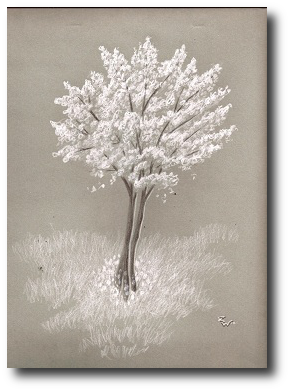
“Oh, look,” said Pete after too long. “Cherry blossoms. those.” Artwork © 2012, R.W. Ware
A Place for Passions. Copyright 2012, Rich W. Ware

Four. That’s how many suicide attempts it took to get me committed to Pleasant Gardens, where I scratched at my wrists and tried not to look at my older brother Pete standing a careful foot away. We walked along smooth stepping stones, my brother and I, trapped by walls of flowers.

“Oh, look,” said Pete after too long. “Cherry blossoms. Love those.”

Something about the way he said “love” made my ears perk up. “You do?”

“Sure. I even have a poster of them… although, currently rolled up under my bed. Kind of girly. But yeah, I love how they only bloom for a week.”

But then he looked at me and I could read his thoughts: shouldn’t have told the suicidal girl he admired something for its transience.

I closed my eyes. “Say that again.”

“That came out wrong — ”

“No, just… please.”

I could hear him breathing, that careful foot away. “Why?”

I sighed. Did I have to explain? Since I had no humility left, I did:

“There’s this place I envision — just in my head — full of all the things people have told me they love. And since you love cherry trees, I wanted to plant one there.”

“I love you,” he said, sounding suddenly scared. I kept my face stony until he moved on. “I mean, it’s cool, but… why?”

How could I make it not sound pathetic… that I was trying to figure out how to love something, anything? That I was searching for my own reason to live?

“Just say it again,” I insisted. “And mean it.”

On some level, I think my big brother understood me. “I actually hate how cherry trees pack all their beauty into one week. But I love the feeling I’m left with, like I need to make my time count.”

Yes, that would do. I watched a cherry tree blossom in my mind.

With Pete here, I was fine. Not five minutes after he left, depression seeped into my bones. It was always this way with me: sudden, physical. I curled around my cramping stomach on the beige carpet of my new room.

And retreated to that place in my mind. For the hundredth time, looked around at all the things that someone, somewhere, was passionate about. Looking was never enough; I reached out and picked up a piccolo. Told myself: This! Music, someone loved music enough to enshrine this here. I could love music. But the piccolo chirped alarmingly and I dropped it and reached for something else — a beer bottle, relic of an avid home-brewer. But that meant nothing to me, nothing at all.

The objects dissolved in self-pity, replaced by the voices of their owners:

“Stars make me feel insignificant… in a good way.”

“If I could get sucked into a video game, I would be so happy.”

“I’m crazy about skirts. Even chunky legs are hot wrapped in a skirt.”

Nothing. It was all meaningless, vapid, stupid. I didn’t love any of it.

“Rebecca?”

That voice was Pete’s — he came back. I opened my eyes to find him prying at my clenched fist, probably thinking I had a razor or something, but only a wad of cherry blossoms fell out.

“I just,” he started. “Well, I’m back.”

“Not like I haven’t been through this before,” I greeted him, because sometimes sharp words are easier than kind ones.

Pete helped, though, and I offered to show him around my imaginary room as I put everything back in its place. I gave him the running commentary as I stacked the video games in a pyramid and polished the window looking out at the stars. I decided to hang the skirt up on a branch of the cherry tree.

“But you’re borrowing other people’s passions,” he insisted when I was done. “What do you love?”

“That’s the problem, isn’t it?”

“Beaches,” he suggested easily.

“When was the last time you saw me in a bathing suit?”

“Or art. You have, like, a hundred posters in your room.”

Dali and Van Gogh: hardly pleasure, more like catharsis. I smiled sadly and shook my head.

Pete rolled his eyes. “Fine, you hate everything.”

He was trying so hard, but that was the absolute worst thing he could have said, because it was exactly what I was afraid of. So I summoned all the gusto I could muster and declared, “You know what, I do love something. Dust!”

“Dust?”

“Yeah, dust. Sometimes, when I can’t even pick myself up off the floor, I’ll spend hours just playing with it. Feeling its texture. It’s real, you know? And who else notices dust? It’s mine.

“Uh-huh.”

“And like, it’s mostly dead skin, right? When I do go, I like knowing that part of me will stick around, in the dust. Yep, I love dust!”

I instantly regretted the look on Pete’s face. Knew that regret would fuel my anxiety later. “I’m sorry.”

“You know what? I think you really do love dust.”

I arched my eyebrows. “That is the most pathetic — ”

“Really, I think you’re crazy about dust. You weird, weird sister of mine.”

I smiled. “I suppose dust does have its virtues.”

“Tell me, in this room of yours,” he tapped the top of my head, “is there any dust? Any at all?”

“Nnno,” I admitted.

“Can I add some?”

There wasn’t a speck of dirt, not a fallen eyelash marring my beige carpet, but he made a show of scraping some up anyway and sprinkling it over my hair.

And I did — in my mind, I saw the cloud of dust wafting over the cherry tree like snow, coating its branches and knocking off blossoms. It twinkled in the starlight and powered the inside of the beer bottle. By the time it settled, everything was covered in a thin but irreverent grey layer.

And I realized, it was more comfortable. The various passions seemed more approachable covered in dust.

I had to admit, I liked it.


Comments

  1. entry mats says:
    The congresswoman’s grueling path to reelection took her from her Tucson
    base across the barren high desert, through an empty expanse of
    tumbleweed and mesquite trees, to this dusty town at the Mexican border
    that has come to symbolize the tinderbox of Arizona politics.

Leave a Reply

Viewpoint

January 2015

We at Flash Fiction Online wish to express our condolences to the family of Ray Bradbury who passed away June 5th. He was a true master of the written word.

In this issue: Viewpoint. What we see and how we see are seldom the same thing. It’s the glass-half-empty-or-half-full idea. Even a small change in how we view our world and circumstances can be life-changing.

In this month’s stories, small changes in the main characters’ viewpoints make for hopeful and satisfying “light bulb” moments for two lost souls. We hope you enjoy “A Place for Passions” by Michael Banker, and “The Mirror With Six Faces” by David Larson.

And our Classic Flash, a dark fantasy called “A Pretty Quarrel” from Lord Dunsany, shows us a change of perspective in the demi-gods as they war against the dwarfs, far from the courts of heaven.

Thanks as always. Please read, link, tweet, and donate!


Leave a Reply

Join the 
Community

Support

Support lorem ipsum dolor sit amet consectetur. At dignissim neque amet proin sodales vulputate dolor elit ipsum dolor sit amet.

Subscribe

Subscribe lorem ipsum dolor sit amet consectetur. At dignissim neque amet proin sodales vulputate dolor elit.

Submit a Story

Submissions lorem ipsum dolor sit amet consectetur. At dignissim neque amet proin sodales vulputate dolor elit. At dignissim neque amet proin sodales vulputate dolor elit.