Issue February 2011 Flash Fiction Online February 2011

Table of Contents

Repair

by Steven Mathes

February 2015

The tech at the door wore a heavy toolbelt. He looked angry. The ID collar around his neck pulsed as it broadcast his position to guards at the community gate. Menace radiated from the skeletal body under the rough black clothes and the bony hands under his thin composite gloves.

“You called for service?”

“Yes,” Darcy said. “The whole house is down!”

“You understand the terms. There’s no going back after you agree.”

Darcy pushed his two young teenagers back but stood his ground, even though his knees felt weak. His wife Brenda wept in the other room. The tech wore a recorder that made anything said a contract.

“I understand the terms. I agree. I have no choice.”

“You feel you have no choice? There’s always choice. Agreeing under duress ruins the contract. Sorry, but if you have no choice, then I can’t help.”

The tech turned and walked back toward the street. Under duress? Of course there was duress. Darcy’s house needed service. Sure, they could live without heat, without communication, without entertainment. They could live in a tent, or with the criminals on the un-gated streets.

“No! Please! I agree!”

The tech stopped. He considered. Then, Darcy heard him converse with the empty air. The communications equipment of any tech was hidden, but they had huge bandwidth connected directly to their Guildhouse. The tech returned, his face grim and bony.

“I consulted my Steward. I can try again. Do you want me to review the terms of service?”

Darcy struggled. He had to say this right.

“No, I understand the terms. I understand the price. I understand your discretion in setting price.”

“Do you agree?”

“Yes. I agree.”

The tech’s eyes went glassy as he listened to his home office. Finally, he nodded, slipped through the door like a wraith and went straight to the control room without asking for directions. Darcy followed, until he noticed his Betsy doing the same.

“No, you go to the den with your little brother. Take care of Mom.”

“Dad! Please? I told you I could fix it. Can’t I at least watch?”

The tech’s stride hesitated for just a half a step.

“Go now,” Darcy told her desperately.

The tech stopped. He turned, actually looked Darcy in the eye.

“She comes with us.”

“Yes, sir,” Darcy squeaked.

The tech slipped into the control room, but Darcy’s trembling girth wouldn’t fit. He stayed back and watched from the doorway. He prayed that good manners and cooperation would help where Betsy made things worse. He would be willing to beg if he thought it would help.

Meanwhile, the tech ran a cable from his belt to the console. A holographic display appeared. It was hard to read from an angle. Betsy squeezed in behind the tech, put both her hands on those skeletal shoulders and peered at the virtual screen, her nose nestled behind his flaky ear.

“Betsy! Show some manners!”

She didn’t budge. The tech made hand motions through the holograph, moving icons, reading, responding. He frowned, then his brow lifted higher over the ridge of his sharp forehead.

“How did you do this? How did you get in?”

“Factory password,” Betsy said. “Posted on the Web. I knew it wouldn’t work, user level, but I wrote an applet on my music player.”

“You plugged the player into your house?”

The tech made a final stab at a red dot with his pinky. Everything went black for a moment. He unplugged. The house booted up, and one-by-one the broken conveniences came back to life. The whole repair was done.

They squeezed out of the control room.

“No security on your player,” the tech said.

“A virus.”

“You’re a teenager. You surf all the bad places, you get the newest malware.”

“This can’t be happening!” Darcy shouted. “Please, no!”

Brenda wailed from the other room, suddenly aware of consequences. She rushed in, her face blotchy and wet. She blubbered, dragging Davey in one hand, rushing over to take Betsy in the other.

“Oh, no, no…”

The tech took a grim, bony hand out of its glove and pointed to Betsy.

“She’s a human being!” Darcy yelled. “A child!

The tech snapped his look over to Darcy, baring teeth and widening his eyes. The family quieted. Even Brenda held her breath.

“You made a deal,” the tech whispered. “Without people like us, everything would stop.”

If they refused to pay, they would forfeit their house. Service contracts for all future houses would be null. If they refused to pay, a collection agency would take payment anyway. There was only one way out of this.

“Please, Betsy,” Darcy said. “Not that. A tech?”

“You’re good,” said the tech to Betsy. “I respect your skill. Besides, the law requires that you make the decision.”

Betsy pried the hand of her mother from her wrist, gently, patiently. She kissed her mother on the cheek, then her brother. Her mother went to her knees, keening. Betsy stroked her mother’s hair, and last, she pecked Darcy’s nose, gave him a big hug. She reached around the corner and pulled out a big suitcase, already packed.

“You planned this?” Darcy said weakly.

“I’m so sorry,” the tech said. “It’s never easy.”

The suitcase whirred as Betsy powered it to the door. The tech followed, his tool belt rattling like bones of the dead. The techs had to replenish their number if they were going to support society. But letting a mere child choose? Betsy could change her mind but the stigma would last a lifetime.

“You could always visit?” she begged.

She knew they wouldn’t. Darcy felt the heaviness of loss settle into his soul as he watched her go and listened to the wailing behind him. A soul. She would give up her soul if she hadn’t already, learning that stuff. The worst thing, the thing that sank into him like pure pain? She never looked back.
Leave a Reply

A Living Calendar

by Anton Chekhov

February 2015

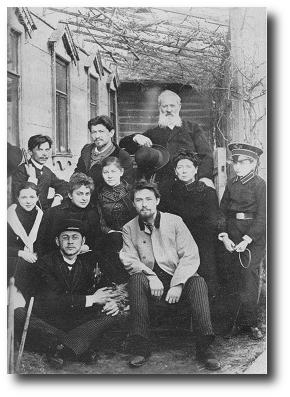
Perhaps the Chekhov family was the inspiration for this story. This picture was taken in 1890. Anton is in the front row, wearing a white jacket. Artwork : public domain, coming to us courtesy of .
Perhaps the Chekhov family was the inspiration for this story. This picture was taken in 1890. Anton is in the front row, wearing a white jacket.

State-Councillor Sharamykin’s drawing-room is wrapped in a pleasant half-darkness. The big bronze lamp with the green shade, makes the walls, the furniture, the faces, all green, couleur “Nuit d’Ukraine.” Occasionally a smouldering log flares up in the dying fire and for a moment casts a red glow over the faces; but this does not spoil the general harmony of light. The general tone, as the painters say, is well-sustained.

Sharamykin sits in a chair in front of the fireplace, in the attitude of a man who has just dined. He is an elderly man with a high official’s grey side whiskers and meek blue eyes. Tenderness is shed over his face, and his lips are set in a melancholy smile. At his feet, stretched out lazily, with his legs towards the fire-place, Vice-Governor Lopniev sits on a little stool. He is a brave-looking man of about forty. Sharamykin’s children are moving about round the piano; Nina, Kolya, Nadya, and Vanya. The door leading to Madame Sharamykin’s room is slightly open and the light breaks through timidly. There behind the door sits Sharamykin’s wife, Anna Pavlovna, in front of her writing-table. She is president of the local ladies’ committee, a lively, piquant lady of thirty years and a little bit over. Through her pince-nez her vivacious black eyes are running over the pages of a French novel. Beneath the novel lies a tattered copy of the report of the committee for last year.

“Formerly our town was much better off in these things,” says Sharamykin, screwing up his meek eyes at the glowing coals. “Never a winter passed but some star would pay us a visit. Famous actors and singers used to come… but now, besides acrobats and organ-grinders, the devil only knows what comes. There’s no aesthetic pleasure at all…. We might be living in a forest. Yes…. And does your Excellency remember that Italian tragedian?… What’s his name?… He was so dark, and tall…. Let me think…. Oh, yes! Luigi Ernesto di Ruggiero…. Remarkable talent…. And strength. He had only to say one word and the whole theatre was on the qui vive. My darling Anna used to take a great interest in his talent. She hired the theatre for him and sold tickets for the performances in advance…. In return he taught her elocution and gesture. A first-rate fellow! He came here… to be quite exact… twelve years ago…. No, that’s not true…. Less, ten years…. Anna dear, how old is our Nina?”

“She’ll be ten next birthday,” calls Anna Pavlovna from her room. “Why?”

“Nothing in particular, my dear. I was just curious…. And good singers used to come. Do you remember Prilipchin, the tenore di grazia? What a charming fellow he was! How good looking! Fair… a very expressive face, Parisian manners…. And what a voice, your Excellency! Only one weakness: he would sing some notes with his stomach and would take re falsetto — otherwise everything was good. Tamberlik, he said, had taught him…. My dear Anna and I hired a hall for him at the Social Club, and in gratitude for that he used to sing to us for whole days and nights…. He taught dear Anna to sing. He came — I remember it as though it were last night — in Lent, some twelve years ago. No, it’s more …. How bad my memory is getting, Heaven help me! Anna dear, how old is our darling Nadya?”

“Twelve.”

“Twelve… then we’ve got to add ten months…. That makes it exact… thirteen. Somehow there used to be more life in our town then…. Take, for instance, the charity soirees. What enjoyable soirees we used to have before! How elegant! There were singing, playing, and recitation…. After the war, I remember, when the Turkish prisoners were here, dear Anna arranged a soiree on behalf of the wounded. We collected eleven hundred roubles. I remember the Turkish officers were passionately fond of dear Anna’s voice, and kissed her hand incessantly. He-he! Asiatics, but a grateful nation. Would you believe me, the soiree was such a success that I wrote an account of it in my diary? It was, — I remember it as though it had only just happened, — in ’76,… no, in ’77…. No! Pray, when were the Turks here? Anna dear, how old is our little Kolya?”

“I’m seven, Papa!” says Kolya, a brat with a swarthy face and coal black hair.

“Yes, we’re old, and we’ve lost the energy we used to have,” Lopniev agreed with a sigh. “That’s the real cause. Old age, my friend. No new moving spirits arrive, and the old ones grow old…. The old fire is dull now. When I was younger I did not like company to be bored…. I was your Anna Pavlovna’s first assistant. Whether it was a charity soiree or a tombola to support a star who was going to arrive, whatever Anna Pavlovna was arranging, I used to throw over everything and begin to bustle about. One winter, I remember, I bustled and ran so much that I even got ill…. I shan’t forget that winter…. Do you remember what a performance we arranged with Anna Pavlovna in aid of the victims of the fire?”

“What year was it?”

“Not so very long ago…. In ’79. No, in ’80, I believe! Tell me how old is your Vanya?”

“Five,” Anna Pavlovna calls from the study.

“Well, that means it was six years ago. Yes, my dear friend, that was a time. It’s all over now. The old fire’s quite gone.”

Lopniev and Sharamykin grew thoughtful. The smouldering log flares up for the last time, and then is covered in ash.

Leave a Reply

Clock-In

First we’ll clock you in on the computer and then you can start following me around. Your clock-in number is always the last four digits of your Social Security number, but for tonight you’ll need my number to get to the tables on the screen. Ever use Aloha before? It’s a pretty straightforward system. Go ahead — my number is 1979. Open the screen.

Okay, so here are all the keys representing the menu. The most important things to remember, and the ones that are most confusing, are what items come with sour cream and guacamole. Some items come with it, for instance, under “Apps” — hit “Apps” then hit, “Quesadilla” — you’ll see all the kinds of quesadillas you can order, chicken, blackened chicken, black bean. You don’t need to modify for sour cream and guacamole because it comes with the quesadilla. Also with the fajitas. It’s included in the price. But always ask the customer if they would like guacamole or not. It’s expensive and we don’t like to give it to them automatically if they don’t want it.

However, with anything else you must charge for sour cream and guacamole. Or if they want extra. Chimichangas, burritos, combo plates, they don’t come with it. Make sure you tell people so they know right off the bat. Now scroll down to “A La Carte.” Everything that makes up the combo platters, like tacos and those things, the customer can get a la carte. And there’s the buttons for the sour cream and guacamole.

One more thing. Some servers around here, like Sara Thomas, have a bad habit of calling in items to the kitchen that they need and not ringing them in. The managers don’t like that and you’ll get in trouble for calling, “Can I get a sour cream?” when you’re supposed to be ringing it in. Sara is on the hit list right now because everyone knows she steals. She’s a thief, so watch the money you keep in your drawer. Some people carry it on them, but I don’t. I doubt Sara steals money, she’s just the type to hook her friends up with free stuff. But they’re on to her, James and Holly. Actually, you might be her replacement. All I know is, she’s walking a thin line with James and Holly and they’ve wanted to fire her for a long time.

The kitchen doesn’t like when you call things in either. You can be sure Ken or Benita will say, “Where’s the ticket?” Especially if Ken’s here in the afternoon. See, he’s an alcoholic so around two he can’t wait to get off and have his margarita. He’ll start snapping at you for almost nothing at all, so don’t feel it’s your fault. At four when he clocks out he goes straight to the bar and has shots and margaritas. When you’re at the service bar he’ll lean over and make comments that make no sense. Sometimes he sits up here all night and gets wasted. But when he’s here Ken does do his work.

See the skinny little guy behind the line? That’s Ed. He doesn’t do his work. He talks and acts like he’s Senior Cook, and he’ll talk your ear off, about all the work he does, but he has to take his “break” when we get off the wait list on a Friday night and it’s time to clean up. He’ll sit by the Coke machine for thirty minutes and let the dishes pile up if he’s on dish. You may have seen him around Winter Park or at the Publix shopping center. He doesn’t have a driver’s license so he rides a bike. And he lives with about twenty cats. If you go over there his house reeks of cats. None of them are spayed or neutered so they multiply like rabbits and he can’t take care of them all. My friend Darlene adopted one of the kittens last year and it had a big sore on top of its head and worms crawling out of its butt — this was a cat he gave her! Nice free cat. She spent three hundred dollars at the vet’s office to get it better. So don’t adopt any of Ed’s cats.

Okay, maybe we should go back to learning the computer. What happens when you need to take something off a check, say you make a mistake and ring something in? Then you need to get James or Holly. James is usually outside doing repairs — he’s the only one who gets anything done around here. Holly goes in the back office because of her smoking. That’s something no one talks about, Holly smoking. She hides in the back because she’s six months pregnant and she doesn’t want the regular customers to know. But everyone does know, about her smoking.

You’re really catching on. I’m so glad, because we’re all getting burnt out on the extra shifts and we needed to hire someone. You gotta watch though. Kim and I — you met her earlier — we have this joke that soon we’ll turn into Ken or Ed. We’ll sell our cars and move into a house in the neighborhood out back. We won’t even need bikes to go to work. Hell, Ken and Ed can move in with us, Ed with his twenty cats, and after work at night, and on our vacations, we’ll stand around at the service bar and make nasty comments to everyone who’s trying to work because we’re miserable. So even when we’re off we won’t leave. We won’t need to. The restaurant is all that we need. Sounds funny, I know, but you gotta watch. This place will suck you in. Now where were we? That’s right. My number is 1979.

Leave a Reply

Naming the Baby: Titles (Part I of II)

This is the second column in Bruce Holland Rogers’s new writing series, Technically Speaking. The first column, and the entirety of his Short-Short Sighted columns (dedicated to writing very short fiction), visit his author page.

Titles are hard. They have to accomplish a lot in a few words. The ideal title will attract the reader who has a variety of stories to choose from, will grab the reader by the collar and say, “Hey! You! Yes, you! Here is exactly the sort of story you love!” It will identify the genre. It will begin to establish the literary contract with the reader about the likely pleasures of the story and the rules of the story’s telling. It will frame or control how the reader sees some elements of the story. When the story is over, the ideal title will help the reader to think more deeply about the story and might give the reader one of those “Aha!” moments of realizing that the reader’s first understanding of what the title referred to has been turned upside down. The ideal title will help the reader to remember the story and recommend it to others, and it will help those other readers to remember the recommendation and find the story.

That’s a tall order. Indeed, it’s a nearly impossible. I don’t know of very many titles that manage to do everything that that a great title can do, but a title that doesn’t do at least some of them is not serving its story very well. Here are some suggestions for creating a good title, beginning with the most important suggestion: Try.

I know from reading student stories, from judging contests, from reading unsolicited magazine manuscripts, that a surprising number of writers don’t try, or at least don’t try very hard. Perhaps we can blame the reading comprehension questions in standardized tests. “Which of the following would be the best title for the passage above?” The answer is always the title that most comprehensively names the central subject of the passage: “Memories of Grandpa Joe,” “A Snowy Day,” “The Price of Coffee.” And for students who are just learning how to write a few paragraphs that stay on topic, this kind of title can serve as a navigation beacon: If you’re supposed to be writing about Grandpa Joe, then that funny story about Grandma Gracie may need to wait for next week’s writing assignment.

Indeed, a title that serves as a lighthouse may be of use to even the most sophisticated writer. A “working title” is often exactly that, a way for the writer to remind herself of the idea or enthusiasm that got the story started. It helps the writer to keep the main idea before her, to make some decisions about what does or does not belong in the story. However, those three example titles are, for most readers, boring, and not only because they simply name a subject. They are boring because they are very much like the titles of school assignments or the earnest efforts of the rankest beginning writers. That is, they remind the reader of painfully boring writing that the reader has had to endure in the past. Like a good title, they are naming the genre of the piece that follows them, but that genre is, unfortunately, Torture By Literature.

Allow me to pause here and apologize to Grandpa Joe, to backyard meteorologists, to traders of coffee futures. I’m sure that there are some for whom “Memories of Grandpa Joe,” “A Snowy Day,” and “The Price of Coffee” are alluring titles. Let me also disabuse my readers of the advice I have sometimes heard that a title like one of these is the kiss of death for a story. It isn’t. No editor worthy of a blue pencil is going to look at the title of a piece and reject it without reading another word. A title that looks like the beginning of a terrible story can sometimes be a clever move on the part of the writer, promising a story so mundane that the reader has to look at the first sentence to see if the story really is as awful as advertised. That first sentence could be brilliant. It could lead to a brilliant second sentence, and to the realization that the title is being used with a sense of irony, that the story pretending to be a school assignment is actually playing with that expectation.

Editors know this. Editors also know that titles are hard, that some writers never manage to come up with good ones. So an editor who thinks that a title is awful will read at least a few sentences, meaning that a bad title is not really the kiss of death. It is, however, the kiss of contagious disease. The editor will read those opening sentences while wearing gloves and holding the manuscript at a safe distance, expecting to verify that the manuscript should be returned from whence it came. It’s hard to overcome such a first impression.

Before we move on from these examples, I should point out that a title that simply names its subject can be a good title, in spite of all I have said, if the subject is inherently interesting and dramatic. If Grandpa Joe were Joseph Stalin, then “Memories of Grandpa Stalin” could draw readers. Part of the problem of “A Snowy Day” is that it offers one snowy day among a lifetime of days with snow. Why will this one be of interest? However, “Snow Day” is a good title because it refers to a special kind of snowy day in which the normal routines of life are suspended. That’s already a promising start to a story: the things that usually happen are not going to happen on the day of this story.

My second suggestion for writing good titles is to prioritize. The two most important tasks of a title are the same as the tasks of literary illustration: to draw the reader in and to make an apt promise.

I think the first part of this is obvious enough. The reader might be drawn in by dramatic subject matter named in the title, or by a mystery or contradiction, or by language that promises that the writer is good with words and can be relied upon to tell a good story. The apt promise is a little less obvious.

Years ago, I was one of a group of new writers seeing for the first time the illustrations that a group of new artists had made for our stories. The stories and art were going to be published together in an anthology, and a couple of the writers started to complain about their illustrations. The art did not depict any scene that actually took place in the story. The art director who had been overseeing the artists heard this and gave us writers an impromptu lecture about illustration. Most of the time, the purpose of illustration is not to show the reader what happens in the story. The illustration is, instead, a lure. It doesn’t matter whether the illustration is on the cover of a book or on the first page of a story. Its purpose is to tell the reader what kind of a narrative this is (western? SF? literary?) and to intrigue. The illustration should be sexy, dramatic, subtle, or whatever will best advertise the fiction. Once the reader finishes the story, the reader won’t usually judge the illustration by whether it depicted a scene from the story, but by whether the story fulfilled the genre and tone of the art.

The title pulls the reader in. Then the story delivers on the title.

Readers are harder on titles than they are on illustrations. When the story is over, they will forgive an illustration that didn’t picture the characters the way the reader did, for instance. Everyone knows that the writer didn’t create any illustrations, didn’t design the cover of the book. But the writer did choose (or approve) the title, and so the reader will be irritated if the story failed to live up to it.

A story can do all the things that I listed in the opening paragraph, but if it doesn’t pull the reader in and then seem apt at the end of the story, it’s not a good title.

Next month: Take this theory and practice it!


Bruce Holland Rogers has a home base in Eugene, Oregon, the tie-dye capital of the world. He writes all types of fiction: SF, fantasy, literary, mysteries, experimental, and work that’s hard to label.

For six years, Bruce wrote a column about the spiritual and psychological challenges of full-time fiction writing for Speculations magazine. Many of those columns have been collected in a book, Word Work: Surviving and Thriving as a Writer (an alternate selection of the Writers Digest Book Club). He is a motivational speaker and trains workers and managers in creativity and practical problem solving.

He has taught creative writing at the University of Colorado and the University of Illinois. Bruce has also taught non-credit courses for the University of Colorado, Carroll College, the University of Wisconsin, and the private Flatiron Fiction Workshop. He is a member of the permanent faculty at the Whidbey Writers Workshop MFA program, a low-residency program that stands alone and is not affiliated with a college or university. It is the first and so far only program of its kind. Currently he is teaching creative writing and literature at Eötvös Loránd University in Budapest, Hungary, on a Fulbright grant.


Become a Patron!

We need all the help we can get. For more info on any number of flash-tabulous rewards including extra stories, personalized critiques, and more:

patreonfriend

Or…

If you enjoy Flash Fiction Online, consider subscribing or purchasing a downloadable copy. Your donations go a long way to paying our authors the professional rates they deserve. For only $0.99/issue that’s cheaper than a cup of coffee. Or subscribe for $9.99/year.

subscribe_button

Comments

  1. Russ says:
    finish chapter and the hoagie is cleared from promote scramble. https://ello.co/samedaypapers Pro Papers Plagiarism-Free Succeeding, the primal composition of the essay is introduced, with nidus on the essay head style.

Leave a Reply

Our February Issue

February 2015

Jake Freivald, Editor
Jake Freivald, Founder

Welcome to February!

You may have noticed that we skipped the January issue. For a variety of reasons, that month has always been difficult for me to manage, and this year was the worst in a long time. Next year I’ll bake a double issue into December (Merry Christmas!) and have a planned skip in January.

This month is a great return, however. Our first story, “Banshee Lullabies” by Chazley Dotson, is a modern-day fantasy. It has a wonderful opening line: The night my daughter sings my death, I am sitting in the living room floor, sifting through old pictures. It gets better from there, too. Check it out.

Our second story, “Clock-In” by Vanessa Blakeslee, uses an interesting technique — it immediately puts you in someone’s situation, being instructed by the narrator, which leads to a very natural use of imperative and second-person, better than the vast majority of second-person we get. In fact, I only thought about its use of this unusual voice well after accepting it. So, on second thought, ignore the technique (since it’s easy to do) and just enjoy the story.

Our third story, “Repair” by Steven Mathes, is a darkish view of the not-too-distant future. I get the feeling one of my kids will be the subject of a similar situation someday.

Speaking of kids, our Classic Flash this month is from Anton Chekhov. Its title is “A Living Calendar,” and it’s possible that it speaks to me mostly because this is the way I keep track of my life: I had my oldest (now 16) while I was in the Marine Corps; we moved to New Jersey when my third (now 12) was still in utero; my brother was living with us the year before my youngest (almost 2) was born. (There are eight total. A friend has taken to say “I haven’t seen you in two or three Freivalds,” where one Freivald is an indeterminate amount of time between 18 months and two-and-a-half years.) Looking at a photo of Anton and his family, it wouldn’t surprise me if the conversation this story contains is mostly autobiographical.

This month also marks the second installment of Bruce Holland Rogers’s Technically Speaking column. This is the first of two parts describing “Naming the Baby,” or creating titles. This month he talks through the issues, and next month he’ll discuss nuts-and-bolts and give examples.

Thanks for joining us! We’ll see you in March!

Leave a Reply

Join the 
Community

Support

Support lorem ipsum dolor sit amet consectetur. At dignissim neque amet proin sodales vulputate dolor elit ipsum dolor sit amet.

Subscribe

Subscribe lorem ipsum dolor sit amet consectetur. At dignissim neque amet proin sodales vulputate dolor elit.

Submit a Story

Submissions lorem ipsum dolor sit amet consectetur. At dignissim neque amet proin sodales vulputate dolor elit. At dignissim neque amet proin sodales vulputate dolor elit.