Issue October 2010 Flash Fiction Online October 2010

Table of Contents

Notes on Writing Weird Fiction

by H.P. Lovecraft

February 2015

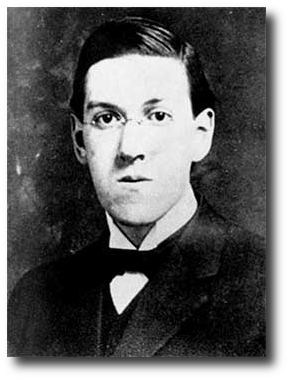
H.P. Lovecraft. Artwork : This photo is in the public domain.
H.P. Lovecraft

My reason for writing stories is to give myself the satisfaction of visualising more clearly and detailedly and stably the vague, elusive, fragmentary impressions of wonder, beauty, and adventurous expectancy which are conveyed to me by certain sights (scenic, architectural, atmospheric, etc.), ideas, occurrences, and images encountered in art and literature. I choose weird stories because they suit my inclination best — one of my strongest and most persistent wishes being to achieve, momentarily, the illusion of some strange suspension or violation of the galling limitations of time, space, and natural law which for ever imprison us and frustrate our curiosity about the infinite cosmic spaces beyond the radius of our sight and analysis. These stories frequently emphasise the element of horror because fear is our deepest and strongest emotion, and the one which best lends itself to the creation of nature-defying illusions. Horror and the unknown or the strange are always closely connected, so that it is hard to create a convincing picture of shattered natural law or cosmic alienage or “outsideness” without laying stress on the emotion of fear. The reason why time plays a great part in so many of my tales is that this element looms up in my mind as the most profoundly dramatic and grimly terrible thing in the universe. Conflict with time seems to me the most potent and fruitful theme in all human expression.

While my chosen form of story-writing is obviously a special and perhaps a narrow one, it is none the less a persistent and permanent type of expression, as old as literature itself. There will always be a small percentage of persons who feel a burning curiosity about unknown outer space, and a burning desire to escape from the prison-house of the known and the real into those enchanted lands of incredible adventure and infinite possibilities which dreams open up to us, and which things like deep woods, fantastic urban towers, and flaming sunsets momentarily suggest. These persons include great authors as well as insignificant amateurs like myself — Dunsany, Poe, Arthur Machen, M. R. James, Algernon Blackwood, and Walter de la Mare being typical masters in this field.

As to how I write a story — there is no one way. Each one of my tales has a different history. Once or twice I have literally written out a dream; but usually I start with a mood or idea or image which I wish to express, and revolve it in my mind until I can think of a good way of embodying it in some chain of dramatic occurrences capable of being recorded in concrete terms. I tend to run through a mental list of the basic conditions or situations best adapted to such a mood or idea or image, and then begin to speculate on logical and naturally motivated explanations of the given mood or idea or image in terms of the basic condition or situation chosen.

The actual process of writing is of course as varied as the choice of theme and initial conception; but if the history of all my tales were analysed, it is just possible that the following set of rules might be deduced from the average procedure:

  1. Prepare a synopsis or scenario of events in the order of their absolute occurrence — not the order of their narration. Describe with enough fulness to cover all vital points and motivate all incidents planned. Details, comments, and estimates of consequences are sometimes desirable in this temporary framework.
  2. Prepare a second synopsis or scenario of events — this one in order of narration (not actual occurrence), with ample fulness and detail, and with notes as to changing perspective, stresses, and climax. Change the original synopsis to fit if such a change will increase the dramatic force or general effectiveness of the story. Interpolate or delete incidents at will — never being bound by the original conception even if the ultimate result be a tale wholly different from that first planned. Let additions and alterations be made whenever suggested by anything in the formulating process.
  3. Write out the story — rapidly, fluently, and not too critically — following the second or narrative-order synopsis. Change incidents and plot whenever the developing process seems to suggest such change, never being bound by any previous design. If the development suddenly reveals new opportunities for dramatic effect or vivid storytelling, add whatever is thought advantageous — going back and reconciling the early parts to the new plan. Insert and delete whole sections if necessary or desirable, trying different beginnings and endings until the best arrangement is found. But be sure that all references throughout the story are thoroughly reconciled with the final design. Remove all possible superfluities — words, sentences, paragraphs, or whole episodes or elements — observing the usual precautions about the reconciling of all references.
  4. Revise the entire text, paying attention to vocabulary, syntax, rhythm of prose, proportioning of parts, niceties of tone, grace and convincingness or transitions (scene to scene, slow and detailed action to rapid and sketchy time-covering action and vice versa. . . . etc., etc., etc.), effectiveness of beginning, ending, climaxes, etc., dramatic suspense and interest, plausibility and atmosphere, and various other elements.
  5. Prepare a neatly typed copy — not hesitating to add final revisory touches where they seem in order.

The first of these stages is often purely a mental one — a set of conditions and happenings being worked out in my head, and never set down until I am ready to prepare a detailed synopsis of events in order of narration. Then, too, I sometimes begin even the actual writing before I know how I shall develop the idea — this beginning forming a problem to be motivated and exploited.

There are, I think, four distinct types of weird story; one expressing a mood or feeling, another expressing a pictorial conception, a third expressing a general situation, condition, legend, or intellectual conception, and a fourth explaining a definite tableau or specific dramatic situation or climax. In another way, weird tales may be grouped into two rough categories — those in which the marvel or horror concerns some condition or phenomenon, and those in which it concerns some action of persons in connexion with a bizarre condition or phenomenon.

Each weird story — to speak more particularly of the horror type — seems to involve five definite elements: (a) some basic, underlying horror or abnormality — condition, entity, etc. — , (b) the general effects or bearings of the horror, (c) the mode of manifestation — object embodying the horror and phenomena observed — , (d) the types of fear-reaction pertaining to the horror, and (e) the specific effects of the horror in relation to the given set of conditions.

In writing a weird story I always try very carefully to achieve the right mood and atmosphere, and place the emphasis where it belongs. One cannot, except in immature pulp charlatan-fiction, present an account of impossible, improbable, or inconceivable phenomena as a commonplace narrative of objective acts and conventional emotions. Inconceivable events and conditions have a special handicap to overcome, and this can be accomplished only through the maintenance of a careful realism in every phase of the story except that touching on the one given marvel. This marvel must be treated very impressively and deliberately — with a careful emotional “build-up” — else it will seem flat and unconvincing. Being the principal thing in the story, its mere existence should overshadow the characters and events. But the characters and events must be consistent and natural except where they touch the single marvel. In relation to the central wonder, the characters should shew the same overwhelming emotion which similar characters would shew toward such a wonder in real life. Never have a wonder taken for granted. Even when the characters are supposed to be accustomed to the wonder I try to weave an air of awe and impressiveness corresponding to what the reader should feel. A casual style ruins any serious fantasy.

Atmosphere, not action, is the great desideratum of weird fiction. Indeed, all that a wonder story can ever be is a vivid picture of a certain type of human mood. The moment it tries to be anything else it becomes cheap, puerile, and unconvincing. Prime emphasis should be given to subtle suggestion — imperceptible hints and touches of selective associative detail which express shadings of moods and build up a vague illusion of the strange reality of the unreal. Avoid bald catalogues of incredible happenings which can have no substance or meaning apart from a sustaining cloud of colour and symbolism.

These are the rules or standards which I have followed — consciously or unconsciously — ever since I first attempted the serious writing of fantasy. That my results are successful may well be disputed — but I feel at least sure that, had I ignored the considerations mentioned in the last few paragraphs, they would have been much worse than they are.

Leave a Reply

Despair

by H.P. Lovecraft

February 2015

O’er the midnight moorlands crying,
Thro’ the cypress forests sighing,
In the night-wind madly flying,
     Hellish forms with streaming hair;
In the barren branches creaking,
By the stagnant swamp-pools speaking,
Past the shore-cliffs ever shrieking;
     Damn’d daemons of despair.
Once, I think I half remember,
Ere the grey skies of November
Quench’d my youth’s aspiring ember,
     Liv’d there such a thing as bliss;
Skies that now are dark were beaming,
Gold and azure, splendid seeming
Till I learn’d it all was dreaming —
     Deadly drowsiness of Dis.
But the stream of Time, swift flowing,
Brings the torment of half-knowing —
Dimly rushing, blindly going
     Past the never-trodden lea;
And the voyager, repining,
Sees the wicked death-fires shining,
Hears the wicked petrel’s whining
      As he helpless drifts to sea.
Evil wings in ether beating;
Vultures at the spirit eating;
Things unseen forever fleeting
     Black against the leering sky.
Ghastly shades of bygone gladness,
Clawing fiends of future sadness,
Mingle in a cloud of madness
     Ever on the soul to lie.
Thus the living, lone and sobbing,
In the throes of anguish throbbing,
With the loathsome Furies robbing
     Night and noon of peace and rest.
But beyond the groans and grating
Of abhorrent Life, is waiting
Sweet Oblivion, culminating
     All the years of fruitless quest.


From Wikipedia: Howard Phillips Lovecraft (August 20, 1890 – March 15, 1937), of Providence, Rhode Island, was an American author of fantasy, horror, and science fiction.

Lovecraft’s major inspiration and invention was cosmic horror: life is incomprehensible to human minds and the universe is fundamentally alien. Those who genuinely “reason”, like his protagonists, gamble with sanity. Lovecraft has become a cult figure for his Cthulhu Mythos, a series of loosely interconnected fictions featuring a pantheon of human-invalidating entities, as well as the famed Necronomicon, a grimoire of magical rites and forbidden lore. His works were deeply pessimistic, fabricating a mythos that challenged the values of the Enlightenment, Romanticism, and Christianity.

Although Lovecraft’s readership was limited during his life, his reputation has grown over the decades, and he is now commonly regarded as one of the most influential horror writers of the 20th Century, exerting widespread and indirect influence, and frequently compared to Edgar Allan Poe in the tone of his writing style.


Become a Patron!

We need all the help we can get. For more info on any number of flash-tabulous rewards including extra stories, personalized critiques, and more:

patreonfriend

Or…

If you enjoy Flash Fiction Online, consider subscribing or purchasing a downloadable copy. Your donations go a long way to paying our authors the professional rates they deserve. For only $0.99/issue that’s cheaper than a cup of coffee. Or subscribe for $9.99/year.

subscribe_button


Leave a Reply

Childhood Fears

by Stephen Smith

February 2015

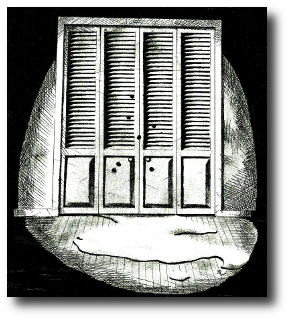
Cory, toes sticking out of the footies in her SpongeBob pajamas, waved her tiny pistol at luminescent green monster blood pooling in front of her closet. Artwork © 2010, R.W. Ware
Artwork © 2010, R.W. Ware

Charles took a moment to look at the houses on his street while the last bit of sun vanished. Broken windows and kicked-in front doors stared back across overgrown brown lawns. Rusting cars slumped on driveways. Weeds pushed through cracks in the sidewalks. He ran through his checklist: backdoor secured, garage door bolted, storm windows closed, chimney capped.

He stepped inside, triple locking and barring the steel door behind him.

“It’s Back! Daddy, it’s Back!”

Charles heard the sharp crack of a twenty-two-caliber pistol as he ran towards his daughter’s bedroom.

“Daddy! I got him.”

Cory, toes sticking out of the footies in her SpongeBob pajamas, waved her tiny pistol at luminescent green monster blood pooling in front of her closet. Bullet holes riddled the barricaded closet door.

“Look, this one’s blood is green. I got him good, daddy. Waited till he rattled the doorknob and bang, bang, I got him.”

“Yes, you did, baby. You always hit your target.”

Voice aged well beyond her years, Cory answered, “No, daddy, not always.”

Charles had to turn away to regain his composure. He pressed his hands against his eyes. Cory had missed the monster under the bed, the one that got her mother. Should have cut the legs off the beds years ago. He breathed in deeply through his nose, out through his mouth. Then he took Cory’s pistol, reloaded it, and tucked her in bed. He kissed her goodnight and went to sit in the candlelit living room, shotgun across his lap.

Steel storm windows rattled as boogiemen went from window to window, testing the locks. Werewolves worried the iron cap that sealed the chimney’s top. A few pieces of mortar rattled, falling on the closed flue.

Pant legs pulled up, Charles gave a deep sigh. He added another bottle of disinfectant to a wastebasket filled with empties before cleaning cuts and bites on his ankles and calves while he waited for morning.

Charles and Cory sat on their porch soaking up the warmth, childhood monsters banished by the sun. A page ripped from a magazine, carried by the wind, landed on the top step. Cory took one look and shrieked. Leaping to her feet, she ran into the house.

Charles’ heart sank when he saw the picture of a tyrannosaurs rex. It fed, blood dripping from a mouth adorned with teeth. Trees in the picture gave it perspective. Damn! I gotta get a bigger gun.

Leave a Reply

The Day of the Poll

by Lord Dunsany

February 2015

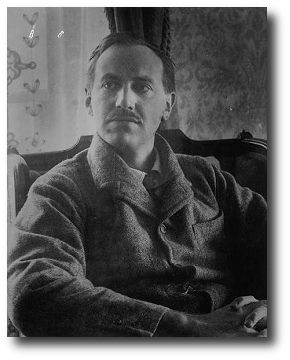
Edward John Moreton Drax Plunkett, 18th Baron of Dunsany. Artwork : This photo is in the public domain.

In the town by the sea it was the day of the poll, and the poet regarded it sadly when he woke and saw the light of it coming in at his window between two small curtains of gauze. And the day of the poll was beautifully bright; stray bird-songs came to the poet at the window; the air was crisp and wintry, but it was the blaze of sunlight that had deceived the birds. He heard the sound of the sea that the moon led up the shore, dragging the months away over the pebbles and shingles and piling them up with the years where the worn-out centuries lay; he saw the majestic downs stand facing mightily south-wards; saw the smoke of the town float up to their heavenly faces — column after column rose calmly into the morning as house by house was waked by peering shafts of the sunlight and lit its fires for the day; column by column went up toward the serene downs’ faces, and failed before they came there and hung all white over houses; and every one in the town was raving mad.

It was a strange thing that the poet did, for he hired the largest motor in the town and covered it with all the flags he could find, and set out to save an intelligence. And he presently found a man whose face was hot, who shouted that the time was not far distant when a candidate, whom he named, would be returned at the head of the poll by a thumping majority. And by him the poet stopped and offered him a seat in the motor that was covered with flags. When the man saw the flags that were on the motor, and that it was the largest in the town, he got in. He said that his vote should be given for that fiscal system that had made us what we are, in order that the poor man’s food should not be taxed to make the rich man richer. Or else it was that he would give his vote for that system of tariff reform which should unite us closer to our colonies with ties that should long endure, and give employment to all. But it was not to the polling-booth that the motor went, it passed it and left the town and came by a small white winding road to the very top of the downs. There the poet dismissed the car and let that wondering voter on to the grass and seated himself on a rug. And for long the voter talked of those imperial traditions that our forefathers had made for us and which he should uphold with his vote, or else it was of a people oppressed by a feudal system that was out of date and effete, and that should be ended or mended. But the poet pointed out to him small, distant, wandering ships on the sunlit strip of sea, and the birds far down below them, and the houses below the birds, with the little columns of smoke that could not find the downs.

And at first the voter cried for his polling-booth like a child; but after a while he grew calmer, save when faint bursts of cheering came twittering up to the downs, when the voter would cry out bitterly against the misgovernment of the Radical party, or else it was — I forget what the poet told me — he extolled its splendid record.

“See,” said the poet, “these ancient beautiful things, the downs and the old-time houses and the morning, and the grey sea in the sunlight going mumbling round the world. And this is the place they have chosen to go man in!”

And standing there with all broad England behind him, rolling northward, down after down, and before him the glittering sea too far for the sound of the roar of it, there seemed to the voter to grow less important the questions that troubled the town. Yet he was still angry.

“Why did you bring me here?” he said again.

“Because I grew lonely,” said the poet, “when all the town went mad.”

Then he pointed out to the voter some old bent thorns, and showed him the way that a wind had blown for a million years, coming up at dawn from the sea; and he told him of the storms that visit the ships, and their names and whence they come, and the currents they drive afield, and the way that the swallows go. And he spoke of the down where they sat, when the summer came, and the flowers that were not yet, and the different butterflies, and about the bats and the swifts, and the thoughts in the heart of man. He spoke of the aged windmill that stood on the down, and of how to children it seemed a strange old man who was only dead by day. And as he spoke, and as the sea-wind blew on that high and lonely place, there began to slip away from the voter’s mind meaningless phrases that had crowded it long — thumping majority — victory in the fight — terminological inexactitudes — and the smell of paraffin lamps dangling in heated schoolrooms, and quotations taken from ancient speeches because the words were long. They fell away, though slowly, and slowly the voter saw a wider world and the wonder of the sea. And the afternoon wore on, and the winter evening came, and the night fell, and all black grew the sea, and about the time that the stars come blinking out to look upon our littleness, the polling-booth closed in the town.

When they got back the turmoil was on the wane in the streets; night hid the glare of the posters; and the tide, finding the noise abated and being at the flow, told an old tale that he had learned in his youth about the deeps of the sea, the same which he had told to coastwise ships that brought it to Babylon by the way of Euphrates before the doom of Troy.

I blame my friend the poet, however lonely he was, for preventing this man from registering his vote (the duty of every citizen); but perhaps it matters less, as it was a foregone conclusion, because the losing candidate, either through poverty or sheer madness, had neglected to subscribe to a single football club.

Leave a Reply

When She’s Ready

She wakes up early. She gets her hair up, she gets her things together, and she’s out the door. If she can do that, she can do anything.

She keeps her boots in the car. She carries extra socks, band-aids, saline for her eyes. She comes prepared. Life is unpredictable.

She puts on her boots in the parking lot and pulls the laces until it hurts. They are good, solid shoes. A good buy. They’ll take her to the mountains one day.

Getting out of bed stems from commitment. When it rains, when it’s cold, when her pride takes a beating, the urge to give up is tempting. The need to lie down, to take it, to die.

But she’s determined to try.

Each trek is different. She follows the way that wants her. She rises to herself, by herself. She is at peace.

She thinks, as she moves. Sometimes. Sometimes she is just breathing, just life, just alone.

There are no numbers to monitor, no reps to count, no clocks, no music, no steppers, no treaders, no peddlers going nowhere.

No people.

Out here, she can’t guilt herself for ten more laps, ten more pounds, ten more minutes. The trail ends when it ends. It will stay or it will leave her. She might have to read the sky to get her bearings, sketch a map in her head to find the roads. She listens to her instincts. This way. Go this way.

She’ll come out when she’s ready.

She seeks out the biggest hills to climb. The footing comes naturally. Indoors she tends to bump into things, lean on things, never knows what to do with her hands. But now she has balance. She is striding, climbing, really feeling the muscles that make up her body. Her limbs are doing what they’re supposed to.

Life is simple.

She is learning that quiet is deafening. She is learning that distance is not far at all.

She is learning that crows have a language. One… two… three means be wary. One, two, all is well.

She finds herself grateful for the life she’s been given. She’ll remember she feels this way.

Out of doors, out of schedules, she has no illusions. No mirrors, no spandex, no idle conversation. No cellular service. No intrusions.

She is disconnected.

She is unhindered, unguarded, unarmed.

She is not alone.

One, two, three is a warning, but birds take flight when threats come along. She can hear footsteps behind her, boots on the path. A twig snaps, a rustle. A man with a smile. He is drawing nearer.

In public, she is numb to the cacophony of strangers, but out here his silence screams an alarm.

Go.

Go now.

She moves, but not fast. Her body’s not made for running. She’ll get there when she gets there. She can’t do any better. The trail goes where it goes, she can’t make it open just because now she needs it to, and the distance between them is closing. She can’t help it, can’t stop it, can’t scream because he’s holding her, and even if she could, no one would hear.

She is down. She is fighting. She is tasting the soil. There’s a knife at her face, and she’s bleeding.

Life is precious.

She tries not to think. Tries not to feel what he’s…

She lies still. Shuts her mouth. She is doing what she’s supposed to.

She still believes in God. If she can do that, she can do anything.

He is rising.

Her body is trying to take root in the earth, in leaves and other things dropped and dying. She has lost the trail, her pack, her breath. She is ready to let go, give in, let him have it.

But she won’t.

She is learning that strength can come quietly. She has a view of the trees grabbing handfuls of sky.

This way. Go this way.

She goes the way that wants her. It’ll all be okay.

She’ll come out when she’s ready.

Leave a Reply

Becoming Normal

by Erin E. Stocks

February 2015

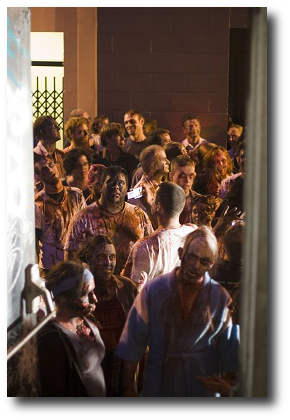
“Go make friends.” Mom points at a boy who holds a glass of punch and a slab of dripping meat. “Ask him to dance.” Artwork : Photo taken on the set of the movie by , used under a Creative Commons Attribution 2.0 license.
Artwork : Photo taken on the set of the movie Meat Market 3 by Joel Friesen, used under a Creative Commons Attribution 2.0 license

I haven’t showered in ten days. My scalp fosters a family of bacteria, but the table of party food — chunks of chicken, weenies slathered in mystery sauce, and eyeballs — has been sitting there for two days. Its smell leaves mine in the dust.

“Nance, we’ve practiced this.” Mom yanks on her matted clumps of hair. Her graying bangs are still flecked with blood from last night’s meal, which we’d picked up in the drive-thru lane at Rimpley’s Butcher. “Just remember that everybody’s watching. There can be no mistakes.”

Her tone is gentle, but she means it’s now or never. One chance to convince my new classmates.

The lights dim. The disco ball flickers to life, then bursts into flames of purple, green, magenta. Beside me, a girl dances the lurch. Nobody will ever send her away. With her jutting collarbone and discolored cheeks, she’s the prettiest girl in the room.

“Go make friends.” Mom points at a boy who holds a glass of punch and a slab of dripping meat. “Ask him to dance.”

Blood pools behind my lower lip. My tongue delves inside the hole in my gums from the incisor Mom pulled this morning.

“Do I look okay?”

“Killer. Don’t forget to shuffle.”

I obediently drag one foot after the other, although it puts a strain on my right hip. Around me, awkward hands join or rest on slanted shoulders and lumpy waists.

The boy doesn’t look up. I sneak in a quick breath — for courage — and because I still need to breathe.

“I’m Nance.”

He lifts his head, peering at me through wet, tousled hair. “Marco.” Crimson veins streak the whites of his eyes. I’ll never get my eyelids to droop that way, not unless I have surgery. Mom has already agreed to an underground procedure to lighten my skin when I am sixteen.

I try not to twitch with nervousness. “Are you new here, too?”

“Yeah. My mom made me come to this stupid dance so I would meet people.” He slouches against the wall. I wonder if he’s noticed the stains on my ragged skirt, applied carefully with blood appliqués. Does he think I’m pretty at all? He’s really nice to look at, with his sagging skin, and disjointed fingers.

“I heard the punch is good,” I offer. “They even put real blood in it, since there’s lots of adults here.”

“I don’t like it,” he says immediately, and presses his lips together, as if he didn’t mean to say that.

I look down at his untouched glass. Everyone likes the punch. Everyone but me, and even I’d chugged a glass, because that’s how this works.

I step closer. His odor reminds me of Rimpley’s Butcher, where the hot scent of blood covers the antiseptics they use to rub counters and floor. Only, Marco smells like the antiseptic part.

A wave of light washes over us. Marco turns away, but not before I see the beads of red grease caked in the corners of his mouth. Not the smooth wet stain of newly sated appetites, or the layer of day-long lipstick I’d applied since I was old enough to realize I was different, but the smear of common house paint.

“You’re not a — ”

His head whips around, far quicker than any head in the room could. “What? I don’t know what you mean.”

Sudden movements draw unwanted attention. I want to shuffle away, because he could blow my cover. His own cover. But I have so many questions.

“What about your eyes?” I blurt out.

“My dad used to be a plastic surgeon.” Marco leans in, and really looks at me for the first time. I feel an odd jerking sensation in my belly, one I’ve never felt before. “Let’s get out of here. Go some place where we can talk.”

He wants to be my friend. I’ve never met someone else like me before, someone who’s made it this far without getting caught. But Mom has warned me about spies, the kids specially trained to spot the rejects. Rejects like me. “I don’t know what you’re talking about.”

He rubs his nose on his sleeve. His eyes become green pools.

“Careful. Don’t cry,” I whisper.

“I’m not crying, I have aller — ” He stifles a sneeze, a harsh, almost-unfamiliar bark.

Our new classmates turn, dangly eyed, lumbering. I drop my right shoulder. I lumber, too. Marco straightens. He’s going to turn me in, after he proves how easy it is to fake normality.

In two seconds, we’re surrounded. I cling to my composure like it’s the only skincake left in the vending machine. My traitorous pulse thuds.

The tallest boy looks at Marco. “You’re new here,” he says. “What’s different about you?”

Marco drops the piece of meat on the floor. It lands with a splat. “I’m not d-different.”

My palms grow damp. What does Marco mean? Is he not a spy? Maybe they’re all in on it together, testing me, waiting for me to cave. I nonchalantly wipe my hands on my skirt.

The tall boy turns to me. “What do you think?”

Words fly from my mouth. “A good imitation, but not enough to fool me.” I run my tongue over my upper teeth to spread the film of blood. “I’m Nance.”

“Trevor.” The boy’s smile reveals splintered teeth. He reaches for my hand; his rotting skin dimples against mine. Mom gives me a big smile and a thumbs-up from the back of the room.

We move onto the floor. Some of the adults shuffle past us. There’s a thudding sound, and scuffling. I rest my head on Trevor’s shoulder and try to ignore the other adults dragging Marco away. He starts to scream, but I’m sure it’s part of the test. They’re waiting for me to react.

His screams sound so real.

Leave a Reply

Slouching Toward Halloween

February 2015

With Halloween coming up, I thought it might be nice (?) to serve up a few horror stories. Zombies have become a bit too trendy, as Becoming Normal shows. When She’s Ready isn’t supernatural horror, and might not be categorized as horror at all, but it still seems to merit a place here. Childhood Fears is about… well, you know.

With election day approaching before my next issue will be out, I decided to run a Classic Flash by Lord Dunsany. The Day of the Poll is a little masterpiece, and is worth reading right down to the last revealing sentence.

But as the issue was laid in place, I felt I couldn’t have a horror issue without including H.P. Lovecraft. My worldview and his are utterly different (though now, perhaps, the late author’s view is closer to mine), but he writes bewitching stuff. Since I already had a classic story, I thought it reasonable to include a poem: hence, “Despair.”

Finally, since Bruce Holland Rogers is not in this issue, I also thought it would be worthwhile to include Lovecraft’s excellent article, “Notes on Writing Weird Fiction.” Like Poe’s “Philosophy of Composition,” the information in it seems to hold true through the few generations separating us from the author.

For a variety of uninteresting reasons, we’ll probably be shifting to a mid-month publishing schedule generally from now on. I hope you enjoy the stories whenever they arrive.

Leave a Reply

Join the 
Community

Support

Support lorem ipsum dolor sit amet consectetur. At dignissim neque amet proin sodales vulputate dolor elit ipsum dolor sit amet.

Subscribe

Subscribe lorem ipsum dolor sit amet consectetur. At dignissim neque amet proin sodales vulputate dolor elit.

Submit a Story

Submissions lorem ipsum dolor sit amet consectetur. At dignissim neque amet proin sodales vulputate dolor elit. At dignissim neque amet proin sodales vulputate dolor elit.