Issue July 2010 Flash Fiction Online July 2010

Table of Contents

Sandra Plays for the Cast-Iron Man

by Tom Crosshill

February 2015

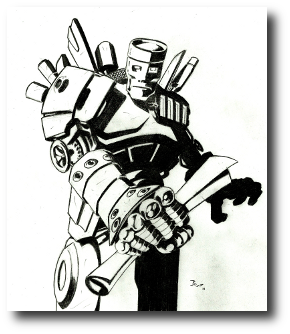
They came every night and sat at their tables with rattles and creaks. Gray-blue visages bathed in the golden light from Outside. Here a steel leg crossed over a many-jointed knee, there a dozen long fingers laced together in a steeple. Artwork © 2010, R.W. Ware
Artwork © 2010, R.W. Ware

“I’m Radok,” he said to her when everyone was gone, and steam hissed gently from his vents.

Sandra hadn’t noticed him in the audience. How could she have? They came every night and sat at their tables with rattles and creaks. Gray-blue visages bathed in the golden light from Outside. Here a steel leg crossed over a many-jointed knee, there a dozen long fingers laced together in a steeple. Seated, they stilled themselves like Victorian gentlemen posing for monochrome immortality. It made her want to jump up and scream, but she’d tried that before to little avail.

Nor did this Radok stir when she began to play. None of them did. As her hands found note after note on the scuffed keyboard, intimately familiar from a thousand nights since the End and three thousand before, as the damp-warped strings rasped out a melody that carried her to the faraway lands of memory, they didn’t so much as breathe.

A creak — on the shoulder of one, a vent closed. A hum — someone’s exhaust fans spun up.

Too soon, her song was over, all of it spent and done. Sandra kept her fingers sunk into the piano as the last of the sound reverberated and faded into silence. She sat still while her audience rose to their feet with a susurrus of clangs and tinkles, and shuffled to the exit. The airlock sucked them through to Outside one by one — hiss, plop. Hiss, plop.

When Sandra rose from the piano, he spoke from behind her, his voice cold and smooth. “Excuse me. I’m Radok.”

She whirled on him, heart hammering. Tall, this one, thick iron limbs riveted with bolts an inch in diameter.

Anger born of surprise gave her voice a hard edge. “I’ve played for tonight. One song, as agreed.”

“I ask a favor. Will you play this for me?” He reached into a cavity in his chest and drew out a sheet of paper.

Sandra took it. A score! Sol major, neatly printed. “Where did you find this?”

“In the ruins of Kalata.”

“You’re lying.” The sheet was pristine, unmarked. It had no smell of sulfur on it — it hadn’t seen Outside. Then she played the first notes in her mind, and she knew. “You wrote this!”

A blur, and Radok loomed over her, sharp angles and corrugated planes. Steam stung Sandra’s eyes, but she didn’t flinch. Surely he wouldn’t hurt her — she was precious to them, one of a kind.

“Play. Now.”

“Play it yourself.” Sandra shoved the sheet at his chest.

Radok sprang back, fast, joints screeching. He watched the piece of paper seesaw to the floor. “I tried. It’s not the same.”

Sandra turned away from him. Walked to the window and looked out into the light, the golden light that drenched Outside like bleach, leaving but a few dark shadows here and there. Tall, the skeleton of a tower. A row of humps in the distance — the domes of the city market. Home.

“I’ll play,” she said, “if you take me Outside.”

With a series of gentle creaks, Radok joined her at the window. “We thought everything would be easier.”

Sandra shivered. She’d never gotten one of them to speak about the End before — all they’d been willing to discuss had been her food and her medicine, and the demand that she play each night. “Well, isn’t everything easier?” She spread her arms wide. “Orderly. Simple.”

“Yes,” he said, “and silent.”

“Then let me out.” She shouted the words — “Let me out!” — and beat on his chest with her fists.

Pain, sharp. And he surged toward her and threw her at the window. Sandra only had time to think — one of a kind indeed — and her head hit glass. Her vision spun.

“No,” he said.

No.

Sandra flushed, not in anger but in shame. For a fleeting moment, just as that simple “No” left Radok’s cast-iron mouth, what she’d felt had been relief. That she needn’t see what they’d made of her world. Needn’t touch and smell what remained. That she might stay in her prison for a while longer.

Sandra hated him just then. She could have thrown herself at him again and been killed, and not regretted it. But a thought occurred to her. Something better than a pointless death.

“I’ll play.”

Radok stepped away from her. “Will you?”

She smiled at him. “Yes.”

Sandra retrieved his sheet of music and settled at the piano. As her eyes roved over the notes he’d written, she tried to ignore the pain in her hands where she’d struck him, the ache in her biceps where he’d held her. And she played. Note after note, as he’d written it. She poured all her anger out through her fingertips, all her pity too, and all her loss. Once through the score she played, then again, a different way. Then once again, striving for her utmost, honest best.

Radok stood behind her, unmoving, silent. When she finished, he spoke with a note of wonderment in his voice, and with a quiet pain. “It’s not music. It’s not music, is it?”

“No,” she said. “It isn’t.”

“But why?”

Sandra rose. She turned away from the piano and walked toward the window where the light of Outside had begun to fade into darkness. She stared out at the shapes that loomed beyond, dark, silent, unmoving, and wondered if she was the last of her kind.

She didn’t pull away when Radok joined her and clanked his fingertips against the glass. He didn’t repeat his question. “I’ll try again,” was all he said, quiet, sure.

Together, they stood there and watched Outside sink into night, while somewhere in Sandra’s head a song played. It was tomorrow’s song, a song that waited for her. Waited to carry her to the faraway lands of memory. Her fingers stirred to its beat.

Just then, listening to the even hiss of steam from Radok’s joints, the Outside within was enough for her.
Leave a Reply

Kolkata Sea

by Indrapramit Das

February 2015

I remember the time my mother took me to see the city where I was born. She was a young woman then. There were sea-birds rippling through the warm white sky high above her head, drifting like ashes on the summer breeze. I was in her lap, slightly nauseous from the motion of our vessel on the cresting waves.

“Look, sweetheart,” she said, her chin moving against my head as she spoke. Her strong hands clasped me under my armpits and lifted me up to get a better view over the side of the boat. I looked out at the sea.

“We’re here. Kolkata,” she said softly into my ear, and even then I remembered being astonished at how beautifully sad her voice was, saying the name of the city where she and I took our first breaths. I looked, and saw only endless miles of undulating water. But I followed her pointing finger to the silver line of the horizon, and found the skyline of a city shimmering there like a mirage. She said no more, lifting me off her lap and patting me on the back. “Go play,” she said, staring out at the distant city. I watched one of the crew cut fish on the wooden deck, his smile broad and white against his dark skin.

“Do you live here in Kolkata?” I asked him, fascinated by this new Atlantis at the edge of my world, this sea-city that twinkled over the water as if it were a dream, a myth made real by my mother.

“No, little one,” he said to me. “We used to live in Kolkata, but now only fish live there. So we sail our boats, and we catch them,” he held one up, its gills sucking at the moist air. “And we eat them.” Disconcerted, I ran to the other side of the boat and clung to the edge, pulling myself up with quivering arms. I just managed to see the dark green line of the mainland. It was still there.

I walked back to my mother. She was marked out among the line of tourists taking photos of the sunken city by the crimson pennant of her dupatta lashing around her neck in the wind. She touched my head, nails raking through my short-cropped hair.

“Remember this. Before it’s gone forever,” she said to me.

“The British called it Calcutta, we called it Kolkata, and now it’s just the sea,” she once told me, holding my hand firmly to keep me from tumbling over the rails of the tour boat (she took me on the same tour many times, as I grew older, and I struggled to keep her from holding my hand). Despite this, I noticed that she still called the city, or whatever part of it still showed itself to her, Kolkata. It is now part of the Bay of Bengal. Even seas have names, after all, because we need to call them something. Kolkata is still my mother’s city, and I have always envied that. She was alive in this Atlantis of the Indias, and lived to tell its tale.

The boat under my feet feels familiar. High tide swallows more of the city than I remember. I look at the few lights flickering in the windows of twilit high-rises reaching out of the water. Despite what that stranger on the boat told me as a child, the fishermen have since inherited what remains here, living in the abandoned apartments behind those windows. Kerosene lamps burn where electric lights once glowed and boats sail down avenues of water where once cars, buses and auto-rickshaws made their way in a noxious haze of fumes.

The lamp-light from the buildings throws quivering streaks on the water. Through the windows I see the shadows of families against flame yellowed walls, going about their lives in rooms much like the ones my parents lived in. The women use chopped furniture or other flammable leftovers of urban civilization to make their cooking fires next to the apartment windows, as they once burned firewood under the open sky behind their huts and houses on the mainland to prepare meals. The smoke from their fires trickles in white streamers from the buildings, pushed outside by the flapping of hand-fans. From the rooftops of the drowned buildings the men of the city watch the tour boats pass by while spreading their nets out to dry, filling the evening air with the stench of dying sea creatures.

I wonder what it is like to wake to a city filled by the sea, in apartments and offices filled with the damp relics of middle and upper classes vanished to the slowly shrinking mainland. To see the sun rise over these flooded urban chasms, to crawl out of an open window and into a boat, and sail through a vanishing city reaping the fish and crustaceans that have reclaimed it.

I wouldn’t be able to live here. I can almost smell the bitter air my mother once described to me, now clean and salty but for the hint of diesel from the motorized tour boats. I can see the haphazard metropolis in the photos I gleaned from her old, scratched discs and yellowed newspaper cuttings.

I think of my father smiling, one hand on the peachy mass of my mother’s belly (full with me), in his last photo with her, taken days before he disappeared during the first chaotic floods that heralded my birth. I have inherited his receding hairline. I look around my hometown, at the relics of its skyline as it perseveres above the tide. I have rarely thought about the fact that my father might still be down there in one of the city’s weed-choked, fish-thronged streets, his skeleton calcifying into a coraled statue. If the city were to sink forever, what pilgrimage would my mother make? What marker would tell her where her husband, whom she loved for just three years, lay at rest? It matters little now. I knew neither my father nor this city, except from my mother’s words.

“It’s still here,” I say, and open the lid of the urn. The ashes land on the waves of Kolkata, where they swirl away a liquid ghost.

Leave a Reply

Through Amber Eyes

by Polenth Blake

February 2015

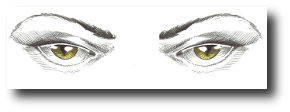
My eyes look brown in the photo, but they’re not. If I tilt my head the right way in the light, I can see amber glittering under the brown. I wish there was a way to peel back the brown and see my real eyes. Artwork © 2010, R.W. Ware.
Artwork © 2010, R.W. Ware.

I paint whiskers on my face with bath water. The water doesn’t stay, but the whiskers remain. I prowl around the house in my bathrobe.

The cat is washing herself on the rug. I kneel down to show her my fresh whiskers. “Meow,” I say. She flicks her tail in disdain, as though I’m any other human.

Dad looks up from his newspaper. “Eyra, stop that.”

I’m too old to be a house cat.

My dad told me a story once, about leopard spots being leftover ink from making humans brown. I’m too brown to be a leopard; the spots wouldn’t show. I try anyway, pressing my fingers in a circle where the spots should be. The spots don’t feel right, so I save them for another cat.

When I was ten, I became a tiger. I searched the house for ambush points and found one under dad’s bed.

There was a book in my hiding place. It was charred around the edges and the cover blackened.

It was a fairytale about a boy who was born as a cat. His human mother was forced to run away, to stop them hurting her little kitten. Once he was grown, he washed away his fur and became a man. Had he always been a man inside, waiting for the right moment to shed his fur? Did he ever miss being a cat? I imagined what it must be like, to be born with a tail and whiskers.

When dad saw me reading it, he snatched it from me. There were tears in his eyes. Said it was mum’s book.

Cheetahs can run at over 70 miles per hour. That’s way above the speed limit.

I run down my road as fast as I can. Maybe I’ll set off the speed camera and people will marvel at how fast I am. I’ll tell them there’s a cat inside me. It’s always been there, but no one could see it. They won’t laugh, because they’ll see me running and know it’s true.

Dad sees me running in the road and stops me. I expect him to shout, but he doesn’t. He hugs me instead.

Dad’s making a cake. I’ll be sixteen tomorrow and we can’t afford a big party. It’s just me, dad, and the cat. We’ve always called her cat, as she wasn’t ours. Just a stray who ended up living here more often than she didn’t.

The oldest photo I have is when I was seven, taken at school. My hair is pulled into a puff and I’m smiling. My eyes look brown in the photo, but they’re not. If I tilt my head the right way in the light, I can see amber glittering under the brown. I wish there was a way to peel back the brown and see my real eyes.

“Dad, do we have any pictures of baby me?”

He stops stirring the cake mix. “Sorry.”

I know what that means: The fire took them. It took my memories, too.

My birthday card from dad has a jaguarundi on the front. It’s one of those conservation cards, where money goes to making sure the cats have a home. Dad looks sad, says he’s just being sentimental, seeing me all grown up.

I sit on the front doorstep and place the card next to me. The little brown cat watches me from the cardboard. I watch the cat, until I win the staring contest and he looks away. We settle down to watch the rain together.

Jaguarundis don’t meow or roar — they whistle to each other. I call into the storm.

A whistled reply comes from the bushes and I remember. I’ve heard the sound before, years ago. Mum sang me to sleep the night they set fire to the house. My room was full of smoke when dad woke me. He picked me up and jumped out the window. Mum wouldn’t jump. She tried to run down the stairs, but she wasn’t a cheetah.

“Look after dad,” I tell the brown cat as I slip the card under the front door.

I step into the rain. It washes away my skin, leaving only my fur behind.

Leave a Reply

In Living Memory

February 2015

Jake Freivald, Founding Editor

This month’s stories are all sort of past-perfect, for you grammar wonks; all of them involve things the main characters once had.

Polenth Blake’s main character in “Through Amber Eyes” seems to be looking for her past, but, knowing she can’t find it, takes a different route to knowing who she is. I enjoyed this for its emotional appeal and the way it almost slips into magical realism.

Indrapramit Das’s “Kolkata Sea” shows us, through her son’s eyes, a mother who lost her city. (“Kolkata” may be more familiar to Western readers as “Calcutta.”)

Tom Crosshill shows us, in “Sandra Plays for the Cast-Iron Man”, a woman who lost her home — and a robot who also lost something, too. This has an odd poignancy to it, and as someone who loves even some of the otherworldly music of Arnold Schönberg, there was one moment that particularly caught me.

It seemed fitting to include a Classic Flash from Lord Dunsany in this mix, too. “The Watchtower” is also about things past and, perhaps, about things present and future.

Finally, with Bruce Holland Rogers trying to organize his withdrawal from Budapest, I thought it might be interesting to give writers a feeling for how withering criticism can be in the hands of a master: Mark Twain is the Deerslayer-slayer. Fenimore Cooper’s Literary Offenses is bitingly funny, but also a sobering critique that is worth reading for its content as well as its style. And remember, The Deerslayer is considered a classic of American literature. If it can be thus eviscerated and still have merit, I’m sure your writing is better than some people are allowing for as well.

And a special thank-you to R.W. Ware for his original artwork!


Leave a Reply

Memory

by H.P. Lovecraft

February 2015

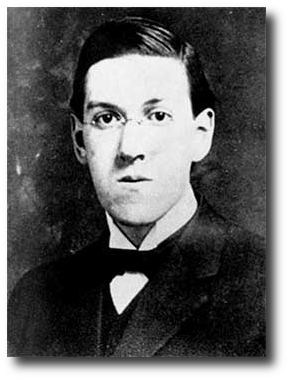
 Artwork : This photo is in the public domain.
H.P. Lovecraft.

In the valley of Nis the accursed waning moon shines thinly, tearing a path for its light with feeble horns through the lethal foliage of a great upas-tree. And within the depths of the valley, where the light reaches not, move forms not meant to be beheld. Rank is the herbage on each slope, where evil vines and creeping plants crawl amidst the stones of ruined palaces, twining tightly about broken columns and strange monoliths, and heaving up marble pavements laid by forgotten hands. And in trees that grow gigantic in crumbling courtyards leap little apes, while in and out of deep treasure-vaults writhe poison serpents and scaly things without a name. Vast are the stones which sleep beneath coverlets of dank moss, and mighty were the walls from which they fell. For all time did their builders erect them, and in sooth they yet serve nobly, for beneath them the grey toad makes his habitation.

At the very bottom of the valley lies the river Than, whose waters are slimy and filled with weeds. From hidden springs it rises, and to subterranean grottoes it flows, so that the Daemon of the Valley knows not why its waters are red, nor whither they are bound.

The Genie that haunts the moonbeams spake to the Daemon of the Valley, saying, “I am old, and forget much. Tell me the deeds and aspect and name of them who built these things of Stone.” And the Daemon replied, “I am Memory, and am wise in lore of the past, but I too am old. These beings were like the waters of the river Than, not to be understood. Their deeds I recall not, for they were but of the moment. Their aspect I recall dimly, it was like to that of the little apes in the trees. Their name I recall clearly, for it rhymed with that of the river. These beings of yesterday were called Man.”

So the Genie flew back to the thin horned moon, and the Daemon looked intently at a little ape in a tree that grew in a crumbling courtyard.

Leave a Reply

Join the 
Community

Support

Support lorem ipsum dolor sit amet consectetur. At dignissim neque amet proin sodales vulputate dolor elit ipsum dolor sit amet.

Subscribe

Subscribe lorem ipsum dolor sit amet consectetur. At dignissim neque amet proin sodales vulputate dolor elit.

Submit a Story

Submissions lorem ipsum dolor sit amet consectetur. At dignissim neque amet proin sodales vulputate dolor elit. At dignissim neque amet proin sodales vulputate dolor elit.