Issue June 2010 Flash Fiction Online June 2010

Test Rocket

by Jack Douglas

February 2015

 Artwork courtesy of , via Wikimedia. This is an image of a test of the Ares I-X rocket, which is part of the program to once again lift mankind beyond low Earth orbit.
Artwork courtesy of NASA, via Wikimedia. This is an image of a test of the Ares I-X rocket, which is part of the program to once again lift mankind beyond low Earth orbit.

It’s amazing how much you can learn about absolute strangers if you just stop to think about the kind of an animal they’ll put in a test rocket…

Captain Baird stood at the window of the laboratory where the thousand parts of the strange rocket lay strewn in careful order. Small groups worked slowly over the dismantled parts. The captain wanted to ask but something stopped him. Behind him Doctor Johannsen sat at his desk, his gnarled old hand tight about a whiskey bottle, the bottle the doctor always had in his desk but never brought out except when he was alone, and waited for Captain Baird to ask his question. Captain Baird turned at last.

“They are our markings?” Captain Baird asked. It was not the question. Captain Baird knew the markings of the Rocket Testing Station as well as the doctor did.

“Yes,” the doctor said, “they are our markings. Identical. But not our paint.”

Captain Baird turned back to the window. Six months ago it had happened. Ten minutes after launching, the giant test rocket had been only a speck on the observation screen. Captain Baird had turned away in disgust.

“A mouse!” the captain had said, “unfortunate a mouse can’t observe, build, report. My men are getting restless, Johannsen.”

“When we are ready, Captain,” the doctor had said.

It was twelve hours before the urgent call from Central Control brought the captain running back to the laboratory. The doctor was there before him. Professor Schultz wasted no time, he pointed to the instrument panel. “A sudden shift, see for yourself. We’ll miss Mars by a million and a quarter at least.”

Two hours later the shift in course of the test rocket was apparent to all of them and so was their disappointment.

“According to the instruments the steering shifted a quarter of an inch. No reason shows up,” Professor Schultz said.

“Flaw in the metal?” Doctor Johannsen said.

“How far can it go?” Captain Baird asked.

Professor Schultz shrugged. “Until the fuel runs out, which is probably as good as never, or until the landing mechanism is activated by a planet-sized body.”

“Course? Did you plot it?” The doctor asked.

“Of course I did,” Professor Schultz said, “as close as I can calculate it is headed for Alpha Centauri.”

Captain Baird turned away. The doctor watched him.

“Perhaps you will not be quite so hasty with your men’s lives in the future, Captain?” the doctor said.

Professor Schultz was spinning dials. “No contact,” the professor said, “No contact at all.”

That had been six months ago. Three more test rockets had been fired successfully before the urgent report came through from Alaskan Observation Post No. 4. A rocket was coming across the Pole.

The strange rocket was tracked and escorted by atomic armed fighters all the way to the Rocket Testing Station where it cut its own motors and gently landed. In the center of a division of atomic-armed infantry the captain, the doctor, and everyone else, waited impatiently. There was an air of uneasiness.

“You’re sure it’s not ours?” Captain Baird asked.

The doctor laughed. “Identical, yes, but three times the size of ours.”

“Perhaps one of the Asian ones?”

“No, it’s our design, but too large, much too large.”

Professor Schultz put their thoughts into words. “Looks like someone copied ours. Someone, somewhere. It’s hard to imagine, but true nevertheless.”

They waited two weeks. Nothing happened. Then a radiation-shielded team went in to examine the rocket. Two more weeks and the strange rocket was dismantled and spread over the field of the testing station. The rocket was dismantled and the station had begun to talk to itself in whispers and look at the sky.

Captain Baird stood now at the window and looked out at the dismantled rocket. He looked but his mind was not on the parts of the rocket he could see from the window.

“The materials, they’re not ours?” the captain asked.

“Unknown here,” the doctor said.

The captain nodded. “Those were our instruments?”

“Yes.” The doctor still held the whiskey bottle in a tight grip.

“They sent them back,” the captain said.

The doctor crashed the bottle hard against the desk top. “Ask it, Captain, for God’s sake!!”

The captain turned to face the doctor directly. “It was a man, a full grown man.”

The doctor sighed as if letting the pent-up steam of his heart escape. “Yes, it is a man. It breathes, it eats, it has all the attributes of a man. But it is not of our planet.”

“Its speech…” the captain began.

“That isn’t speech, Captain,” the doctor broke in, breaking in sharply, “It’s only sound.” The doctor stopped; he examined the label of his bottle of whiskey very carefully. A good brand of whiskey. “He seems quite happy in the storeroom. You know, Captain, what puzzled me at first? He can’t read. He can’t read anything, not even the instruments in that ship. In fact he shows no interest in his rocket at all.”

The captain sat down now. He sat at the desk and faced the doctor. “At least they had the courage to send a man, not a mouse. Doctor, a man.”

The doctor stared at the captain, his hand squeezing and unsqueezing on the whiskey bottle. “A man who can’t read his own instruments?” The doctor laughed. “Perhaps you too have failed to see the point? Like that stupid general who sits out there waiting for the men from somewhere to invade?”

“Don’t you think it’s a possibility?”

The doctor nodded. “A very good possibility, Captain, but they will not be men.” The doctor seemed to pause and lean forward. “That rocket, Captain, is a test rocket. A test rocket just like ours!

Then the doctor picked up his whiskey bottle at last and poured two glasses.

“Perhaps a drink, Captain?”

The captain was watching the sky outside the window.
Leave a Reply

Thicker Than Water

February 2015

This story took the laurel in Life Magazine’s Shortest Story Contest, and was published along with 80 other stories in 1916.

Doctor Burroughs, summoned from the operating room, greeted his friend from the doorway: “Sorry, Harry, but you’ll have to go on without me. I’ve got a case on the table that I can’t leave. Make my excuses, will you?”

“There’s still an hour,” replied the visitor. “I’m early and can wait.”

“Then come in with me.” Markham followed to the operating room, white-walled, immaculate, odorous of stale ether and antiseptics. On the table lay the sheeted form of a young girl. Only the upper portion of the body was visible, and about the neck wet, red-stained bandages were bound. “A queer case,” said the surgeon. “Brought here from a sweat-shop two hours ago. A stove-pipe fell and gashed an artery in her neck. She’s bleeding to death. Blood’s supposed to be thicker than water, but hers isn’t, poor girl. If it would clot she might pull through. Or I could save her by transfusion, but we can’t find any relatives, and there’s mighty little time.”

The attending nurse entered. “The patient’s brother is here,” she announced, and is asking to see her.”

“Her brother!” The surgeon’s face lighted. “What’s he like?”

“About twenty, Doctor; looks strong and healthy.”

“See him, Nurse. Tell him the facts. Say his sister will die unless he’ll give some blood to her. Or wait!” He turned to Markham. “Harry, you do it! Persuasion’s your line. Make believe he’s a jury. But put it strong, old man! And hurry! Every minute counts!”

The boy was standing stolidly in the waiting-room, only the pallor of his healthy skin and the anxiety of his clear eyes hinting at the strain. Markham explained swiftly, concisely.

“Doctor Burroughs says it’s her one chance,” he ended.

The boy drew in his breath and paled visibly.

“You mean Nell’ll die if someone don’t swap his blood for hers?”

“Unless the blood she has lost is replaced — ”

“Well, quit beefin’,” interrupted the other roughly. “I’m here, ain’t I?”

When he entered the operating room the boy gave a low cry of pain, bent over the form on the table, and pressed his lips to the white forehead. When he looked up his eyes were filled with tears. He nodded to the surgeon.

Doggedly, almost defiantly, he submitted himself, but when the artery had been severed and the blood was pulsing from his veins to the inanimate form beside him his expression changed to that of abject resignation. Several times he sighed audibly, but as if from mental rather than bodily anguish. The silence became oppressive. To Markham it seemed hours before the surgeon looked up from his vigil and nodded to the nurse. Then:

“You’re a brave lad,” he said cheerfully to the boy. “Your sacrifice has won!”

The boy, pale and weak, tried to smile. “Thank God!” he muttered. Then, with twitching mouth: “Say, Doc, how soon do I croak?”

“Why, not for a good many years, I hope.” The surgeon turned frowningly to Markham. “Didn’t you explain that there was no danger to him?”

“God! I’m afraid I didn’t!” stammered Markham. “I was so keen to get his consent. Do you mean that he thought — ”

The surgeon nodded pityingly and turned to the lad. “You’re not going to die,” he said gently. “You’ll be all right tomorrow. But I’m deeply sorry you’ve suffered as you must have suffered the past hour. You were braver than any of us suspected!”

“Aw, that’s all right,” muttered the boy. “She’s my sister, ain’t she?”

Leave a Reply

Taking the Census

February 2015

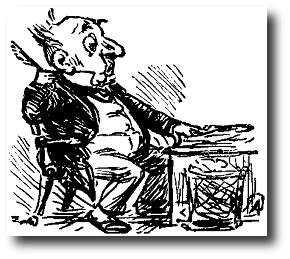
I may say that the title of the subordinate officer intrusted with the addition of my household to the compilation of the Census pleased me greatly — “Appointed Enumerator” was distinctly good. Artwork : This picture, apparently of Mr. A. Briefless, Jr. filling out the census form, illustrated this story in the original Punch magazine. It is in the public domain.
Artwork : This picture, apparently of Mr. A. Briefless, Jr. filling out the census form, illustrated this story in the original Punch magazine. It is in the public domain.

(A Story of the 6th of April, 1891.)

A. Briefless, Junior.

As I have but a limited holding in the Temple, and, moreover, slept on the evening of the 5th of April at Burmah Gardens, I considered it right and proper to fill in the paper left me by the “Appointed Enumerator” at the latter address. And here I may say that the title of the subordinate officer intrusted with the addition of my household to the compilation of the Census pleased me greatly — “Appointed Enumerator” was distinctly good. I should have been willing (of course for an appropriate honorarium) to have accepted so well-sounding an appointment myself. To continue, the general tone of the instructions “to the Occupier” was excellent. Such words as “erroneous,” “specification,” and the like, appeared frequently, and must have been pleasant strangers to the householder who was authorised to employ some person other than himself to write, “if unable to do so himself.” To be captious, I might have been better pleased had the housemaid who handed me the schedule been spared the smile provoked by finding me addressed by the “Appointed Enumerator” as “Mr. BEEFLESS,” instead of “Mr. BRIEFLESS.” But this was a small matter.

I need scarcely say that I took infinite pains to fill in my paper accurately. I have great sympathy with the “Census (England and Wales) Act, 1890,” and wished, so far as I was personally concerned, to carry out its object to the fullest extent attainable. I had no difficulty about inserting my own “name and surname,” and “profession or occupation.” I rather hesitated, however, to describe myself as an “employer,” because the “examples of the mode of filling-up” rather suggested that domestic servants were not to count, and for the rest my share in the time of PORTINGTON, to say the least, is rather shadowy. For instance, I could hardly fairly suggest that in regard to the services of my excellent and admirable clerk, I am as great an employer of labour as, say, the head of a firm of railway contractors, or the managing director of a cosmopolitan hotel company. Then, although I am distinctly of opinion that I rightly carried out the intentions of the statute by describing myself as “the head of the family,” my wife takes an opposite view of the question. In making the other entries, I had no great difficulty. The ages of my domestics, however, caused me some surprise. I had always imagined (and they have given me their faithful and valuable services I am glad to say for a long time) that the years in which they were born varied. But no, I was wrong. I found they were all of the same age — two-and-twenty. To refer to another class of my household — I described my son, SHALLOW NORTH BRIEFLESS (the first is an old family name of forensic celebrity, and the second an appropriate compliment to a distinguished member of the judicial Bench, whose courtesy to the Junior Bar is proverbial) as a “scholar,” but rejected his (SHALLOW’s) suggestion that I should add to the description of his brother (one of my younger sons, GEORGE LEWIS VAN TROMP CHESTER MOTE BOLTON BRIEFLESS — I selected his Christian names in anticipated recognition of possible professional favours to be conferred on him in after-life) the words “imbecile from his birth,” as frivolous, untrue, and even libellous. We had but one untoward incident. In the early morning of Monday we found in our area a person who had evidently passed the night there in a condition of helpless intoxication. As she could offer no satisfactory explanation of her presence, I handed her over to the police, and entered her on the Census Paper as, “a supposed retired laundress, seemingly living on her own means, and apparently blind from the date of her last drinking-bout.” I rejected advisedly her own indistinctly but frequently reiterated assertion that “she was a lady,” because I had been warned by “the general instructions” to avoid such “indefinite terms as Esquire or Gentleman.”

As I wished to deliver my completed schedule to the “Appointed Enumerator” in person, I desired that he might be shown into my study when he called for the paper.

“Excuse me, Sir,” he said, after looking through the document at my request; “but you see there is a fine of a fiver for wilfully giving false information.”

“Yes,” I returned, somewhat surprised at the suggestion; “and the proposed penalty has rendered me doubly anxious to be absolutely accurate. Do you notice any slip of the pen?”

“Well, Sir,” he answered, with some hesitation, “as the young chap who does the boots tells me that he has never heard of you having had a single brief while he’s been with you, and that’s coming three years, hadn’t you better put ‘retired’ after ‘Barrister-at-Law’? It will do no harm, and certingly would be safer!”

Put “retired” after Barrister-at-Law! “Do no harm!” and be “safer!”

I silently intimated by a dignified gesture to the “Appointed Enumerator” that our interview was at an end, and then, taking my walking-stick with me, went in earnest and diligent search of “the young chap who does the boots!”

(Signed) A. BRIEFLESS, JUNIOR.

Leave a Reply

Give It Up

by Franz Kafka

February 2015

Franz Kafka in 1906. Artwork : This picture is in the .

It was very early in the morning, the streets clean and deserted, I was walking to the station. As I compared the tower clock with my watch I realized that it was already much later than I had thought, I had to hurry, the shock of this discovery made me unsure of the way, I did not yet know my way very well in this town; luckily, a policeman was nearby, I ran up to him and breathlessly asked him the way. He smiled and said: “From me you want to know the way?” “Yes,” I said, “since I cannot find it myself.” “Give it up! Give it up,” he said, and turned away with a sudden jerk, like people who want to be alone with their laughter.

Comments

  1. Richard C Winant says:
    Not an impressive story from a usually brilliant writer. It expresses his usual paranoid response to bureaucratic indifference or incompetence, that’s all. Give it up.
    1. Rebecca Halsey says:
      Indeed, I have often wondered why my predecessors wanted to post classic flash fiction on the site. Maybe as a way to generate traffic. I’ll have to see if anyone from that era still on staff knows the reason
  2. A R Leonard says:
    To take the opposite position of the above comments, this is an efficient piece of writing, particularly its final few words of “like people who want to be alone with their laughter,” which is both multilayered in its own meanings, and forms an inverted mockery of the rest of the piece.

Leave a Reply

The Artful Touch

by Charles Dickens

February 2015

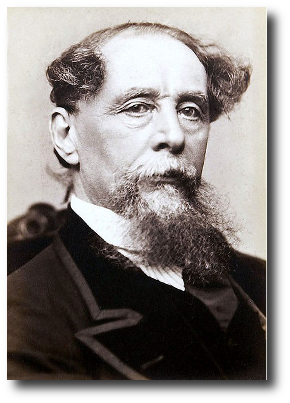
. Artwork : This photo is in the public domain and comes to us via .
Charles Dickens, circa 1867

“One of the most beautiful things that ever was done, perhaps,” said Inspector Wield, emphasising the adjective, as preparing us to expect dexterity or ingenuity rather than strong interest, “was a move of Sergeant Witchem’s. It was a lovely idea!

“Witchem and me were down at Epsom one Derby Day, waiting at the station for the Swell Mob. As I mentioned, when we were talking about these things before, we are ready at the station when there’s races, or an Agricultural Show, or a Chancellor sworn in for an university, or Jenny Lind, or anything of that sort; and as the Swell Mob come down, we send ’em back again by the next train. But some of the Swell Mob, on the occasion of this Derby that I refer to, so far kidded us as to hire a horse and shay; start away from London by Whitechapel, and miles round; come into Epsom from the opposite direction; and go to work, right and left, on the course, while we were waiting for ’em at the Rail. That, however, ain’t the point of what I’m going to tell you.

“While Witchem and me were waiting at the station, there comes up one Mr. Tatt; a gentleman formerly in the public line, quite an amateur Detective in his way, and very much respected. ‘Halloa, Charley Wield,’ he says. ‘What are you doing here? On the look out for some of your old friends?’ ‘Yes, the old move, Mr. Tatt.’ ‘Come along,’ he says, ‘you and Witchem, and have a glass of sherry.’ ‘We can’t stir from the place,’ says I, ‘till the next train comes in; but after that, we will with pleasure.’ Mr. Tatt waits, and the train comes in, and then Witchem and me go off with him to the Hotel. Mr. Tatt he’s got up quite regardless of expense, for the occasion; and in his shirt-front there’s a beautiful diamond prop, cost him fifteen or twenty pound — a very handsome pin indeed. We drink our sherry at the bar, and have had our three or four glasses, when Witchem cries suddenly, ‘Look out, Mr. Wield! stand fast!’ and a dash is made into the place by the Swell Mob — four of ’em — that have come down as I tell you, and in a moment Mr. Tatt’s prop is gone! Witchem, he cuts ’em off at the door, I lay about me as hard as I can, Mr. Tatt shows fight like a good ’un, and there we are, all down together, heads and heels, knocking about on the floor of the bar — perhaps you never see such a scene of confusion! However, we stick to our men (Mr. Tatt being as good as any officer), and we take ’em all, and carry ’em off to the station. The station’s full of people, who have been took on the course; and it’s a precious piece of work to get ’em secured. However, we do it at last, and we search ’em; but nothing’s found upon ’em, and they’re locked up; and a pretty state of heat we are in by that time, I assure you!

“I was very blank over it, myself, to think that the prop had been passed away; and I said to Witchem, when we had set ’em to rights, and were cooling ourselves along with Mr. Tatt, ‘we don’t take much by this move, anyway, for nothing’s found upon ’em, and it’s only the braggadocia*, after all.’ ‘What do you mean, Mr. Wield?’ says Witchem. ‘Here’s the diamond pin!’ and in the palm of his hand there it was, safe and sound! ‘Why, in the name of wonder,’ says me and Mr. Tatt, in astonishment, ‘how did you come by that?’ ‘I’ll tell you how I come by it,’ says he. ‘I saw which of ’em took it; and when we were all down on the floor together, knocking about, I just gave him a little touch on the back of his hand, as I knew his pal would; and he thought it was his pal; and gave it me!’ It was beautiful, beau-ti-ful!

“Even that was hardly the best of the case, for that chap was tried at the Quarter Sessions at Guildford. You know what Quarter Sessions are, sir. Well, if you’ll believe me, while them slow justices were looking over the Acts of Parliament, to see what they could do to him, I’m blowed if he didn’t cut out of the dock before their faces! He cut out of the dock, sir, then and there; swam across a river; and got up into a tree to dry himself. In the tree he was took — an old woman having seen him climb up — and Witchem’s artful touch transported him!”

* Three month’s imprisonment as reputed thieves.

Leave a Reply

Border Crossing

When I drove north across the border, I didn’t have smuggling on my mind. I drove through the mountains like any tourist who wanted only a little respite. Artwork : Photo courtesy of Matt Keilty.
Artwork : Photo courtesy of Matt Keilty.

This story collection is an exemplar for Short-short Sighted #23, “Let Me Repeat That: A Prose Villanelle”.

Lately I don’t recognize this country, the land of my birth. The contours of the land are the same. I can buy what I always bought in the stores. The weather has changed, though. Last winter, we had no snow, but the wind blew love letters to dead soldiers into drifts up to my knees.

When I drove north across the border, I didn’t have smuggling on my mind. I drove through the mountains like any tourist who wanted only a little respite. In the alpine snow fields, I saw blue shadows. That particular color has its own name, a name unknown on my side of the border.

The border guard walked around my car, inspecting with a mirror on a long rod. He made me open the trunk. A dog sniffed the upholstery. “Take off your shoes,” the guard said. With gloved fingers, he lifted the insole to find the word I had hidden underneath, the word for blue shadows in snow. He said, “Did you think we wouldn’t know where to look?”

When I was a boy of five, I played all summer in a green jumpsuit with insignia on the sleeves, firing my cap guns at the enemy trees. I had a red fireman’s helmet, too, with the long brim in back, and I was spanked for aiming the garden hose through an open bedroom window. When I grew up, I was going to be a fireman or a soldier, and I didn’t see much difference between them.

Across the border, the money is more colorful. On the blue or red bills are portraits of heros whose names I never heard in school.

Lately I don’t recognize this country, the land of my birth. These mountains are the same mountains. The presidents on my money are the same ones whose names I learned in school. The weather has changed, though. Last winter, we had no snow. Instead, the names of dead presidents fell from the sky. Wind blew the black letters of WASHINGTON and LINCOLN into drifts up to my knees.

It was no trouble at all to cross the border. The guard looked at my passport and stamped it only because I asked her to. I wanted some physical sign that I had been somewhere else, some evidence besides memory.

Certainly, I did not have smuggling on my mind. On my second day there, I drove across the grasslands at first light. Cresting a rise, I saw wheat fields lying before me like a blanket. We have such fields in my own country, but we do not have a word for the color of the ripe grain first thing in the morning.

The border guard walked around my car, inspecting with a mirror on a long rod. He made me open the trunk. A dog sniffed the upholstery. “Open your mouth,” he said. With gloved fingers, he lifted my tongue to find the word I had hidden underneath, the word for miles of ripe wheat in the morning light. He said, “Did you think we wouldn’t know where to look?”

There is a border between innocence and experience, a border that moves. I keep thinking that I have crossed it, and having crossed it, I change my mind about what I know. I am a man now, and I know what it is to be a man. But then I find that the border has moved ahead of me, and I still have much to learn about being a man. War is never necessary, I think. But the border has moved. War is sometimes necessary. No, I find that I am still on the side of innocence.

The same trees grow on either side of the border. In the other country, many people speak the same language as the language they speak in the country of my birth. Not all the words are the same. The dust doesn’t know which country it belongs to. Wind blows dust north today and south tomorrow, increasing one nation at the expense of the other, then taking back what it gave. Lately I don’t recognize this country, even though the trees are the same on either side of the border. My own country feels strange. It is the other side that feels familiar. Familiar, and strange at the same time. In the land of my birth, the weather is still the weather, although last winter we went without snow.

For miles and miles, no fence divides one side from the other. You could walk back and forth all day, testing the difference until night fell. You might wake to find your head in one country and your feet in the other.

In fact, I did not walk the unguarded portions of the border at night, but when I was in the other country, I walked beyond the glow of my campfire until I could no longer see my hand before my face. I lay on my back and looked up through the trees silhouetted against the starry sky. The darkness between the stars is the same darkness we see from my own country. The border guard walked around my car, writing notes on a clipboard. He made me pop the hood and open the trunk. He took me to a room without windows. “Take off your shirt,” he said. He used a sharp blade on the skin of my chest, and he peeled back my skin to reveal the word I had hidden underneath, the word for the dark between the stars. He said, “Did you think we wouldn’t know where to look?”

In the other country, they wear red plastic poppies on their lapels to remember the war dead.

In the mountains of the other country, I came upon a field of poppies. They were not red at all, but a shade of orange.

Lately I don’t recognize this country, the land of my birth. I feel sometimes as if I crossed a border that I hadn’t intended to cross. Those are the hills that have always been there, forested with trees that I know. But last winter, we had no snow, and the wind blew the dried petals of poppies into drifts up to my knees.

The border guard walked around my car. He inspected the back seat, the trunk, the hubcaps. He took me to a room without windows. “Take off your shirt,” he said. He pushed a needle into my arm and drew out my blood. He spread the blood on a plate of glass. He read the word that I was smuggling home. He said, “Did you think we wouldn’t know where to look?”


Bruce Holland Rogers has a home base in Eugene, Oregon, the tie-dye capital of the world. He writes all types of fiction: SF, fantasy, literary, mysteries, experimental, and work that’s hard to label.

For six years, Bruce wrote a column about the spiritual and psychological challenges of full-time fiction writing for Speculations magazine. Many of those columns have been collected in a book, Word Work: Surviving and Thriving as a Writer (an alternate selection of the Writers Digest Book Club). He is a motivational speaker and trains workers and managers in creativity and practical problem solving.

He has taught creative writing at the University of Colorado and the University of Illinois. Bruce has also taught non-credit courses for the University of Colorado, Carroll College, the University of Wisconsin, and the private Flatiron Fiction Workshop. He is a member of the permanent faculty at the Whidbey Writers Workshop MFA program, a low-residency program that stands alone and is not affiliated with a college or university. It is the first and so far only program of its kind. Currently he is teaching creative writing and literature at Eötvös Loránd University in Budapest, Hungary, on a Fulbright grant.


Become a Patron!

We need all the help we can get. For more info on any number of flash-tabulous rewards including extra stories, personalized critiques, and more:

patreonfriend

Or…

If you enjoy Flash Fiction Online, consider subscribing or purchasing a downloadable copy. Your donations go a long way to paying our authors the professional rates they deserve. For only $0.99/issue that’s cheaper than a cup of coffee. Or subscribe for $9.99/year.

subscribe_button


Leave a Reply

The Talking-out of Tarrington

by Saki

February 2015

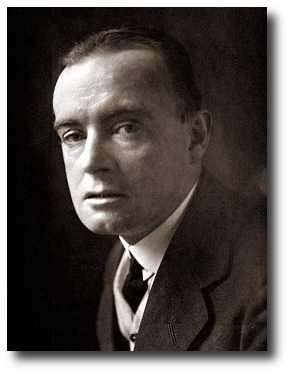
Hector Hugh Munro, a.k.a. Saki, in 1913. Artwork : This photo is in the public domain.

“Heavens!” exclaimed the aunt of Clovis, “here’s some one I know bearing down on us. I can’t remember his name, but he lunched with us once in Town. Tarrington — yes, that’s it. He’s heard of the picnic I’m giving for the Princess, and he’ll cling to me like a lifebelt till I give him an invitation; then he’ll ask if he may bring all his wives and mothers and sisters with him. That’s the worst of these small watering-places; one can’t escape from anybody.”

“I’ll fight a rearguard action for you if you like to do a bolt now,” volunteered Clovis; “you’ve a clear ten yards start if you don’t lose time.”

The aunt of Clovis responded gamely to the suggestion, and churned away like a Nile steamer, with a long brown ripple of Pekingese spaniel trailing in her wake.

“Pretend you don’t know him,” was her parting advice, tinged with the reckless courage of the non-combatant.

The next moment the overtures of an affably disposed gentleman were being received by Clovis with a “silent-upon-a-peak-in-Darien” stare which denoted an absence of all previous acquaintance with the object scrutinized.

“I expect you don’t know me with my moustache,” said the new-comer; “I’ve only grown it during the last two months.”

“On the contrary,” said Clovis, “the moustache is the only thing about you that seemed familiar to me. I felt certain that I had met it somewhere before.”

“My name is Tarrington,” resumed the candidate for recognition.

“A very useful kind of name,” said Clovis; “with a name of that sort no one would blame you if you did nothing in particular heroic or remarkable, would they? And yet if you were to raise a troop of light horse in a moment of national emergency, ’Tarrington’s Light Horse’ would sound quite appropriate and pulse-quickening; whereas if you were called Spoopin, for instance, the thing would be out of the question. No one, even in a moment of national emergency, could possibly belong to Spoopin’s Horse.”

The new-comer smiled weakly, as one who is not to be put off by mere flippancy, and began again with patient persistence:

“I think you ought to remember my name — ”

“I shall,” said Clovis, with an air of immense sincerity. “My aunt was asking me only this morning to suggest names for four young owls she’s just had sent her as pets. I shall call them all Tarrington; then if one or two of them die or fly away, or leave us in any of the ways that pet owls are prone to, there will be always one or two left to carry on your name. And my aunt won’t LET me forget it; she will always be asking ’Have the Tarringtons had their mice?’ and questions of that sort. She says if you keep wild creatures in captivity you ought to see after their wants, and of course she’s quite right there.”

“I met you at luncheon at your aunt’s house once — ” broke in Mr. Tarrington, pale but still resolute.

“My aunt never lunches,” said Clovis; “she belongs to the National Anti-Luncheon League, which is doing quite a lot of good work in a quiet, unobtrusive way. A subscription of half a crown per quarter entitles you to go without ninety-two luncheons.”

“This must be something new,” exclaimed Tarrington.

“It’s the same aunt that I’ve always had,” said Clovis coldly.

“I perfectly well remember meeting you at a luncheon-party given by your aunt,” persisted Tarrington, who was beginning to flush an unhealthy shade of mottled pink.

“What was there for lunch?” asked Clovis.

“Oh, well, I don’t remember that — ”

“How nice of you to remember my aunt when you can no longer recall the names of the things you ate. Now my memory works quite differently. I can remember a menu long after I’ve forgotten the hostess that accompanied it. When I was seven years old I recollect being given a peach at a garden-party by some Duchess or other; I can’t remember a thing about her, except that I imagine our acquaintance must have been of the slightest, as she called me a ’nice little boy,’ but I have unfading memories of that peach. It was one of those exuberant peaches that meet you halfway, so to speak, and are all over you in a moment. It was a beautiful unspoiled product of a hothouse, and yet it managed quite successfully to give itself the airs of a compote. You had to bite it and imbibe it at the same time. To me there has always been something charming and mystic in the thought of that delicate velvet globe of fruit, slowly ripening and warming to perfection through the long summer days and perfumed nights, and then coming suddenly athwart my life in the supreme moment of its existence. I can never forget it, even if I wished to. And when I had devoured all that was edible of it, there still remained the stone, which a heedless, thoughtless child would doubtless have thrown away; I put it down the neck of a young friend who was wearing a very décolleté sailor suit. I told him it was a scorpion, and from the way he wriggled and screamed he evidently believed it, though where the silly kid imagined I could procure a live scorpion at a garden-party I don’t know. Altogether, that peach is for me an unfading and happy memory — ”

The defeated Tarrington had by this time retreated out of ear-shot, comforting himself as best he might with the reflection that a picnic which included the presence of Clovis might prove a doubtfully agreeable experience.

“I shall certainly go in for a Parliamentary career,” said Clovis to himself as he turned complacently to rejoin his aunt. “As a talker-out of inconvenient bills I should be invaluable.”


Leave a Reply

Let Me Repeat That: The Prose Villanelle

This column is about a fixed form first introduced in Short-short Sighted #4 in September 2008.

You can also read Bruce’s column from last month here, or visit his author page to see them all.

One of the best-known poems in the English language is “Do Not Go Gentle into That Good Night” by Dylan Thomas, a poem that Thomas wrote for his dying father. One of the first things that a reader might notice about that poem is that there are two lines in the poem that repeat exactly. Do not go gentle into that good night is the first line, the sixth line, the twelfth line, and the eighteenth line of this nineteen-line poem. Rage, rage against the dying of the light is the third line, the ninth, the fifteenth, and the final line.

This poem by Thomas is an example of a villanelle. You’ll recall that rhyme schemes in poems are usually indicated with lower-case letters. The scheme for a Shakespearean sonnet is ababcdcdefefgg. The first and third lines of such a sonnet rhyme with each other, as do the second and fourth lines. The rhyme scheme of a villanelle requires some way of noting that some of the lines don’t just rhyme with other lines, but are refrains that repeat exactly. For that, we use capital letters and a superscript number: A1bA2 abA1 abA2 abA1 abA2 abA1A2. One of the refrains is A1, Do not go gentle into that good night in the Thomas poem. The other refrain, Rage, rage against the dying of the light, is designated A2. Each line represented by a will be a line that rhymes with the refrains (Thomas’s rhyme words are right, bright, flight, sight, and height), while the b lines will rhyme with each other (day, they, bay, way, gay, and pray).

Which is all good to know if you are a poet planning to write a villanelle, but you might well wonder what any of this has to do with writing short-short stories. It turns out that at least three writers have been crazy enough to try to adopt the rules of the villanelle for writing prose narratives. One of my favorite examples is “Romance: A Prose Villanelle” by Rick Demarinis, a story much too long to be considered flash, but worthy of tracking down… especially if you are familiar with the conventions of formula romance novels, conventions which Demarinis gently and amusingly subverts.

Other writers who have attempted to write villanelles as prose are Barbara F. Lefcowitz, who has been been publishing such villanelles since the seventies, and yours truly. Although the three of us have approached the prose villanelle in our own idiosyncratic ways, we have all taken the paragraph as the essential poetic unit, rather than the line. Our prose villanelles are nineteen paragraphs long, and we write paragraphs that in some way follow the pattern of A1bA2 abA1 abA2 abA1 abA2 abA1A2. Our prose villanelles have some recognizable repetition so that the sixth paragraph is obviously a new iteration of the first paragraph, and the twelfth and eighteenth paragraphs will obviously be the reappearance of that same element again. However, exactly what a “refrain” is going to be in prose is up to the writer to decide.

One thing that a refrain won’t be in prose is an exact repetition of an earlier paragraph. A line of poetry is short enough to hold in the mind whole, and the reader can enjoy how the line seems to change in its meaning according to what comes before or after it. But a paragraph of prose that repeats exactly is likely to bore or irritate the reader since the repeated section is too long to hold in the mind like a phrase of verbal music. A prose refrain ought to be recognizable as the same thing coming around again, but it also needs to be different. In the sample story for this month, “Border Crossing,” the first refrain paragraphs always begin with the same words: Lately I don’t recognize this country, the land of my birth. The second refrain always starts with The border guard walked around my car. The action that follows these openings always follows a similar pattern.

As for the paragraphs that “rhyme” with each other, it’s again up to the writer to decide what this means. I think it’s important that the sense of similarity or repetition in these paragraphs should be weaker in the refrain, and I don’t think it’s important that the way in which paragraphs “rhyme” be obvious to the reader.

In fact, you can make the connection between your refrain paragraphs much more mysterious than I have done in “Border Crossing.” For me, one of the pleasures of reading a Lefcowitz villanelle lies in trying to figure out in what sense a given paragraph is a refrain or a rhyme with another. The connections between her paragraphs are often as subtle as the return of a particular theme, mood, or object.

Part of the fun of a fixed form is jumping in without knowing exactly where the form will take you. You don’t have to decide what you are going to allow as a “refrain” or a “rhyme” before you begin to write. Pick a topic and start writing. You can, in fact, ignore the rhymes and just concentrate on the refrains, in which case you don’t have any sort of technical decision to make until you get to the sixth paragraph. That paragraph will have to revisit the first paragraph. Exactly what that means is for you to decide.


Bruce Holland Rogers has a home base in Eugene, Oregon, the tie-dye capital of the world. He writes all types of fiction: SF, fantasy, literary, mysteries, experimental, and work that’s hard to label.

For six years, Bruce wrote a column about the spiritual and psychological challenges of full-time fiction writing for Speculations magazine. Many of those columns have been collected in a book, Word Work: Surviving and Thriving as a Writer (an alternate selection of the Writers Digest Book Club). He is a motivational speaker and trains workers and managers in creativity and practical problem solving.

He has taught creative writing at the University of Colorado and the University of Illinois. Bruce has also taught non-credit courses for the University of Colorado, Carroll College, the University of Wisconsin, and the private Flatiron Fiction Workshop. He is a member of the permanent faculty at the Whidbey Writers Workshop MFA program, a low-residency program that stands alone and is not affiliated with a college or university. It is the first and so far only program of its kind. Currently he is teaching creative writing and literature at Eötvös Loránd University in Budapest, Hungary, on a Fulbright grant.


Become a Patron!

We need all the help we can get. For more info on any number of flash-tabulous rewards including extra stories, personalized critiques, and more:

patreonfriend

Or…

If you enjoy Flash Fiction Online, consider subscribing or purchasing a downloadable copy. Your donations go a long way to paying our authors the professional rates they deserve. For only $0.99/issue that’s cheaper than a cup of coffee. Or subscribe for $9.99/year.

subscribe_button


Leave a Reply

Classic Flash

February 2015

Suppose I asked you for the name, editor, and publication date of the book whose introduction contains this question: “How short can a short story be and still be a short story?”

Many people who are familiar with flash fiction would point to Flash Fiction, a book edited by James Thomas, Denise Thomas, and Tom Hazuka and published in 1992.

They would be close, but wrong. Thomas, Thomas, and Hazuka did ask almost the same question, “How short can a story be and still be a story?” But that was seventy-six years after Thomas L. Mason, Life’s Managing Editor, wrote the question above in the introduction to a 1916 edition of the stories that won the Life Shortest Story Contest.

Why do I point this out? Am I really such a pedantic fool?

Well, yes, probably. But I’m responding to statements I’ve heard recently about how new flash fiction is, and how little respect it gets.

Don’t get me wrong: Newness isn’t all bad. Sometimes flash fiction is cool because of its emphasis on compression, or because it’s ideal for the Internet age. But we also hear that it’s a sign of our intellectual decline, of our inability to pay attention to anything that lasts longer than a politician’s promise. Well, it appears that either it’s not a degenerate art form, or that we’ve been degenerates for a long time. (I’m open to both answers, by the way.) The eight stories presented here range from 51-160 years old, being published between 1850 and 1959.

These aren’t the meager works of unknown hacks, either:


  • Kafka is a literary giant;
  • Dickens was extremely popular in his day and remains one of the world’s most-read authors;
  • Saki was a well-loved humorist;
  • Jack Douglas’s radio and TV writing and appearances gave him an audience of millions;
  • Lovecraft is often seen as the father of the modern horror story.

The stories were published in prestigious magazines, too:


  • Punch is perhaps the longest-running humor magazine in England, and
  • Life was one of the most well-regarded journals of its time.


(Ralph Henry Barbour, one of the authors of the Life story, was famous in his own right for juvenile sports literature.)

So extremely short stories aren’t new. Maybe the approach to creating stories has changed over time, what with modernism, post-modernism, impressionism, and so on, but that’s probably true across the literary spectrum. Rather than insisting that flash fiction is something new, I’d say that the shortest fiction just hasn’t been exempt from the transformations that have altered every other facet of the literary world.

That leads me to disbelieve claims that flash fiction gets no respect. Now, to be sure, if a writer never writes any story longer than 500 words, it would take some real convincing that he was a serious writer (whatever those are). But when so many big writers are creating tiny literature, and when the history of that occurring goes back more than a hundred years, I think it’s safe to include flash fiction among those types of literature that has a place in any serious writer’s portfolio.

And it has a place in any reader’s portfolio, too. Go take a look, and leave comments to tell us what you think.


Comments

Leave a Reply

Join the 
Community

Support

Support lorem ipsum dolor sit amet consectetur. At dignissim neque amet proin sodales vulputate dolor elit ipsum dolor sit amet.

Subscribe

Subscribe lorem ipsum dolor sit amet consectetur. At dignissim neque amet proin sodales vulputate dolor elit.

Submit a Story

Submissions lorem ipsum dolor sit amet consectetur. At dignissim neque amet proin sodales vulputate dolor elit. At dignissim neque amet proin sodales vulputate dolor elit.