Issue April 2010 Flash Fiction Online April 2010

Table of Contents

Bust-Head Whiskey

 Artwork : This photo is in the public domain.
Artwork : This photo is in the public domain.

For two days the quiet of the Rising Sun Tavern, in the quaint little town of Shearsville, Ohio, was disturbed by a drunken Democratic member of the Pennsylvania Legislature, who visited the town in order to address what he hoped would turn out to be the assembled multitude of copperheads, but which proved after all no great snakes!

For two days this worthless vagabond insulted travelers stopping at the tavern, until at last the landlord’s wife, a woman of some intelligence, determined to have her revenge, since no man on the premises had pluck enough to give the sot the thrashing he so well merited.

On the third day, after a very severe night’s carouse on bust-head whiskey, the Pennsylvanian appeared at the breakfast table, looking sadly the worse for wear, and having an awful headache. The landlady having previously removed the only looking glass in the tavern — one hanging in the barroom — said to the beast as he sat down to table:

“Poor man! oh, what is the matter with your face? It is terribly swollen, and your whole head too. Can’t I do something for you? send for the doctor, or — ”

The legislator, who was in a state of half-besottedness, listened with sharp ears to this remark, but believing the landlady was only making fun of him, interrupted her with —

“There ain’t nothin’ the matter with my head. I’m all right; only a little headache what don’t ’mount to nothing.”

But a man who sat opposite to him at table, and who had his clue from the landlady, said with an alarmed look —

“I say, mister, I don’t know it’s any of my business, but I’ll be hanged for a horse thief, if your head ain’t swelled up twice its natural size. You’d better do something for it, I’m thinking.”

The drunken legislator! (Legislator, n. One who makes laws for a state: vide dictionary) believing at last that his face must in fact be swollen, since several other travelers, who were in the plot, also spoke to him of his shocking appearance, got up from the table and went out to the barroom to consult the looking glass, such luxuries not being placed in the chambers. But there was no glass there. After some time he found the landlady, and she told him that the barroom glass was broken, but she could lend him a small one; which she at once gave him.

The poor sot, with trembling hand, held it in front of his face, and looked in.

“Well,” said he, “if that ain’t a swelled head I hope I may never be a senator! or sell my vote again at Harrisburg.”

“Poor man!” exclaimed the bystanders.

“Fellers,” said the legislator, “what d’ye think I’d better do?” Here he gave another hard look in the glass. “I ought to be back in Harrisburg right off, but I cant go with a head like that onto me. Nobody’d give me ten cents to vote for ’em with such a head as that. It’s a — ”

“Big thing,” interrupted a bystander.

“Fellers,” said the blackguard, “I’ll kill a feller any day of the week, with old rye, if he’ll only tell er feller how to cure this head of mine.”

“Have it shaved, sir, by all means,” spoke the landlady: “shaved at once, and then a mild fly blister will draw out the inflammation, and the swelling will go down. Don’t you think so, doctor?”

The doctor thus addressed was a cow doctor, but, accustomed to attending brutes, his advice was worth something in the present case; so he also recommended shaving and blistering.

“I’ll go git the barber right off the reel, shan’t I?” asked the doctor, to which the legislator assenting, it chanced that in fifteen minutes his head was as bald as a billiard ball, and in a few more was covered with a good-sized fly blister.

“Ouch — good woman — how it hurts!” he cried. But that was only the beginning of it.

“Ee-ea-ah!” he roared, as it grew hotter and hotter. One might have heard him a mile. The neighbors did hear it, and rushed in. The joke was “contaminated” round among them, and they enjoyed it. He had disgusted them all.

“Golly! what a big head!” cried a bystander.

The legislator took another look at the glass. They held it about a yard from him.

“It’s gittin’ smaller, ain’t it?” he groaned.

“Yes, it’s wiltin’,” said the landlady. “Now go to bed.”

He went, and on rising departed. Whether he ever became an honest man is not known, but the legend says he has from that day avoided “bust-head whiskey.”

Don’t you see it, reader? The landlady had shown him his face in a convex mirror — one of those old-fashioned things, which may occasionally be found in country taverns.

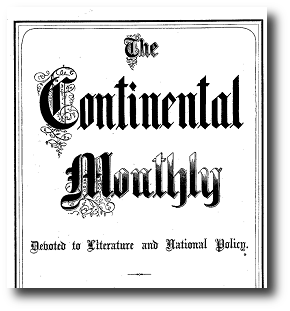
Continental Monthly, April , 1864

Leave a Reply

Small Rebellions: Prose Poems

Read Bruce’s previous column here, or visit his author page to see them all.

These columns are about writing flash fiction, but this month I want to peer over the border to examine flash fiction’s sister genre, the prose poem. At least some flash fictions and prose poems are similar enough that it can be difficult to see just which side of the border they belong on. Russell Edson calls what he writes “poems,” but all of his work is formatted as prose and is narrative. Readers can be forgiven for thinking that it’s flash fiction. Some of my own work that I considered to be fiction when I wrote it has ended up being published as poetry. Whenever I teach a class in the “short forms” of flash fiction, prose poem, and brief literary nonfiction, one of the first things I do is show the students a variety of short prose pieces and ask them to tell me whether those works are fiction, poetry, or nonfiction. Students seldom agree completely on the genre of any of the sample writings.

I mentioned in the first of these columns that Robert Hill Long considers all of these short prose forms to be essentially subversive. They are in a constant state of rebellion against the rules of literature or the reader’s expectations. Certainly there’s a good historical argument for seeing the development of prose poems as a series of insurrections against the “rules” of poetry. When Baudelaire, Rimbaud, and Mallarmé started writing their poetry as prose, the dominant form of French poetry was the Alexandrine with rhyming lines of twelve syllables per line and additional fussy rules about the one or two pauses — or caesuras — per line. These writers, each of whom had startling things to say to their readers, seem to have concluded that the dominant rules were for a tamer, more domesticated poetry than theirs.

I think of prose poems as trouble makers in the genteel drawing room of poetry. The French writers managed to get them admitted to the party, and a few traditional poets grudgingly admitted that maybe the prose poems could be poetry after all, provided that the poems hid interesting rhythms and meters in their language. “Oh, yeah?” said the prose poems (or at least some of their practitioners), and they adopted language that was less musical. That’s how I think of prose poems, standing in the middle of the room with their arms folded and saying to any attempt to nail them down, “Oh, yeah?”

Any attempt to nail down the rules, standards, or reader expectations for the prose poem is futile. Prose poetry doesn’t even have to make sense in order to please some readers. Gertrude Stein seems to have composed much of her prose poetry in pursuit of language itself, choosing words because she liked the sound or shape of them. The so-called “language poets” follow a similar aesthetic, one in which it’s not desirable for a poem to make sense or to refer to anything particular in the real world. (I once submitted a poem to an anthology whose editors shared this aesthetic. The editors at first accepted the poem, then weeks later rejected it as “too referential.” In other words, they had re-read it enough to realize that it was actually about something.)

Prose poems don’t have to break rules or strain any existing definitions of literature in order to be good, but they do have this history, this penchant for glaring and saying, “Oh, yeah?” And that’s why I think it’s a good idea for writers of flash fiction to read the form and try writing it, particularly writers who are feeling a bit constrained or bored with the rules of what a story is supposed to be. Prose poetry laughs in the face of rules, and even the writer who is mostly going to follow the rules will likely find liberation, and ideas, in flouting them.

Recently, I established that the only definition of “story” that makes sense to me is the highly subjective one: A story is any narrative that satisfies the reader’s desire for a story.

The definition of the prose poem is even broader than this. The prose poem is a work of prose that presents itself as a prose poem (by appearing in print alongside other prose poems, for example). This definition admits the possibility of a lot of bad prose poetry. A paragraph from an algebra textbook could be titled and published as a prose poem, and I don’t think there’s any universal standard by which we could exclude it from the genre. We have to let every claimant into the genre, even the ones that we don’t like.

Because the territory of the prose poem is lawless, I find it relaxing to visit there. I can sit down with pen and paper to push words around in any way that I like, and I’m composing a prose poem. I can allow myself to be surprised by any idea about what I’m saying or how I’m going to say it. I might accidentally wind up with a flash fiction, but even if what I write would satisfy no one’s notion of “story,” I can at least be sure that no matter what turn I take, I’m at least going to end up with a prose poem.

Naturally, it might be a bad prose poem. In the end, even if I have been writing without rules, I have to apply some standard to what I am creating in order to decide whether it’s done and whether I like it enough to submit it for publication. A good prose poem is one that not only claims to be a prose poem, but also rewards the reader who invested time in reading it. Rewards how? Any answer will do. For me, the only criterion for quality in this genre is that I am glad to have read the poem, and I especially like reading that rewards me in a way I didn’t anticipate or haven’t seen before.

But all this talk of having no rules or breaking expectations doesn’t mean that a prose poem has to break new ground in any way. In spite of the prose poem’s history of breaking rules and redefining itself, it can also be conservative. As the genre that dares the reader to say it isn’t poetry, the prose poem doesn’t have to be written in beautiful or efficient language, but beautiful and efficient language are one way that it might reward the reader. As the genre often favored by poets who are allergic to making sense, prose poetry doesn’t have to have a message, but making sense and having a message will be what leaves some readers feeling satisfied. The prose poem can be unambitious, can consist of a single metaphor or express a certain state of mind. The only rule is the rule for all good writing: don’t bore the reader.


Two Prose Poems

by Bruce Holland Rogers

Yellowstone Burning

For the second time today I find myself stepping into traffic against the light. Tires squeal, and a sedan stops an arm’s length from my knees. It has been like this all week. All week I have felt like Yellowstone burning. Above smoke-shrouded mountains, the sun dims with the shifting wind. Fire advances along the ridgeline of my spine, and trees explode like drums of turpentine with an orange flash and a ball of black smoke. Helicopters hover to take on water, their blades beating the bitter air. Ashes snow down. The moose and bear and elk move on ahead of the flames, but the ground squirrels dodge from rock to tree until they are surrounded. Beneath my skin, nests crackle like candy wrappers.

Small Town in a Snowstorm

It’s late. The pen sleeps in my hand, and tonight I feel like a small town in a snowstorm. Near the town square the traffic lights flash red in four directions; no one sees them. The snow is too deep to walk through, falls too densely for anyone to see across the street, but no one’s looking anyway. The storefront windows and windows of the houses are dark. Someone far away is trying to make a telephone ring in one of the dark rooms, but the storm has downed all the phone wires near the heart. The caller keeps dialing, and the impulse to make the bell ring keeps bleeding from the end of the broken wire into the snow. Snow falls thicker than ever, piles deeper, and the darkness inside the windows grows darker still.


Leave a Reply

The Zombie of His Early Days

by Tom Crosshill

February 2015

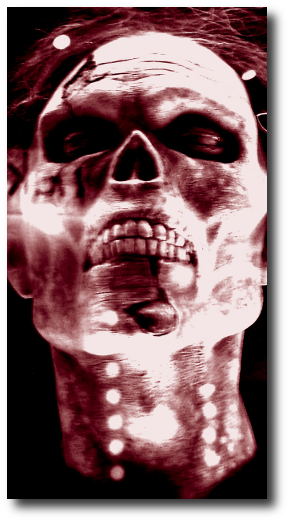
Wonder of wonders, there stood Chuck! Pungent, no meat on his thighs, left eye hanging out, but Chuck nevertheless. Artwork courtesy of on flickr, used under the Creative Commons Attribution license.
Artwork courtesy of welovethedark on flickr, used under the Creative Commons Attribution license

Every morning Bobby visits Chuck. He goes down to the basement and rattles Chuck’s cage with his cane. Chuck only snarls and spits, and grinds the rotten stubs of his teeth — gnish, gnash, gnish, gnash. He’s a real codger, Chuck is. Should have seen him back in the day, though. World ain’t got zombies like Chuck anymore.

As a boy, Bobby liked to climb the town walls and watch grown-ups fight Chuck’s pack outside. Splurt sprayed blood, whee flew a zombie head, but Chuck kept going. A freshly undead football player, he had the highest biting average in the county, and all the kids loved to hate him. “I wanna be an ax-man, Mommy,” Bobby pleaded over breakfast. “I wanna brain Chuck.” His mother shook her head at him, weary and wise. “There’s no money in it, Bobby. None.”

Crossbows were all the rage in school, and Bobby picked off a zombie head or two on the lazy golden afternoons of summer, but he never got a shot at Chuck. Came college and a girl, and hungry-mouthed children underfoot. Bobby became an actuary and tried to forget about Chuck. Occasionally he’d see a buddy on the street with brains dripping off his axe, and he’d come home melancholy with thoughts of a career change. But there was always the mortgage and tuition for the kids, and extermination fees for the wife (after she got bit in the parking lot at Trader Joe’s).

Came the Surge; all over the country ax-men brained zombies day and night. Bobby had never felt so low. He watched despondent as the red spots on the TV man’s map grew sparse (while Bobby’s waist thickened), and sparser (while Bobby’s hair grayed), and sparser still. One day Bobby was debt-free, and his house was wife- and children-free. He could’ve taken up the axe then, but his town was zombie-free.

Except, he learned, for a specimen in the local zoo, preserved for posterity in a metal cage. Bobby went to visit. Wonder of wonders, there stood Chuck! Pungent, no meat on his thighs, left eye hanging out, but Chuck nevertheless. “What a sorry state he’s in!” Bobby said to Chuck’s keepers. “Don’t you know who this is? Come, at least feed him sheep brains at breakfast.” They wouldn’t listen.

For once, Bobby made the hard choice. For once, he did the right thing. He maxed out his cards. He paid off the night guard. He backed in his truck, loaded up the cage and drove Chuck across state lines.

Bobby feels guilty now and then, but he figures a man’s got a right to his dream. His knees won’t bend and his back aches something fierce, but he can still rattle Chuck’s cage okay. Then Chuck snarls at him and Bobby laughs, and they pretend it’s good old days all over again.

Soon Bobby will decide. Perhaps he’ll brain Chuck. Perhaps he’ll burn Chuck. Or perhaps… perhaps one night when all is quiet he’ll drive Chuck into town and unlock his cage, and gift him back to society.

World ain’t got zombies like Chuck anymore. It sure could use some.

Comments

  1. Jeffrey Zaayman says:
    I enjoyed the banality of zombies in this world. They’re just another thing for humans to deal with from now on, much like COVID.

Leave a Reply

ZigZag Strikes Again

Very elliptical years, the 57th Century, or “Years of the Cat.” Practically nobody uses sentences. Anymore. Very eccentric. Tell story.

Am Time Bum. Name of ZigZag, honorable family, agent, sex-linkages. Manipulator and explorer of paraHistory via the Leonardo.

Journey to the Age of Styrofoam, the Coke Bottle Century, my favorite time, the 20th, when Giants walked the Earth. Mao Tse Tung, The Beatles, and the Father of Time Travel: Albert Einstein.

“Hey, Al, how they hangin’?” I sez as I pop into his Princeton, New Jersey pad. He looks up from his desk, his gentle eyes & white atomic hair.

“ZigZag, my friend, did you by any chance bring me an icecream cone?”

“Jamocha Macadamia Fudge, vintage 1984.”

“My favorite flavor. Too bad they won’t make it for another 30 years.”

“OK park my Leonardo here for a while?”

“Sure, ZigZag, just lean it up against my Peugeot there. So how’s the War?”

“Same War. Talk General Relativity.”

“Gladly. I’ve been thinking about gravity again…”

Same War. Some War. Always was. Always will. Last trip, I eliminated time-leak from 34th Century (Years of the Cuttlefish). Vegetarian Void-oid name of Hitler. Hooked on Amphetamines and time-leaked violence drug Akaia. Got his staff stuck on Cocaine. Mutual incomprehension and geomilitary collapse followed inevitably.

One loose end very subtle. So-called World War II now overlap so-called First Uranium War. How to stop premature vaporization of Los Angeles? Will clean up mess with little side-trip. Chat with Einstein necessary research.

“… and so, re-examining Schwarzschild’s metric I still see these ugly singularities following gravitational collapse. No one else seems to notice that space-time cannot be defined in this case.”

“Bet your booties, Al. No one will for couple decades. Will make you feel better if tell you charge and angular momentum conserved there anyway?”

“Much better. Is this related to the principle of your time machine bicycle?”

“Sorry, Al, forbidden to answer. But business: how and when did Nazi atom-folk develop fission weapon without you?”

“Because, my temporally peripatetic pal, they could not exorcise ‘Jewish science.’ It all came together at the Max Planck Institute in 1941…”

Jews again! Never a chance to clean up that leak from the 41st, whole Moses burning bush tablets tractor beam on Red Sea routine. Chosen people supposed to be Romany, but no one perfect.

Left main Leonardo with Father of Antigravity. Check saddlebag. Mescaline for Bosch, Blake, Dante still there. Took short-range Leonardo with me, inside lucky rabbit’s foot.

Jump to Max Planck Institute. Hypno German. Dress like lab assistant. Were methodically checking one element after another. Neutron cross sections. I examine apparatus. So crude! To check Uranium in an hour. Simple fix. Found little square of gold foil. Placed between target and detector. Will hide effect, change history. Rub rabbit’s foot. Eight hours later. Heisenberg himself in laboratory.

“Werner, baby, how’s tricks?”

“Herr ZigZag! How pleased I am to see you again. Maybe you can help me. Just this morning we tested Uranium for the chain-reaction effect. The theory is good, but we can’t seem to find an element it works for. Tomorrow we try Cerium, Neodymium, something like that. Can’t you give me a hint?”

“Sorry, Werner, dead end alley. You cut out to be a great Theoretician. Folks my time still appreciate Uncertainty you invented.”

“Immortality! Thank you, Herr ZigZag. I’m glad to hear that someone appreciates Quantum Physics.”

“Well, nobody uses in 57th Century, but much aesthetic joy from Uncertainty principle. Work of Art. Rest on laurels. Perhaps you and me for schnappes and beer?”

Few hours later, after good time at local cat-house, back to Princeton. Seems shame to mislead such nice guy, but now only America gets fission weapon, uses only twice, orientation nexus Disneyland safe. Unfortunately, New York safe too. Must fix that. Else kid name of Dylan will spread pacifist message, prevent Second Uranium War in Africa. Void-oid name of Amin Dada.

New York not such bad place. Maybe fix so only New Jersey vaporized. Not so much complaint there. Final chat with Einstein, Father of Warp Drive, before continue Heaven/Hell medieval Archetype Enhancement with psychedelics. Necessary preparation for Helium Invasion of the 29th Century (Years of the Monster). As climb on Leonardo, Albert Einstein insists: “I do not believe that God plays dice with the universe.”

Well, nobody right ALL the time.

Leave a Reply

April Foolery

February 2015

It’s April, and I like to get a little silly.

ZigZag Strikes Again is by Professor Jonathan Vos Post. I think it’s better to let him tell us about it. “It is a in one sense Hard Science Fiction (the historical episodes about Einstein come to me from him, as he was mentor to Rebert Oppenheimer, who was mentor to Richard Feynman, who was my mentor and co-author), and the specific incident in Heisenberg’s lab was verified to me from the great Freeman Dyson at the Institute for Advanced Study. In another sense, as the humor and odd diction suggest, a parody of Time Travel tales within Hard SF. But, in its heart of hearts, it is fantasy or meta-fantasy, in that it probes the origin of Blake’s Fantasy poetry and etchings, Bosch’s Fantasy/Horror paintings, and Dante’s epic fantasy poems.” All I really know is that I enjoyed the zany voice and funny time-travel humor.

The Zombie Of His Early Days is a darkly humorous piece by Tom Crosshill, and, I’m happy to say, it’s the sale that popped him over the top into full membership in the Science Fiction and Fantasy Writers of America (SFWA). One of his prior qualifying sales was the Writers of the Future contest, in which he took first place: Look for more from this guy.

Our third story, Alligators by Twitter by John Wiswell, is a hoot. It’s also, as you might guess, a tweet stream. This story probably only fits in an April issue. If you’d prefer to see it in its natural form, follow us on Twitter and it’ll roll out once or twice during April. Look for the retweets of holegatorguy — the name will make sense once you read it or follow it.

Our Classic Flash this month is a practical joke — suitable for April Fools, and originally published in April — from 1863 called Bust-Head Whiskey. It’s been just slightly edited to reduce the heavy dialect.

Bruce Holland Rogers’s column focuses on Prose Poems, and gives two examples. I didn’t break them out separately this month, so just go straight to the end of his column to read them.

Thanks for joining us!


Leave a Reply

Join the 
Community

Support

Support lorem ipsum dolor sit amet consectetur. At dignissim neque amet proin sodales vulputate dolor elit ipsum dolor sit amet.

Subscribe

Subscribe lorem ipsum dolor sit amet consectetur. At dignissim neque amet proin sodales vulputate dolor elit.

Submit a Story

Submissions lorem ipsum dolor sit amet consectetur. At dignissim neque amet proin sodales vulputate dolor elit. At dignissim neque amet proin sodales vulputate dolor elit.