Issue January 2010 Flash Fiction Online January 2010

Table of Contents

Last Bites

by Ken Pisani

February 2015

And so the mourners dispersed and shuffled from the funeral home, stuffed but somehow unsatisfied. Artwork comes to us via and is used through the .
Artwork comes to us via Wikimedia Commons and is used through the GNU Free Documentation License 1.2.

The wake held for Sven Müeller at Karloff’s Funeral Home in Queens, New York, was completely unremarkable until a tiny nephew of Sven’s was lifted to kiss his uncle good-bye, but instead bit off the dead man’s nose. Women shrieked and strong men fainted and, when the toddler continued to chew and swallow the nose, his mother dropped him and vomited.

But the boy just grinned and said, “Chocolate.”

Sure enough, on closer examination, the deceased watchmaker proved to be made entirely of Swiss white chocolate. His family pondered this unusual discovery, nibbling absent-mindedly on Sven’s slender, sweet fingers clutched around a crucifix. They all agreed that Sven had been a good and decent man, but who knew he was also delicious?

They decided that further investigation was warranted and, after meeting with understandable resistance in the corridors of the funeral home, it was determined that Sven was not alone in his delectable condition. Across the hall the late Giovanni Marconi, looking every bit as life-like as he did moments before collapsing over the pants-presser in the back of his dry-cleaning business, tasted like saucy meatballs, with just the right hint of parsley. Down the corridor from Mr. Marconi, Ravi Darjeeling was made of Lamb Vindaloo (too spicy for some), while just next door, Nicholas Boskopoulos tasted distinctly of spanakopita. The growing number of suddenly hungry mourners paused briefly outside the room holding the remains of Max Weinberg before bypassing in favor of the Spaniard Francisco Castillo, who offered a sweet-tinged Chicken Marbella flavor good enough for the Silver Palate.

These formerly somber mourners now resembled a festive, roving diner’s club, reveling in each exotic taste and eating off each other’s plates, from the salt-cured gravlax of the late Scandinavian longshoreman Dag Sørensen to the sweet jerk pork of Malachi “Roots” Dekker, taken from us too soon. Even the stolid glazed-ham flavor of the portly Walter Lundgren proved a complete but happy surprise.

However, by the time they’d consumed the wine-marinated remains of Henri LeBeau (especially enjoying the foie gras of his engorged liver), a noticeable change had crept over the group: at first there were tiny criticisms — that this one was “too sweet” or “overdone,” or that the elderly Sheila Taylor “could use some salt.” Perhaps recalling too fondly just how tasty the earlier offerings had been, the dissatisfied gourmands felt that these latest offerings fell short; one couple even lamented how inattentive the service had become. Frowning after a single bite of the late Esther Becker, the young widow of Marshall Johnson (himself tasting of a perfectly seasoned pork loin), took out her iPhone and posted a half-star review of the unsatisfactory fare at the Becker viewing. The goulash that had been Eva Szabó proved a pedestrian disappointment, and by the time they’d reached the soggy corpse of retired schoolteacher Susan Turner (“Meat loaf,” the first taster sneered, and the others shook their heads in shared displeasure), the jovial conviviality of the group and their collective wonder had dissipated like the aroma of a dish left sitting too long.

And so the mourners dispersed and shuffled from the funeral home, stuffed but somehow unsatisfied. They never spoke again of this mystifying, gourmet event, when the delicious remains of loved ones who had once nourished their lives offered a surprising final bit of sustenance, only to disappoint, as they had so often in life.

Comments

  1. JRBrillianton says:
    I couldn’t turn away from this story. I found myself
    being dragged along with the mourning diners hoping for a nice pork roast with
    sauerkraut.
  2. laquisha says:
    This is just deliscous
  3. laquisha says:
    this is ashton bud >:)
  4. laquisha says:
    who wants some deep fried chicken down in my cella
  5. sharkisha says:
    needs salt
  6. laquisha says:
    lets add some fingers?
  7. sharkisha says:
    Italian food

Leave a Reply

Okra, Sorghum, Yam

This story is an exemplar for Short-short Sighted #18, “Ellipsis: What to Leave Out.”

So the following summer when the second princess came to Old Kwaku’s hut, he said, “What do you want?”

“My father said that I must learn wisdom from you.”

“And is that what you want?”

“I wouldn’t mind being wise, but when my sister returned from here last summer her hands were rough and red. She said she hadn’t learned anything at all. What if I go home like that? What man will marry a princess who has a farmer’s hands?”

“And if you must work to become wise?”

“I hope that you’ll have better luck than with my sister, however you do it. Make me wise, and my father will be pleased. Then he will marry me to a prince rich in goats and cattle. I’ll dress in fine clothes and have twice as many servants as I have now.”

“So it’s wisdom you want?”

“Do I look like a girl who wastes her time? Yes, I want wisdom! Stop asking the same question and get on with it!”

So Old Kwaku, he told her what he had told her sister, that she must work with him in the fields all summer and through the harvest if she wanted to learn wisdom. She didn’t like that idea one bit, but she couldn’t go back to her father and say that she hadn’t tried.

In his vegetable garden, Old Kwaku planted collard and okra and cowpeas. He showed the second princess how to cut the weeds down with a sharpened stick.

“I don’t think I’m learning any wisdom,” she said. “And look at my hands! Imagine what they’ll look like at the end of the summer!”

“Here is part of wisdom,” Old Kwaku said, and he began to rearrange some okra pods while they were still on their mother plants. He pulled one and nudged another and coaxed a third. He moved this one and that one together and tied the pods together in the shape of a little green person.

“That doesn’t look like wisdom to me,” the princess said. “Oh, I’m going to go home and die in my father’s house, an old maid!”

Elsewhere, Old Kwaku had planted sorghum. He gave the princess a strip of cloth to wave to scare the birds away from the ripening grain.

“This cloth is rough,” she said. “When I am married to a rich man, I hope that nothing this coarse will ever touch my skin! I will lie in the shade while other people work, when wisdom has made me into an excellent bride.”

“Here is part of wisdom,” Old Kwaku told her, and he began to bend this plant gently toward that one and to tie some of the seed heads together. Torso, arms, legs, and head. He tied the sorghum into the shape of a person.

“That doesn’t look like wisdom to me,” she said. “I hope I start seeing soon what this has to do with wisdom.”

In another place, Old Kwaku grew yams. He showed the princess how to clear the weeds and grasses away from the vines, and then he had her dig very carefully to expose some of the tubers without damaging them. He had her pour water from an earthen jar to wash the yams while they were still in the ground.

She stood up and flung mud from her fingers. “Digging in the dirt is no way to learn wisdom! You’re taking advantage of me! Show me some wisdom right now!”

“Here is part of wisdom,” Old Kwaku said. Gently, he moved the yams without pulling them free. He positioned two to be the arms, two to be the legs, one for the trunk and one for the head. Sure enough, he had put yams together in the shape of a person. He gently pushed the soil back over them.

“That doesn’t look like wisdom to me,” said the princess. “I should break that water jar over your head!” She stomped off to the river to wash her hands.

When it was time, Old Kwaku harvested the crops, all except for the figures made of okra, sorghum, and yams. He made a great big pot of stew, but he did not taste it and he did not let the princess have any, either. “Soon you’ll return to your father, with wisdom or without,” he told her. “We’ll fast tonight. Beginning tomorrow, let us feast for three days and see whether, at the end, you are wise.”

The princess didn’t want to fast, but Old Kwaku slept by the pot with the ladle in his hand, like a guard with his spear. So the princess went to bed hungry for the first time in her life. When she woke up, she was very hungry indeed. Old Kwaku was already awake. He had set out three bowls on the mat. The princess knelt down before one, but Old Kwaku said, “We must wait for our guest.”

Just then, a tiny voice called out, “I am here for now, but I’m afraid I’m not here for long!”

“Come in, come in,” said Old Kwaku. “We were expecting you.” He pulled aside the mat that covered his door, and in came a little green person made of okra. Old Kwaku filled the bowls and knelt before one.

As the princess reached for her bowl, the little okra person went to the third bowl and peered inside. “What if it’s poisoned?”

The princess looked at her stew. Old Kwaku took a taste from his own bowl and said, “It’s not poisoned.”

“But how do we know,” said the okra person, “that you didn’t poison only mine? Or hers?”

“You saw me dish them out.”

“Ah, but you’re sly,” said the okra person. “We weren’t watching you carefully. And even if you are innocent, a witch might have poisoned it all while you slept.”

The princess was very hungry, but now she sat looking at her stew without eating it.

“What do you care if you are poisoned in the morning?” asked Old Kwaku, eating some more of his stew. “You are going to die anyway when the sun goes down.”

“Why did you have to remind me?” shouted the okra person in a voice so shrill that the princess had to cover her ears. “I don’t want to die! Will I suffer? I don’t want to be in pain! What is death, anyway? Is it only the beginning of more suffering? Poor me! I am going to a place of torment, I just know it! When will it happen? How high is the sun? How much time is left to me?” The little okra person cried and fretted and cried some more. The princess sat with her hands over her ears all day. Old Kwaku calmly finished his stew, then dumped the untouched servings of the princess and the okra person back into the pot.

When the sun touched the horizon, the okra person ran around in circles, shrieking in terror until it fell down dead. Old Kwaku threw its body into the fire and gave the princess the empty bowls. “Take these to the river and clean them,” he said.

“First I want some stew,” said the princess.

“No,” said Old Kwaku. “Now we must fast until tomorrow. Then we will eat our fill.”

The princess took the bowls to the river. She was very, very hungry now. But what if something like this happened again the next day? How could she eat with such a terrible visitor in the hut? What if she starved to death? She brought the clean bowls back and lay down to try to sleep, but she couldn’t. She stayed up thinking about herself growing thinner and thinner.

In the morning, Old Kwaku set out three bowls again. The princess was both hungry and tired as she knelt before one. “We must wait for our guest,” said Old Kwaku.

From outside, a little voice called, “I’m here for now, and I hope I’ll be welcome!”

“Come in, come in,” said Old Kwaku. “We were expecting you.”

In danced a little brown and white person made of sorghum seeds. Old Kwaku filled three bowls.

As the princess reached for her bowl, the sorghum person said, “I hope this has tender meat in it!”

Meat sounded wonderful to the princess. She smiled at the thought.

“It’s a vegetable stew,” said Old Kwaku. He tasted his.

“Well I hope it tastes rich. I hope it’s as smooth as butter.”

The princess held her bowl, thinking of the wonderful taste of butter.

“It tastes as it tastes,” said Old Kwaku, eating some more.

The princess was still very, very hungry, but the stew did not seem so appealing, now that she had tender meat and butter on her mind.

The sorghum person said, “Well, I hope we’ll have something better tomorrow, something meaty and buttery that we can eat every day for the rest of our lives!”

“But you have only this day to live,” said Old Kwaku.

“That’s true,” said the little sorghum person, beginning to dance around. “Oh, I hope I am going to paradise! I hope I have an easy death, and that in the land of the dead, there is goat meat cooked in milk. Plantains in honey would be tasty. I’d like to have some roasted beef. After I am gone, I hope I won’t have to eat ordinary stews. I’ll have fish curry with groundnuts!”

The princess forgot that she was holding a bowl of ordinary stew as she watched the little sorghum person dance and listened to it name all the fine things that it would eat in paradise. Old Kwaku finished his stew. When the sun touched the horizon, the sorghum person fell over dead, and Old Kwaku threw it onto the fire where it popped and crackled. He took the princess’s bowl from her and dumped the stew back in the pot. He did the same with the third serving and sent the princess to the river to wash the empty bowls.

As she washed the bowls and brought them back, the princess hoped that tomorrow would be better. Hunger gnawed at her when she lay down on her mat. Old Kwaku slept by the pot as before. Perhaps he would fall asleep before she did and she could sneak a taste of stew. But weariness overcame even her hunger, and her eyes closed.

She awoke to the sound of a little voice shouting, “Let me in! I have no time to waste!” She opened her eyes to see that there were already three servings of stew on the mat. A little purple person made of yams entered the hut and stamped across the floor toward the bowls.

“You call this stew?” it said. “I deserve a better feast than this!”

The princess sat up and rubbed the sleep from her eyes. Old Kwaku picked up one of the bowls and began to eat. “It’s very good,” he said.

“Well, it’s not good enough for the likes of me!” insisted the yam person. It tried to overturn one of the bowls, but it wasn’t strong enough. “Why are your stupid bowls so heavy?” It kicked the side of the bowl.

“Calm down,” said Old Kwaku. “Life is short.”

“I know that life is short!” It kicked the bowl again. “I know it!”

The princess reached for one of the bowls, and the yam person said to Old Kwaku, “Aha! I see that you’re up to your old tricks, deceiving girls and making them work your fields. Look at her hands!”

The princess looked at her callused hands and stopped reaching for the bowl.

“You got a season’s work out of her, and what does she have to show for it? Her body is tired, her belly is empty, and is she wise? She’s wise to you, maybe! Maybe she’s finally catching on, you old fraud!”

The princess closed her hands into fists. She looked at Old Kwaku, who calmly ate his stew. She trembled. “It’s true!” she said. “You’re nothing but a cheat! I did everything you told me to do, and am I wise?” She seized one of the bowls.

“You are hungry,” said Old Kwaku. “Have some stew.”

“I’ll give you stew!” she shouted. She hurled the bowl to the floor. She picked up the other bowl and broke that one as well. “You promised wisdom and gave me only grief! If I were a man, I would kill you!” On her way out, she tore the mat from the doorway and flung it to the ground.

“Are you going to let her talk to you like that?” the yam person demanded.

Old Kwaku went on eating.

“Those were good bowls!” said the yam person. “How dare she break those bowls!”

When he had eaten his fill, Old Kwaku cleaned up the mess of stew and broken pottery.

“Look! She didn’t just rip your mat from the doorway! She tore the mat itself! Your best mat! Why aren’t you getting mad? You let her walk all over you! I could just strangle you for being so soft!”

Using some reeds, Old Kwaku mended and rehung the mat. When the sun touched the horizon, the little yam person stamped on the ground, screamed with fury and died. Old Kwaku threw what was left of him onto the fire.

Now the next summer, when the third princess came to visit, it was an altogether different story.


Leave a Reply

Ellipsis: What to Leave Out

Read Bruce’s previous column here, or visit his author page to see them all.

Two columns ago, I looked at how the writer can save words by using a character that the reader already knows. We can also tell stories by leaving out narrative sections or details that the reader can supply on her own either because the story, or the type of story, is already familiar or else because the writer has already supplied enough of the story for the reader to fill in the rest.

Actually, leaving things for the reader to supply — writing efficiently — is one hallmark of good writing at any length. Even a novel that the reader enjoys for its descriptive detail will become tedious if the writer describes everything. All writing is a collaboration with the reader, and a good writer knows when to get out of the way and lets the reader’s imagination do the rest.

When I talk to my writing students about overwriting, the defect of supplying too much detail, I give them this sentence: “Lighting her way with the candelabra, she descended the broad staircase, crossed the floor, and opened the door.”

Do you have a picture of this unnamed character and her action in your head? Then consider the questions I put to my students about this scene: What is the woman wearing? What is the floor made of? How would you describe the door?

No one ever sees the woman descending those stairs in a skimpy nightgown, in jeans and a T-shirt, or in a raincoat. You’ve probably imagined her in either a long nightgown or a long dress. No one ever sees a wall-to-wall carpet on this floor. You’ve probably seen a stone floor or a wooden one, perhaps with an elaborate rug. The door is massive, solid, and possibly equipped with an iron knocker. You may have heard the sound of iron hinges even though I haven’t mentioned sound until now. Not every reader will imagine exactly the same clothes or the same room, but most will imagine a roughly similar scene based only on the candelabra and the broad stairs.

Beginning writers will often try to control too much of the reader’s imagination, describing clothes, facial configurations, and the placement of furniture in a room. There are circumstances in which the reader must be given particular details because the reader will otherwise imagine the wrong thing. For instance, if your novel’s protagonist is going to take offense when another character tells a dumb-blonde joke on page 40, it would be a good idea to establish in the first pages that she is blonde. Without such guidance, by the time readers have reached page 40, they may have spent all of those 40 pages imagining a brunette or a redhead. Every mention of the protagonist’s blonde hair (if this detail arrives too late) will now disrupt their reading experience. If a detail matters, establish it as soon as possible. But be selective. Your readers will supply the rest.

If efficiency makes for good prose generally, it’s especially vital in flash fiction. Efficiency applies both to description and story events. You can substitute an ellipsis for part of the story.

Here’s a series of shades: “White, light gray, medium gray,…”

What comes next? Once you see the direction that my series is going, you don’t really need me to say “dark gray, black,” do you? The ellipsis can occur anywhere in a series where the reader will be able to fill in what isn’t stated, whether at the beginning, middle, or end of a series:

…4, 5, 6…

100, 200, … 800, 900.

In an earlier column, I discussed writing flash fiction fairy tales. When you retell a familiar tale to suit your own purposes, you have basically two tasks: remind the reader of the original, and show how your version is different.

This is how James Thurber’s “The Little Girl and the Wolf” can retell Little Red Riding Hood in under 200 words. Thurber reminds us of the basic set-up: girl meets wolf, reveals that she is on her way to her grandmother’s house, and the wolf gets there ahead of her. Then the story reveals how it is different: The girl arrives to find the wolf in her grandmother’s bed, dressed as her grandmother. The little girl then shoots the wolf dead. The moral: “It is not so easy to fool little girls nowadays as it used to be.”

Notice that the grandmother and the woodcutter don’t appear as characters in this Thurber’s version. If the wolf has eaten the grandmother, she is rendered superfluous. The woodcutter is made superfluous because the heroine has solved the problem on her own. Anything that doesn’t contribute to reminding and revealing is removed.

Such retellings are a staple of brief satire. BBC Radio Four recently aired a series called The News at Bedtime, a nightly newscast from storyland. One news story featured Jack, who had just grown an enormous beanstalk, and a Greenpeace activist who was protesting against what was clearly a genetically modified crop. Jack climbs the beanstalk and returns with a goose that lays golden eggs, another clearly unnatural product of genetic meddling, according to the activist. In this case, the reader is reminded of the original tale and shown a different version simultaneously, as opposed to the two-step process in Thurber’s story. But like the Thurber story, this tale leaves out the middle. Jack’s adventure in the giant’s castle is irrelevant to Jack’s conflict with Greenpeace, so it disappears.

In these first two examples, the writer relies on the reader’s knowledge of a particular, familiar tale. Flash fiction can also rely on the reader’s ability to recognize traditional story patterns. If, for instance, I tell you that a wood-cutter had three sons and that he sent them out into the world, one by one, to find their fortune, you already know, roughly, what will happen with the first and second, sons. In one fairy tale after another, the older brothers fail in their mission. The youngest will then somehow prevail.

My example story, “Okra, Sorghum, Yam,” relies on a reader’s general knowledge of how fairy tales work. The retelling of Jack and the Beanstalk left out the middle bit. My story tells the middle bit only and lets the reader imagine the beginning and ending. I don’t actually have three dots at the beginning and end, but the reader can see the prose equivalent in the first and last sentences of the story.

Using actual ellipses as punctuation can suggest that there is more to the narrative if the reader will only think about it a little. Russell Edson writes brief narratives that are classed as prose poems, but many of them can also be read as (and have been anthologized as) flash fiction. Edson uses a lot of ellipses, both within the text and as his final punctuation. In his retrospective collection, The Tunnel, more than half of Edson’s poems end with an ellipse as if to say, “These things I’ve just revealed to you go on and on in this way.” Or, as Kurt Vonnegut sometimes wrote, “And so it goes.”

Provided that the story action has some kind of momentum by the end, the reader will sometimes be satisfied with an ending of “et cetera.” Whether that ending satisfies or not depends on whether the reader is sufficiently entertained by the parts of the story that have been told and is likely to agree that those are, indeed, the parts worth telling.

Next time, The Minimal Story: How Short Can You Go?

Leave a Reply

Caltrops

by Tim Pratt

February 2015

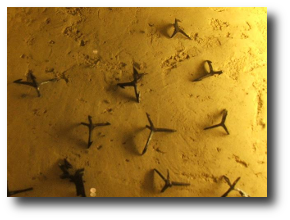
Roman caltrops. Artwork brought to us through the and licensed under the .
Roman caltrops.

We hit the spikes on Interstate 40 East in Texas, soon after the second-largest freestanding cross in the Western hemisphere dropped over the horizon and disappeared from our rearview mirror, along with the giant thing crucified on it. (All the faded tourist-trap signs claim that cross is the largest, but I look into these things, and I know the cross in Effingham, Illinois actually has a wider armspan.)

Our car hit the spikes at speed. Four blowouts and several seconds of terror later I gave up on the regular brakes and yanked up the emergency. The car spun, screeching, and settled mostly on the shoulder, pointed back west, the low sun glaring in our eyes.

Tana got out and I followed, trembling, as she knelt and pried a metal spike from the deflated rubber of one tire. It looked like an oversized jack, something a child would play with, but with sharp points. “Caltrops,” she said, then looked up. “They’re all over the road back there.”

“So, what’s that, medieval? To stop heavy cavalry charges? They’re for maiming horses, not cars, right?”

“They were used even earlier, in Roman times, against horses drawing chariots. I think radical environmental activists used them into the modern era, but I was a Classics major, so it’s outside my area. Could be from almost any time, really.”

I took a shotgun from the back seat, and handed Tana a crossbow. I heard whoops coming from far up the highway to the east, but couldn’t make out enough of the language to guess their origin. If they were moderns, the shotgun could help. If they were from a civilization that predated firearms, the shotgun would just be an unwieldy club. Ever since the Disaster — or, as they call it where I’m from, The Shake-Up — time’s been funny. Highwaymen bring the technological limitations of their own eras with them. “Did the Romans even have crossbows?”

Tana shrugged, loading a bolt. “They had ballista. Close enough.”

We put our backs against the car and watched our ambushers, rapidly approaching specks charging down the blacktop. “We had some good times, didn’t we?” I said. “I mean, we — ”

“Hey,” she said. “You know, there’s hundreds of caltrops scattered on the road back there. Why don’t we walk real carefully and get on the other side of them? I’d like to see these guys rush us then, with the sun in their eyes and spikes in their way. We might have a chance.”

That’s why I love Tana. She’s way smarter than me. Without her, I would have died the first time I tried to use a chainsaw against a caveman.

Leave a Reply

Hungry

by Tree Riesener

August 2018

From the editors:

I’m not generally a fan of stories from a child’s POVs. I find a lot of stories with young narrators take the tack of making the prose almost overly simplistic (short sentences, and simple words), in order perhaps to make it clear this is a child speaking.

For me, the best stories featuring children aren’t simple at all. They take the wonderful, open imagination of children and spin it into new possibilities.

But all that imagination can have a dark side.

That’s what “Hungry” does. It’s a child’s slight misunderstanding that shifts tragedy to horror. And Tree Riesener makes the child’s conclusion so terrifyingly logical. She makes it feel possible. And really, how sure are you that when your day comes, your children won’t decide to be cruel to be kind. How can we ever be sure?

Eat up.

Sabrina West

Managing Editor

Quiet. You sit quiet as a mouse in the corner. Push a little doll around and hum la-la-la so they forget you’re there while they have the cocktail hour.

That’s how you find out they’re killing Grandma.

Not a single bite to eat or a swallow of water. Your mother is killing her mother.

That’s their favorite punishment for you, too. Go to your room without any supper. They can do it to their daughter and they can do it to their mother.

You feel like a balloon somebody’s lost the string of and you’re helplessly blowing in the wind.

You didn’t realize they were that powerful that they could just kill somebody, especially their own mother. You wonder if someday you’ll have to kill them by not giving them anything to eat or drink and you decide you’ll never do it, never.

Dead dead dead forever, all skinny and dried out like an old sponge and nothing in her tummy. That’s what Grandma will be.

Grandma that you visited in her little house of lace and cookies with real green plants hanging at all the windows and a bird feeder in the garden. Grandma who put a little bed right in her room for you when you visited so nothing could get you and never said don’t be silly when you worried about vampires under the bed and while you were drying the dishes for her, said you didn’t have to tell mommy and daddy.

Sometimes you have to be cruel to be kind. That’s what they keep saying while they pour each other drinks. They’re the grown-ups and they should know. But they say everybody at your new school really likes you, they’re just teasing the new kid, when you know everybody hates you to hell and it won’t ever stop until you’re dead.

You know what they’re telling you about Grandma is true because Mother sneaks you in, whispers something to the nurses so they look the other way, and takes you in to say goodbye so with your own eyes you see Grandma in the bed with sides like prison bars, her skinny arms that look like tissue paper with black and blue blotches stretched out and tied down and stabbed with silver needles.

You think they’ll do something, but they just stand there looking down at her and Mother holds your hand in a tight grip so you can’t get away.

Grandma can’t say anything because of the tube in her mouth but her eyes finally leave Mother and Daddy and roll really scared at you, like she’s saying please, you’ll help me, won’t you? Remember what good times we had that week you stayed with me, baking cookies and sitting on the porch, filling the bird feeder? We can do that again, if you’ll help me.

Well, of course you start to cry and a nurse comes running in, looking mad like teachers look when you’ve done something wrong. Mother shakes your arm and says shhhh but you don’t care and just keep on wailing. Your father hisses at Mother that he told her this wasn’t a good idea and she hisses back at him.

Then they take you out into the hall to a little place with hard plastic chairs you keep sliding off of and say in those sweet voices they use when you fall down or get hurt that Grandma doesn’t know anything anymore, it’s just her old body there, she isn’t hurting, is just waiting for Jesus to come and get her.

Jesus? Who’s Jesus? The only time you’ve ever heard his name is when somebody gets mad and says oh, Jesus Christ!

You ask if Jesus is a doctor and will he help Grandma and they look at each other and smile that way people do when little kids say something so stupid it’s cute. How are you supposed to know about Jesus when they never told you, never let you know he’s also God in Heaven and flies down like Superman to get you when you die and takes you back with him? They tell you now.

That evening they go out and stay for a long time. When they come back, they pay the hotel sitter, then ask you to sit down and tell you in their nice voices that Jesus has come and Grandma is gone.

Since you don’t know what you’re supposed to say, you just say okay and while you’re brushing your teeth, you hear them talking about adding this to the list of stuff Dr. Samuels is supposed to help you with. Your throat and chest are bursting with pain but for some reason you don’t think you should let them know.

They take advantage of being in the city to do some shopping and hire the sitter to stay with you while they go to the funeral, that they say isn’t for little girls.

At least Jesus has come for Grandma. You learned long ago that they tell you a whole bunch of lies but that much is probably true. You sort of remember her singing, that time you got to stay with her, that she had a friend in Jesus, and if Jesus can float in air and carry people back with him like a lifesaver, he’ll know about her needing a snack and by now she’ll have had time to eat several times, with Jesus.

You say you’re not hungry, but they order you a fancy sandwich held together with toothpicks and ginger ale with a little paper parasol stuck in a cherry. You have to eat, darling, they say and you know you’d better do it because there’s no way in the world you ever want to make them mad at you again.

Previously published in Flash Fiction Online, February 2015. Reprinted here by permission of the author.

Leave a Reply

Join the 
Community

Support

Support lorem ipsum dolor sit amet consectetur. At dignissim neque amet proin sodales vulputate dolor elit ipsum dolor sit amet.

Subscribe

Subscribe lorem ipsum dolor sit amet consectetur. At dignissim neque amet proin sodales vulputate dolor elit.

Submit a Story

Submissions lorem ipsum dolor sit amet consectetur. At dignissim neque amet proin sodales vulputate dolor elit. At dignissim neque amet proin sodales vulputate dolor elit.