Issue December 2009 Flash Fiction Online December 2009

Table of Contents

Christmas Presents, 1914

February 2015

“I quite agree with Henry,” said she. “This is no time for Christmas presents — except to hospitals and Belgians and men at the Front.” Artwork  by greengymdog on and used via a Creative Commons license.
Artwork by greengymdog on flickr and used via a Creative Commons Attribution license.

“It’s perfectly simple,” said the Reverend Henry, adopting his lofty style. “We must cut the whole lot. There is no other course.”

“I don’t consider that your opinion is of any value whatever,” said Eileen. “In fact you ought not to be allowed to take part in this discussion. Every one knows that you have always tried to get out of Christmas presents, and now you are merely using a grave national emergency to further your private ends.”

The Reverend Henry was squashed; but Mrs. Sidney had a perfect right to speak, for she has been without doubt the most persistent and painstaking Christmas provider in the family, and has never been known to miss a single relation even at the longest range.

“I quite agree with Henry,” said she. “This is no time for Christmas presents — except to hospitals and Belgians and men at the Front.”

“You mean that you would scratch the whole lot,” said I, “even the pocket diary for 1915 that I send to Uncle William?”

“Yes, even that. You can send the diary to Sidney” (who is in Flanders). “I have always wanted him to keep a diary.”

“What about the children?” said I.

“The children must realise,” said the Reverend Henry solemnly, “what it means for the nation to be at war.”

“Oh, no,” Laura broke in impetuously. “How can they realise? How can you expect Kathleen to realise?”

“Do you know,” said the Reverend Henry, “that only last Sunday my niece Kathleen was marching all over the house singing at the top of her voice, ‘It’s a long, long way to Tipperary: the Bible tells me so’? Obviously she realises.”

“But what about — ” Eileen was beginning.

“Let’s have a scrap of paper,” said I, “a contract that we can all sign, and then we can put down the exceptions to the rule.”

Henry was already hard at work with a sheet of foolscap.

“… not to exchange, give, receive, or swap in celebration of Christmas, 1914, any gift, donation, subscription, contribution, grant, token, or emblem within the family and its connections: and further not to permit any gift, donation, subscription, contribution, grant, token, or emblem to emanate from any member of the family to such as are outside.”

“Good so far,” said I.

“The following recipients to be excepted,” Henry went on,

“(1) All Hospitals; (2) Belgians; (3) His Majesty’s Forces — ”

“(4) The Poor and Needy,” suggested Eileen.

“(5) The Aged and Infirm,” said I. “I only want to get in Great-aunt Amelia. She mustn’t be allowed to draw a blank.”

“That’s true,” said Henry; “we’ll fix the age limit at ninety-one. That’ll bring her in.”

“(6) Children of such tender age that they are unable to realise the national emergency,” said Mrs. Sidney.

“Quite so,” said Henry. “What would you suggest as the age limit? Three?”

“Four,” said Laura simultaneously.

“I should like to suggest five,” said I, “to bring in Kathleen.”

“Let’s make it seven,” said Mrs. Henry. “I can hardly believe that Peter realises, you know.”

“Stop a bit,” said I. “If you take in Peter you can’t possibly leave out Tom. Make it eight-and-a-half.”

“That seems a little hard on Alice, doesn’t it?” said Eileen.

“Any advance on eight-and-a-half?” called Henry from the writing-desk. And from that moment the discussion assumed the character of an auction, Laura finally running it up to thirteen (which brings in the twins) to the general satisfaction.

When the contract was signed, witnessed and posted on its way to the other signatories there was a general sense of relief that Christmas would not be very different from usual after all. Henry growled a good deal. But we know our Reverend Henry: He will do his duty when the time comes.

Leave a Reply

Catalyst

by Rick Novy

February 2015

After consuming half the fuel, the torch broke through the hull. Bright as a nova turned out to be an understatement. Artwork : Plasma jet image courtesy of NASA and ESA using the Hubble telescope. Brought to us courtesy of .
Artwork : Plasma jet image courtesy of NASA and ESA using the Hubble telescope. Brought to us courtesy of Wikimedia Commons.

“Sabotage?”

Chief Engineer Hoyle nodded. “I caught Officer Jarimath mucking about with the safety controls myself.”

The commander turned around to stare at the dim yellow star that controlled this solar system. “And there’s no way to vent the fuel?”

“The relief valve is frozen solid.” He paused a moment to consider how that might have happened. “Probably welded earlier. We haven’t purged the system in a long while.”

A long sigh punctuated the Commander’s resignation to the situation. “Ten hours, you say?”

Hoyle nodded.

“See if you can work it out.” The commander pointed toward the star. “There is a habitable planet in this solar system, and it is fairly close. Can we still use thrust? If we have to abandon ship — ?”

“We can put her into a high orbit.” Hoyle didn’t quite believe that, but at least the idea would give the Commander hope. It might even prolong the inevitable. A little.

Back in the engine room, Hoyle’s eyes alternated between the gauges and the blueprint for this section of the ship. There had to be another way to vent the pressure. Cutting into the line would fill the ship with toxins, and in addition to the main valve, Officer Jarimath ensured all backup systems were frozen, too. If only he could release it into space.

“Do you think it will work?” The Commander looked uncomfortable with the concept of cutting a hole in his ship’s hull to relieve the pressure. “It sounds risky.”

“Risky, of course.” Especially for the guy cutting the hole, and that guy would be Hoyle. “But what alternative do we have? It’s the only way.”

Hoyle never liked working outside, especially while in orbit. Working with a planet hanging overhead would make anyone nervous. Even the opaque goggles didn’t help. Planetshine leaked around the edges. Still, Hoyle knew the ship better than anyone else aboard.

With one of the extended reach tools normally used for reaching deep into the radioactive stores, Hoyle lit a torch and began cutting into the hull. The opaque glasses made it difficult to see the torch flame, but the purge would be bright as a nova, and that made the eye-protection mandatory. Even with the reach tool, Hoyle would be lucky to finish this escapade with his life. Once the torch penetrated —

After consuming half the fuel, the torch broke through the hull. Bright as a nova turned out to be an understatement. He could clearly see the hull of the ship through the opaque glasses, illuminated by the jet of hot plasma erupting from the new hole. That jet would continue for many local days. Pressure relieved. Mission accomplished.

In the Commander’s ready room, a pair of soldiers held Officer Jarimath. The commander stood in front of his desk, while Hoyle sat in one of the comfortable crew chairs.

The stare that the Commander gave Officer Jarimath could have been used in place of the torch. “You nearly destroyed my ship and killed my crew. Treason is punishable by death or banishment. In this case, since the inhabitants are human, my decision is exile. Officer Jarimath, do you have anything to say for yourself before you are expelled to this primitive world?”

Officer Jarimath remained stoic, saying nothing.

“Take him away.” The soldiers escorted Officer Jarimath out of the ready room and onward to his fate.

The commander turned to Hoyle. “When can you begin repairs on the engine?”

Hoyle got to his feet and adjusted the shirt that had bunched while he sat. “The engine will vent for eight or nine more local days. Once the gasses escape, it will only take a day or two before we can be underway.”

“Very well.” The commander walked around his desk and sat.

Hoyle took a step toward the door, then stopped to turn back to the Commander. “One thing. We are in stationary orbit above a populated desert region. Surely the natives see what must look like a very bright star.”

The Commander shrugged. “This planet is populated by primitives. In a generation, there will be no memory of a bright star in the sky.”

Leave a Reply

Write Rites: The Ritual Story

In the previous column we looked at the advantages of writing about characters that the reader already knows. This strategy can be applied to other elements of stories. Anything that you might have to develop for a reader — setting, the rules of a particular society, the backstory for characters — doesn’t have to be developed in detail if you work with a setting, a society, or characters that the reader already knows.

It’s even possible to extend this idea into realm of the problem story, the kind where the character or characters face a difficult problem, fail repeatedly to solve it, and finally take a new approach and successfully solve the problem. If you can start with a problem that’s already familiar to the reader, you won’t have to spend words explaining the problem.

Many stories that are re-tellings of familiar tales take advantage of the reader’s familiarity with the original version. If you want to write a version of Cinderella without a fairy godmother, you can begin your story with Cinderella at her wit’s end because the fairy godmother who is supposed to get her ready for the ball hasn’t shown up. You can use a word or two to remind the reader about Cinderella’s difficult life up to this point, but you can rely on the reader to remember Cinderella’s drudgery and her cruel step-family from other versions of the story.

However, my favorite form of a problem-solving tale that relies on the reader’s familiarity with the problem isn’t the traditional story of struggling to solve the problem and arriving at a solution after some failures. The kind of story I have in mind focuses on a problem that some character or some group of characters has already solved, and keeps successfully solving time and again.

What I’m talking about is the story of a ritual.

Rituals exist, for individuals or societies, because they address some regularly occurring problem, the kind of problem that all human beings will know about. How do we deal with the fact of our mortality? How to we restore ourselves when life wears us down? How do we manage to heal after a betrayal?

Narrating a ritual is a very good fit with very short stories. A ritual has its own beginning, middle, and end. Participating in a fictional ritual as a witness gives the reader some of the satisfaction of going through such a ceremony or practice. It’s also true that a story centered on a ritual has a potential problem in that a good ritual goes the same way every time. It’s predictable. So the writer may not be able to use the suspense of having a character’s actions generate unexpected results. When the story is about a ritual that goes off without difficulties, the story doesn’t have much plot.

However, the story of a ritual makes up for this with the power of mystery. Because we know that rituals are created to solve our universal human problems, we’re interested in finding out what all the parts of a ritual add up to. Why does this character or community of characters engage in this ritual? What are the parts? How does the ritual help them?

My favorite story of an individual’s ritual is Yasunari Kawabata’s story “Snow.” Sankichi, a man in middle age, has a ritual of checking into a hotel from the evening of New Year’s Day until the morning of January third. He spends this time in bed, always having the same dream-like experience.

The problem Sankichi is addressing with his ritual is only hinted at with these words: “he was seeking rest from the irritation and fatigue of a busy, agitated year” and the observation that even after this fretful tiredness leaves him “a deeper weariness welled up and spread out within him.” His ritual helps Sankichi recover from both ordinary fatigue and something deeper, perhaps a matter of the spirit.

Most of the story is given over to the visions that Sankichi has in his hotel room. Every year, he envisions a place where it is snowing, where he himself is the snow that is falling. He sees a vision of himself as a small boy in his father’s arms. Later, he sees the approach of birds and realizes that they are not birds at all, but all of the women who have ever loved him, with wings. The story ends with Sankichi communing with these spirits and feeling their love.

In short, it is a story about a man who has figured out a way to retreat from the world for about 36 hours and nurture himself with the restorative powers of memory and love.

One of my own best-known, most-reprinted stories is “Don Ysidro,” which recounts how one village in Mexico has invented a ritual for solving the problem of death. The story creates a ritual that makes literal the idea that when we die, we endure in the work and lives of others whom we have influenced. Rather than the idiosyncratic ritual of one person, such a story is like an anthropological report about a group of people who share this ritual.

My advice for writing ritual stories is that you find your ideas by doing three different kinds of research. In the first instance, think about your own answers to the Big Questions in life. What is our purpose? How can we deal with the departure of some people from our lives and the arrival of others? What do we owe one another as human beings?

In the second instance, what are some ordinary recurring problems in your life that might be easier to bear with the right kind of ritual? Are you world-weary like Sankichi in the Kawabata story? Do you feel that life is moving too fast? Are you anxious about losing memories or objects that are dear to you? Or are there too many memories or objects that you’re holding onto? What ritual might a character in your situation invent, and how would that ritual make the character feel better?

Finally, I suggest reading about rituals and attending rituals while thinking about what universal problems they address. What do these rituals give the participants? Consider inventing fictional rituals that in a different way give a community something that its people crave.

I wrote a whole chapter in Word Work about the rituals that writers use to help them get the writing done. If you’re writing a story about ritual, you might as well incorporate some small ritual into your drafting process. Light a candle. Say a little prayer for your favorite dead author, your personal patron saint. Burn some incense. Wear a feather in your hair.

And then give the reader the pleasure of a good ritual, a rite or practice that, with any luck, will leave you, your character, and your reader feeling at least temporarily restored.

Comments

  1. Absolutely lovely. I have never heard of Yasunari Kawabata, but put Snow [Country] on my To Immediately Read list. Thank you for this article, Bruce, and hello from 2024.

Leave a Reply

Don Ysidro

This story is used as an exemplar for Bruce’s column, “Write Rites: The Ritual Story”. You may want to see all of Bruce’s writing columns; you can find them listed here.

On that last morning, anyone who came to visit me could see that I was dying. I knew it myself. As if I had cotton in my ears, I heard the voice of don Leandro saying to my wife, “Doña Susana, I think it is time to fetch the priest,” and I thought, yes, it’s time. We don’t have our own priest, or even our own church, so someone has to drive in a pickup truck to get the priest from El Puentecito. But don’t be fooled by what you may hear in Malpasa or in Palpan de Baranda. Here we remain Catholic. Yes, we make pots in the old way. That’s why tourists come here. And it’s true, as is sometimes whispered, that we have restored certain other practices from the past. But not as they were done back then. Those were bloody and terrible times, the times of the Mejica. They say that the sacrificial blood covered the sun pyramids from top to bottom. Thank the Virgin, we don’t do anything like that.

A little after the priest came and went, I died. Word spread. People came to our house. My family asked first for things of mine that they wanted. Then the other neighbors. Don Francisco stood near my body and said, “Don Ysidro, may I have your shovel? I need one, and your sons-in-law can dig new clay for Susana.”

I said, “Take it with my blessing.”

Susana said, “He says for you to take it.”

Next was doña Eustacia. She asked for one of my seguetas for scraping pots.

I said, “Of course. Go with my blessing,” and Susana said, “He says for you to take it.”

When don Tomás came, he asked for my boots, the ones of red leather with the roosters in the stitching.

I said, “Tomás, you thieving rascal! I know very well that you took two of my chickens that night seven years ago to feed to your whore from Puebla. And here you come asking not for a segueta or some wire, but for my good boots!”

And Susana said, “He says for you to take them.” Because, of course, she couldn’t hear me. In any case, I would have let Tomás have the boots. I only wanted to see him blush just one time.

They came and asked for everything that Susana would not need. They asked even for things for which it was not necessary to ask. They asked for things I had already promised to them. They even asked for permission to dig white clay from the place where I liked to find it. They asked, and I said yes, with my blessings. We are nothing if not polite.

Last of all, they asked for a few of my hairs to make brushes for painting pots. They cut what locks there were with scissors. They asked for my hands and cut them off with a knife for butchering goats. They said, “Don Ysidro, we want your face.” I agreed, and they flayed off the skin very carefully and tenderly. They put my hands in a metal drum and burned them. They dried my face in the sun. Meanwhile, they wrapped the rest of my body in a shroud and buried it in the churchyard according to the customs of the Church.

For a time after that, I was in an emptiness, a nowhere place. I didn’t see. I didn’t hear. I couldn’t speak. I wasn’t anywhere, not in my house, not in the coffin in the ground. Nowhere. But that would change.

All my life, I had taught the other people of my village to make pots as I made them. That was nothing special. We all did this. I made my own don Ysidro pots, except when doña Isabela showed me how to make her little tiny ones, or don Marcos demonstrated how he painted his. Then for a while, I would make little tiny pots just like doña Isabela or pots painted in the style of don Marcos. When doña Jenífera had gone to the capital to see the birds and animals on ancient pots, she imitated those decorations, showed us, and soon we all knew how to do it. The rest of the time, I made pots in my own manner, though sometimes with a little touch of Isabela or Marcos or Jenífera that I had learned from them and made my own.

Now for the week after I had died, everyone in the village would be making pots as I had made them. Even the children, if they were old enough to make pots of their own. They dug white clay from my favorite place, soaked it, filtered it, let it settle, and poured off the clear water from the slurry. When the clay was dry enough, they mixed in the ashes of my hands. Then they made clay tortillas and pressed them into big plaster molds for the base, just like the ones I used. Sometimes they used my very own molds. They made snakes of clay, attached them to the bases, wound them around from the bottom up. My pots didn’t have necks. Neither did these. The people — my family and all the rest of the town — scraped these pots smooth, rubbed them to a shine, and painted them with black paint, using brushes of my own hair and in designs I would have used: lizards and rabbits with checkered backs, or else just checkers that started big around the middle of the pot and became intricate at the lip. Those were pots in the don Ysidro style. They fired them. The ones that the fire didn’t break, they brought to my house. Susana put pots all around the front room, and even in the bed where I had lain.

But I didn’t see this. I only knew it was happening.

These pots in my house sat undisturbed. The people burned the brushes made from my hair.

On the third day, there was a feast at my house. Probably there were all kinds of tamales, some with olives and meat, some with seeds and beans. Men and women drank pulque, and there was perhaps melon water for the children. The sun went down. Candles were lit. A fire burned in my fireplace.

At midnight, don Leandro opened a box and took out the mask made of my own skin. He put my face over his face, and I opened our eyes. I came from the place that was nowhere. I was in the room. I looked at the faces, at the wide eyes of the living, at Susana holding her hand over her mouth. I saw my grandchildren, Carlos and Jalea, Ana and Quinito. And for the first time, I could see the pots in the living room. They glowed in the candlelight. Together, don Leandro and I went into the bedroom and I saw the pots there on the bed. We returned to the living room, and I said with our mouth, “I see that I am not dead after all!”

“No, no, don Ysidro,” they assured me. “You are not dead!”

I laughed. That’s what you feel like doing when you see that you aren’t dead.

Then don Leandro threw the mask into the fire, and I wasn’t in the mask any more. I was in the pots. In all those round pots made by the hands of my friends, my rivals, my family, my neighbors. I was there, in each one. The people took me away from my house, pot by pot, and I entered their houses with them. In my former home, they left only the pot that Susana had made in my style.

From that night forward, I was all over the village. People stored corn in me, or rice, or beans. They used me to carry water. And I spread out from there, for if tourists came to buy pots and happened to admire me, the potter would say, “Oh, that’s don Ysidro.” And the tourist would nod and perhaps buy the pot that he thought was merely made by don Ysidro.

I am still in my little village, but I am in Stockholm, too, and Seattle. I am in Toronto and Buenos Aires. Some of me is in Mexico, the capital, though I am mostly still at home here in the village where I grew up, grew old, and died. I sit on Susana’s shelf where I can watch her make ordinary tortillas for her breakfast or clay tortillas for her pots. She is old, but her hands are still quick as birds. Sometimes she knows that I am watching her, and she looks over her shoulder and laughs. Whether she can hear it or not, my answering laughter is deep and full and round like a great big pot in the manner of don Ysidro.

Leave a Reply

Note From the Future

by Ray Vukcevich

February 2015

Yes, there would be the keys. Artwork courtesy of , who placed it on and placed it in the public domain.
Artwork courtesy of Benedicto16, who placed it on Wikimedia Commons and placed it in the public domain.

I didn’t notice the note under my windshield until I’d already gotten into the car and put the key in the ignition. Immediately, a sequence of future events came into my mind. I would open the car door. I wouldn’t take the keys out of the ignition as I got out. I would automatically push the lock button down. I wouldn’t want to take the chance that I might get a grease smear on my white shirt, so instead of just reaching over and grabbing the note, I would slam the door shut and walk around for it. I would pull the note out from under the windshield wiper and unfold it. It would be folded in a very complicated manner, and my unfolding would be a long and frustrating experience. Once I had it open, I would see that there was only a single sentence written in pencil. The sentence would read, “You’ve just locked your keys in your car.”

And it would be true. Clutching the note in one hand and trembling with hope and fear, I would reach down with the other hand and seize the door handle. But the door really would be locked. I would cup my hands around my eyes and peek in. Since I’d still be holding the note, I would get a small paper cut above my left eye.

Yes, there would be the keys. So close and yet I might as well have been looking through a supernaturally powerful telescope at them on the moon.

I would now be late to an important meeting this morning. It would be the last straw, the very last straw. The Big Guy would sadly fire me. I mean to say he would pretend to be sad. I would be mostly pissed. I would say things that would forever burn my bridges in this business. Word would get around that I was not only late, but hard to work with and generally unpleasant in stressful situations.

Blood from the paper cut would run into my left eye, and I would wipe it away and smack my palm against the glass of the driver’s side window and leave a bloody handprint.

Maybe I should kill myself. I was already bleeding — no need to cut my wrists. I could just wait it out and bleed to death from my face right there in the driveway.

Or I could go into the house and get my spare car key if it were not for the fact that my house key was also locked in my car. I could try breaking into the house, but I had already set the alarm. It would go off. The security company would call the police. By the time I convinced them I was the homeowner, I would already be late, and the Big Guy would have already decided who was to get my office.

So, in order to derail that sequence of events and cheat Fate, I carefully removed the key from the ignition and put the whole bunch of keys into the front right pocket of my pants. I got out of the car and automatically pushed down the lock, and, not wanting to get my white shirt dirty, closed the door and stepped around and snatched up the note and negotiated the complexity of its origami.

Inside it looked like this.


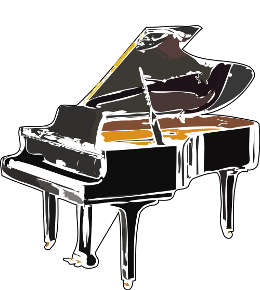
Piano Turner.

Let a professional do it.


There was a local phone number.

There was a treble clef and staff drawn in blue ballpoint pen and seven musical notes.

I didn’t recognize the tune, but I understood the message.

I had been at the point where it might have gone either way, and I had made the right turn.

I had not locked my keys in the car. I would be on time for my big meeting.

The Big Guy would love me.

My future was bright.

To seal the deal, I got out my phone and called the number on the note and made arrangements to have my piano turned just enough to catch the spring sunlight.

Leave a Reply

Brass Canaries

by Gwendolyn Clare

February 2015

We perch next to the glass, where window shoppers can press their flushed faces against the panes and ooh and aah at us. It is shopping season. We know because they cover their hands in cloth, and the sky falls white and fluffy around their feet.

They hurry by in twos and threes, carrying bags and boxes clutched close to their bodies. Sometimes a large one leads a line of smaller ones, like our Maker the year he built ducklings. The smaller ones linger by our window and stare.

We also know it is shopping season because some of us are sold. Maker takes one of us from the window perch, carries it to the counter, and wraps it in bright red tissue paper. “Sold” means you go away and do not come back. The brass grackles squawk jealously every time our Maker rustles the tissue for another bird; we have asked them why, but they won’t tell. After closing time, our Maker says goodnight to every bird, cooing about the pleasures of being sold. We suspect the grackles know no more of it than we do.

The mockingbirds used to live next to us in the window display. Their favorite songs are the whoosh-whoosh of the street cleaner and the bee-yoo bee-yoo of emergency sirens. They did not sell well, and our Maker moved them to the back room. We miss them. They were interesting conversationalists.

Last year we fluttered our polished wings and cocked our heads at all the passersby, enticing them to pause for a closer look. But now we stare out the glass, or hop around on our perch to face away. Maybe, if we ignore them, we too will sell poorly and our Maker will move us to the back room with the mockingbirds.

A woman enters the shop one morning, the old silver jay cawing her arrival from his perch atop the doorframe. Our Maker shuffles out of the back room to help her. The woman looms over him, imposing and tall, swathed in furs and golden jewelry that gleams like our polished brass plumage. On the high shelf behind the counter, the brass owl lets out a single hoot, a low note of warning. It has an excellent instinct for customers. Our Maker ignores it.

“How may I help you, madam?” he says.

The woman sweeps her gaze around the crowded shop, and with hardly a moment’s pause, she points to us and says, “I’ll take one of those.”

“Ah, the brass canaries. They’re delicate, very fragile,” our Maker warns. “Only recommended for the most discerning and dedicated hobbyists.”

“Is that so?” She raises a stern eyebrow.

“Well, they are a fine choice, my most life-like yet; that’s why they need such care. Just as with real canaries, their health suffers from the slightest neglect. Very sensitive birds.”

A big red ladder truck whizzes by in the street, singing bee-yoo bee-yoo, and in the back room, the mockingbirds take up the song. Bee-yoo, bee-yoo, bee-yoo.

The woman smoothes the cloth on her hands and frowns. “I was not planning to stick it down a mine shaft, sir. I’m simply looking for a toy for my son.”

“Perhaps you’d be interested in the brass bats, then? They can fly,” he said, leaning in as if sharing a confidence. Hanging from the rafters, the bats squeak nervously and fan their wings; our Maker may not heed the owl’s warnings, but we all do.

“No, I think I’d rather a songbird. Last year, I bought him a brass kitten from LaGrange down on Main Street, and it scampered off not three days after Christmas. Never saw the bloody thing again. This time, I want something in a cage.”

We chittered amongst ourselves; a bloody brass kitten was news, indeed. Owl, we ask, what is blood?

Owl is the wisest of us all. He says, blood is what people have in their hearts.

And what is a heart, owl?

A heart is a mainspring, but for people.

The woman and our Maker are arguing about the number written on the little sign below our perch. We wonder: if people wind our springs, then who winds their hearts?

In the end, the woman agrees to purchase a pair of us at a reduced price, and she wanders to the other end of the store to select a cage. Our Maker plucks two of us from the perch and wraps them carefully, lovingly. The grackles squawk, and we exchange knowing glances out of the corners of our beady eyes. “Sold” means you go away and do not come back.

Our Maker gives her a list of instructions for our care and reminds the woman that we must be wound once a day. The shop is not responsible for birds broken as a result of neglect. Warranty valid for thirty days with proof of care. Not for use in coal mines.

“Thirty days?” the woman reads, and laughs. “You really expect a child to pay attention to the same toy for thirty consecutive days?”

“As I told you,” our Maker says, tight-lipped, “your canaries are quite fragile and require frequent care.”

“Yes, yes, of course.” She turns to go. “Happy Christmas.”

The silver jay chirps when she leaves, and our Maker lets out a weary sigh. Above him on the shelf, the owl shifts from one foot to the other, disquieted on our behalf. But we are not upset, we do not worry for our brethren. We know it is only the work of time and fate.

All the brass birds have a purpose. The mockingbirds were built to sing a siren chorus, the owl to be a keeper of knowledge, the bats to fly, and even the old silver jay has his job as the doorman of the shop. We, too, have a purpose. Our Maker would never tell us — he is too soft-hearted — but now we understand:

We were built to die.

Leave a Reply

Join the 
Community

Support

Support lorem ipsum dolor sit amet consectetur. At dignissim neque amet proin sodales vulputate dolor elit ipsum dolor sit amet.

Subscribe

Subscribe lorem ipsum dolor sit amet consectetur. At dignissim neque amet proin sodales vulputate dolor elit.

Submit a Story

Submissions lorem ipsum dolor sit amet consectetur. At dignissim neque amet proin sodales vulputate dolor elit. At dignissim neque amet proin sodales vulputate dolor elit.