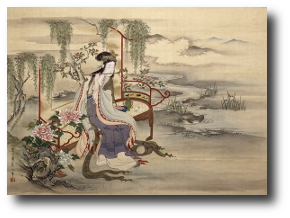
Artwork comes to us through Wikimedia Commons and is in the public domain. Click for a larger image; I couldn’t bring myself to crop the original.
One day when the chamberlain, Master Tēng-t’u, was in attendance at the palace he warned the king against Sung Yü, saying: “Yü is a man of handsome features and calm bearing and his tongue is prompt with subtle sentences. Moreover, his character is licentious. I would submit that your Majesty is ill-advised in allowing him to follow you into the Queen’s apartments.”
The king repeated Tēng-t’u’s words to Sung Yü.
Yü replied: “My beauty of face and calmness of bearing were given me by Heaven. Subtlety of speech I learned from my teachers. As for my character, I deny that it is licentious.”
The king said: “Can you substantiate your statement that you are not licentious? If you cannot, you must leave the court.”
Sung Yü said: “Of all the women in the world, the most beautiful are the women of the land of Ch’u. And in all the land of Ch’u there are none like the women of my own village. And in my village there are none that can be compared with the girl next door.
“The girl next door would be too tall if an inch were added to her height, and too short if an inch were taken away. Another grain of powder would make her face too pale; another touch of rouge would make her too red. Her eyebrows are like the plumage of the kingfisher, her flesh is like snow. Her waist is like a roll of new silk, her teeth are like little shells. A single one of her smiles would perturb the whole city of Yang and derange the suburb of Hsia-ts’ai. For three years this lady has been climbing the garden wall and peeping at me, yet I have never succumbed.
“How different is the behavior of master Tēng-t’u! His wife has a woolly head and misshapen ears; projecting teeth irregularly set; a crook in her back and a halt in her gait. Moreover, she has running sores in front and behind.
“Yet Tēng-t’u fell in love with her and caused her to bear him five children.
“I would have your Majesty consider which of us is the debauchee.”
In nineteenth-century novels, there was time to admire the scenery and get to know the characters at our leisure. There might be an entire chapter devoted to the lovely English countryside before we ever met Squire Greenfield, and we might have tea with the good squire in his drawing room in chapter two, admiring the paintings that his grandfather had collected and getting a firm sense of the squire’s character before the first glimmer of a problem, and a plot, would appear in chapter three.
But twenty-first-century readers want their novels to start with a bang. If they are going to have a description of the lovely English countryside, they want that description to come in the midst of a wild chase, or at least a desperate argument. Readers, and editors, expect the story to supply setting and characterization on the fly. Characterization has to be carried out after the action has started, with everything that a character thinks, does, or says, along with the reactions of characters to one another, gradually revealing to us the nature of the story’s imaginary people. In contemporary novels, we get to know characters the way that we get to know people in life: gradually, after seeing them in a variety of circumstances.
Naturally, this sort of gradual revelation of character can’t work in flash fiction. Sometimes, this hardly matters. The characters in much flash fiction are ciphers whose role is to reveal an idea or act out an episode, and the idea, the episode, or even the way that the story is told is the real star of the story. A common convention in flash fiction is to tell the story without giving the characters names, a sure indication that the individuality of the character is not necessary for the story.
But there are stories in which it is vital that the hero of the story be, say, immensely compassionate. The set-up of the story requires that the protagonist care deeply about the suffering of others. How can the writer establish this characteristic?
One way is to resort to some unfashionable techniques. The era of the leisurely novel was also the era of the trusted omniscient narrator who could simply tell the reader things and be believed. We have the example of Moll Flanders making her living as a prostitute and thief while the novel’s narrator assures us that in spite of what we see her doing, Moll is a good person.
Novelists don’t use this omniscient authority in a straightforward way any longer because a novel’s readers are not going to trust it. I think that eighteenth-century readers had rather different notions of both psychology and authority, so they could be convinced, on the authority of the narrator, that Moll’s essential nature was good and virtuous even as she was delighting in a clever plan to cheat a man of his money.
Contemporary readers would see irony in any contradiction between what a narrator said was true and what the reader could see for herself. She would not believe that Moll was, at heart, a good person in spite of the evidence. Novelists now can use an omniscient narrator, but readers will be a little suspicious of what they are told as opposed to what they learn for themselves.
This is, in part, what underlies the advice to “show, don’t tell.” Unfortunately, taking advice without understanding why it has been given makes it hard to know when to ignore the advice, and there are plenty of times when a writer can safely ignore “show, don’t tell.”
Flash fiction in general allows for satisfying stories that are told rather than shown. For many readers, a short-short story isn’t long enough to allow them to become fully immersed in the reality of the story, so it matters little if the story doesn’t create the little dream of events unfolding as if before the reader’s eyes. And perhaps more to the point, in a short-short, there isn’t room to convince the reader of very much by showing. The reader is as likely to believe what she is told as she is to believe what she can be shown in only a few words.
Telling a story can be almost as entertaining as showing it. It is true that what the writer tells is apt to be less dramatic than what is shown, but even a reader who is a little bored by being told that a character is compassionate can see that the boredom won’t last long. The story is very short. It is either going to transition into a scene soon or, if not, will soon be over anyway.
Another technique that the writer can use in flash fiction is to write the story about a character that the reader already knows well. Take the example of the character who, for the sake of the story, must be deeply compassionate. Make the main character Jesus or Buddha, and most readers will see exactly the character your story needs.
Historical figures are ideal for this purpose if they are well known, and known for the personality that you want to convey in the story. Legally, any real person who is dead is safe for you to use as a fictional character. The dead are not considered to have reputations to protect, so what you write about your fictional version of Michael Jackson won’t result in a libel judgment against you.
Using characters from literature is a more ambiguous situation. Certainly a writer is not free to use characters in another writer’s works that are protected by copyright. But even when the writer’s work has passed into the public domain, the writer’s estate may have registered the characters as trademarks. Trademarks, unlike copyright, are forever. As long as someone keeps re-registering and defending the trademarks of Sherlock Holmes and Tarzan, those are two characters who can’t safely appear in your own stories.
Another problem with literary characters is that so few of them become real cultural icons the way that generals, politicians, or movie stars often do. Will most readers have a stronger impression of Hamlet, or of Marilyn Monroe?
Three common settings for well-known figures as flash fiction characters are (1) their natural setting, (2) a generic setting, and (3) a contemporary, realistic setting.
Michael McFee’s brilliant story “The Halo” is narrated by Mary, who tells how Jesus was born with his halo and played with it as a boy, embarrassing Joseph to the point that he made Jesus put the halo in a box and bury it. Most readers know some version of the life of Jesus, and this story simply recounts a part of that story that we hadn’t heard before. Jesus is in the context we know.
The generic setting of other stories may conventional (Abe Lincoln and Martin Luther King sitting on a cloud), or so bland that it isn’t mentioned (Jesus and Buddha drinking tea together, with no indication of their surroundings).
Alternatively, well-known figures can appear in a context entirely different from the one we know them for. I once wrote a series of such stories using key figures from the American War of Independence. In some ways, what I attempted was the opposite of the usual strategy. Much of what we think we know about our founding fathers is either wrong or only part of the story. Paul Revere never completed his famous ride. Patrick Henry, famous for “Give me liberty or give me death!” also hedged his political bets and wasn’t entirely trusted by the more steadfast founders.
In these stories, then, I was bringing these historical figures into my own times and writing stories that depicted what I see to be their true characters. Sometimes they live up to the popular impression of them. Sometimes they don’t. But I’m relying on the reader having an impression of them already that I can either affirm or debunk.
Writing stories about well-known characters allows the writer to rely on impressions that the reader will already have as soon as the character is named.
The secretary never had a chance to say, “Do you have an appointment?” Washington was already past her and opening the CEO’s door. Benjamin Rush, the man behind the enormous desk, was on the phone. He looked up and said, “I’ll call you back. Something’s come up.”
The secretary hovered in the doorway behind Washington, but Rush said, “It’s all right. I’ll see him.”
Washington shut the door.
The CEO stood up and extended a hand. “Always good to see you, George.”
Washington ignored the hand. “You’ve owned this team for two months, and I haven’t heard a word from you. Your assistant calls. You don’t want an appointment, but your underling does. When I let a player go, I have the guts to do it in person.”
“All right,” Rush said. “I’ll be straight with you. The team’s been stuck in neutral — ”
Washington looked at two glass encased baseballs on the desk. “Ruth and Williams. Any chance those are authentic?”
“They…of course they’re authentic.”
“How would you know? I ask because you seem to have a hard time recognizing the genuine article.” Washington thumped his own chest with his fingers. “I am the genuine article. Did you know that I take batting practice with the team? At my age? Why do you think I do that?”
“George, it’s not a question of your leadership — ”
“Those guys would walk through fire for me. Hell, they have walked through fire. We were twenty-five games out of first place when we played the Yankees. Did you see that series? Did you see my guys lose in fourteen innings and then play their hearts out the next day to avoid the sweep?”
“When a team changes hands, some adjustments — ”
“Yes. So here are the changes we’re going to make. First, you’re promoting me to president of baseball operations.”
“Promoting you.” Rush smiled a thin smile.
“But I’m still managing the team in the dugout, so I’ll need to hire an assistant. Someone I trust. He’s not in baseball any more, but Al Hamilton would be perfect.”
“Alexander Hamilton?” Rush laughed. “He makes the kind of money I make!”
“He’ll come down a peg for me. He will. Anyway, you’re going to have to get used to spending. Pitching is going to cost us. Two top starters and a middle reliever. Then we’re going to buy the best closer available. You’re going to bid against the Yankees ownership until they blink.”
Rush seemed to be fighting to keep a genial smile in place. “George, we’re rebuilding.”
“You’re saying you don’t expect to win.”
“These things take time.”
“We’ve got the bats, Rush. We don’t have to go for the long ball. Singles. Men on base. Patient offense. Give me the pitching staff I want, and I’ll bring you a pennant with the position players we already have. They’ll walk through fire, but I want them walking through fire because there’s something on the other side.” He leaned over the desk. “So is there going to be something on the other side? Or is this a hobby for you?”
Rush’s face reddened. “I want to win.”
“But that’s not enough. You’ve got to want to win as much as I want to win.” Then Washington pushed at his dental work as if the bridge were loose. It wasn’t, but the gesture would remind Rush that when Washington was a player, he’d stood in at the plate, bases loaded, and taken a brush-back pitch right in the mouth. He lost five teeth and won the game.
Washington reached across the desk, picked up the phone, and handed it to Rush. “Call publicity. Tell them about your new president of baseball operations.”
And Benjamin Rush, to his lasting credit, made the call.
Irma Splinkbottom loosened the back string of her apron as she shuffled over to the sliding glass door in her kitchen. The temperature on the gauge outside made her hesitate. She knew Fall brought cooler temperatures to the small town of Sapulpa, Oklahoma, but 68 degrees at 2:13 PM. It rankled her to think she’d need to wear a light sweater to go out and pinch the spent blooms on her petunias.
She looked around the kitchen and sighed. With the corn bread in the oven, beef stew simmering on the stove, and forty-seven minutes to go before her husband, Ernest, woke up from his nap, she had nothing to do. Then inspiration hit.
Irma remembered an interview they had with some know-it-all scientist on the Today Show that morning. They talked about cold fusion. Silly terms were used, like ‘electrolysis,’ which her friend Rose said hurt like the dickens, and ‘heavy water,’ which didn’t make a heck of a lot of sense. The scientist said cold fusion could never really work.
Irma shook her head. “Young folks,” she said to herself. “They’re always giving up on things.” They never seemed to go in the right direction either. Of course fusion wouldn’t work if you kept things cold. As an experienced baker, she knew if you wanted to mix things up and make something else, a little heat went a long way. Imagine putting together a pie and not baking it? That wouldn’t do. Cold fusion was a dead end. Warm fusion would work much better. And it didn’t take a bunch of fancy college degrees for her to figure that one out. She decided to give warm fusion a whirl.
At eighty-one years of age, Irma knew someone might think she was a kook for trying. But growing up she had done quite well in science class, chemistry in particular. That’s because she understood the need for precision. She always measured things with utmost care. If the experiment called for ten milligrams of sodium nitrate, that’s just what she’d put in. Not nine milligrams or eleven, but ten. That’s why when the end result was supposed to be light green or the consistency of cream, hers always did — precisely.
That precision carried over to Irma’s kitchen, too. She made sure to only use glass bowls and metal measuring spoons. Things could stick to plastic. If her spaghetti sauce had a quarter teaspoon more oregano than her recipe called for it wouldn’t taste quite right. Ernest would tell her so. “Irma, this sauce just isn’t quite right,” he’d say. Ernest had a discriminating palate.
Irma went over to her microwave, which she considered the number one most important invention over the last fifty years. She relished all the different buttons and had read the manual carefully to make sure she knew how everything worked. Irma was no fool, though. When she bought hers it came with a metal rack inside. With her scientific background she knew you couldn’t put metal in a microwave. That would burn it up. She figured the manufacturer probably put it in there so unsuspecting souls would be conned into buying another one. But not Irma. Her metal rack was resting nicely in a 9×13 inch Pyrex pan in the cabinet next to the dishwasher, out of harm’s way.
She thought a moment, then pulled out the necessary ingredients. First up, of course, was water. Irma had gathered that much from the interview. She opened the upper cabinet and pulled out her measuring cup.
Next up was baking powder. Now even with her scientific mind, Irma couldn’t help but think of baking powder as pure magic. How else could it make bread rise three times the size it should? Baking powder had to be involved, that she knew for certain.
Irma got the salt, too. Back in 1976 she had visited her cousin, Betty, in San Bernadino, California. They drove to the ocean, and Irma remembered how easily she could float compared to swimming in Lake Sahoma. The salt water seemed heavier, and she felt lighter. When the scientist talked about ‘heavy water’ in the interview, that’s probably what he meant.
Irma knew it was all about precision anyway, just like in science class. Fusion might not come from a half a cup water, one sixteenth of a teaspoon salt, and an eighth of a teaspoon baking powder microwaved at forty percent power for two minutes and twenty five seconds. But what about half a cup water, one sixteenth of a teaspoon salt, and one quarter of a teaspoon baking powder on thirty percent power for two minutes and fifty-two seconds? The possibilities were endless. One combination might just be the ticket.
Irma’s first attempt bore limited results, but by her eighth try she actually heard a little pop go off in her microwave. By her eleventh try, the glass bowl she used actually broke into chunks. Irma was getting somewhere.
As for her twelfth try? Irma was no fool. If it meant fusion, the microwave door might just blow clean off. She decided to hustle into the laundry room. It was just off the kitchen, and she could throw in a load of socks while she was at it.
Irma popped in her ingredients then scooted over to the washer, listening to the microwave’s gentle hum as she measured exactly three-quarters of a cup of Tide. Then it occurred to her. “I bet there’s money in this if I get it right.” Irma leaned on the washer and envisioned a trip to Branson, Missouri, even though seeing Kenny Rogers wouldn’t be the same after his botched plastic surgery.
That was Irma’s last thought.
The crater from the blast was 22.3 feet deep and .87 miles wide. The authorities suspected terrorism, but no one could figure out who would consider consider Shady Oaks Retirement Village a threat. They never did discover it was Irma Splinkbottom’s recipe for cold — strike that — warm fusion.
Artwork courtesy of Wikimedia Commons and used under the Creative Commons Attribution 2.5 license.
His own saliva wakes him up.
The icy patch on his face tips him out of the warmth he mustered from the newspapers pitched against the restaurant grate in the alleyway. Gabe checks the clockstrip he filched from a street vendor. 1/10/2015… 7:22 a.m… 18 degrees F…
A shelter tonight. He hates being locked in, but it beats frostbite. More from the strip: Center City closed to traffic… Prez speech at Independence Hall.
Good. Whenever downtown is crowded the cops don’t bother hassling vagrants. Maybe he’ll slip into the men’s at the 30th Street Station and wash up. He checks the compartment inside his jacket. Two soap tablets, six shaving capsules, a few toothpaste buds. No food, meds, or money, but in the voicelock compartment closest to his heart he still has a hologram of Julia, smiling. He’s also held onto every micronscript his mother sent since he deployed to Iraq. Five years’ worth on one wafer. He last responded two years ago. That didn’t stop her; but he can’t imagine going home, making the effort, trying to pretend he’s the same person.
A woman’s smile. Before she stopped wanting to please him, Julia would dress up in vintage clothes, parrot-bright slinky dresses, impractical high-heeled shoes, lacy bras and panties. “I’ll slip into something uncomfortable,” she’d laugh.
The last time he saw her was two years ago, after he got back to the States. When she agreed to meet him, he hoped she’d changed her mind. She’d changed more than that. She’d moved south (she wouldn’t tell him where) to train to be an aquanaut. Coming out of the alleyway, he shakes his head. Julia always hated the water. Well, she did what he wanted when they were together; maybe she’s generous at her own expense. ‘Cause when she left she didn’t take a thing besides his heart. He loves her enough to wish her well.
It’s snow-bright on the street, the sun glancing off the white plastic carapace of a drobot picking its way down the sidewalk. Drobes are designed to look friendly, but, as Gabe well knows from the Hokusai Mark IV Trotters he retrofitted in Afghanistan, they can deliver a taser jolt as easily as a pizza. This one, though, carries a see-through crate of red sta-hot boxes of Philly’s Best Cheesesteaks. Stomach rumbling, he trails the mechanism.
Down the block, the cheesesteak drobe is stuck behind a troop of Youth Scouts blocking the intersection. Gabe snatches a National Times from a kiosk and closes in. He’ll do an Indiana Jones on the thing, the paper for a sandwich, without it sensing the switch. Gabe is just about to make the swap when it hits him: there’s no scent. Here he is, inches away from a stack of warm meat and cheese, and no aroma. Nothing. Nada. He aborts the mission, pivoting away. Then he follows the drobe at an oblique angle, checking it out.
When it motors past a building with a façade of brassy polarizing glass, the white plastic carapace takes on a bronze sheen, revealing a greenish stain spreading over the drobe’s hindquarter. Might just be a spray of lubricant from a broken valve. But this stain has an odd pattern, traveling horizontally as well as vertically. Plus, why isn’t ArToo radioing a maintenance request to its command center? And who orders cheesesteaks at 7 A.M. anyway? No one. He flashes back to a heat-laden workshop in the war zone, when his bomb squad gingerly disarmed a drobe. That’s when they discovered its sac of placentoleum, the illegally engineered amniotic fluid designed to protect a bio-bomb egg’s fragile shell as well as obscure its detection until it was detonated in a crowd, unleashing a deadly virus.
It’s headed for Independence Hall. Gabe’s running after it now, shoving people aside. Two guys grab him, but he fights away. Same thing happened in Tel Aviv last year. A drobe deposited an egg at an outdoor festival, but a little girl picked it up to show her mother. The terrified woman held her daughter, who in turn held the egg for nearly two hours until a hazmat team freed them.
Gabe lunges for the machine’s kill-switch, but it tases him and he staggers back. He must have triggered a failsafe device because the drobot drops its payload, tottering away. Gabe fights his twitching body, scooping up as much as he can of the placentoleum along with the bomb.
He cradles the thing in his trembling, gooey hands, screaming until he’s hoarse for everyone to get back, it’s a bomb. People give him wide berth but the cops are closing in, as if he’s the bomber. He shouts “Tel-Aviv! Tel-Aviv!” and an old man gets it and explains. The force quickly clears the area. A reedy-voiced guy talks to Gabe through a bullhorn two hundred meters away.
“You okay, soldier?”
“I could use a cup of coffee.”
“How you gonna drink it, son? No hands free.”
“My name is…” His voice shakes. He clears his throat. “My name is Gabe.”
“Gabe, you just hold on, okay?”
“Yes, sir.”
Surrounded by abandoned cars and emergency vehicles, the only movement Gabe sees is the satellite tower sprouting from behind one of the squad cars. Of course. He’s ‘breaking news’ all over the net. His mom could be watching right now. Or Julia.
If he lives, he’ll be a hero; if he dies, a martyr. He has to laugh. This is what he thought he’d be doing in Afghanistan. Being brave, saving lives. Captain Frigging America. Instead, it was picking up the wounded, burying the dead. The ones who didn’t make it, kids most of them, barely in their twenties, all said the same thing at the last. Madre, Mamma. Mother.
“Yo, mister.”
“What, Gabe?”
“Call my mother before she sees this on the news.” Gabe recites the number.
Artwork from Flickr and used under a Creative Commons Attribution license.
I can pretty much find anything. It’s my superpower. It was always below the surface, in the backwaters of my brain, just waiting. I’m dead certain it was my kids and husband that finally forced it into the open.
“Hon, have you seen my garpledeybip?” Like I knew what that was.
“How should I know? I don’t even know what color it is.”
“Blue.”
“You lost it; you find it, dammit,” But I’d always give in and look. I’d wander around the garage, dish towel in my hand, lifting up the dead batteries and swishing around the half-filled oil pans, and sure as little green aliens it would appear. “It’s right here, next to the weed whacker.” It was a puzzle to me, how I could find things and they couldn’t.
The Camaro incident was the first real inkling that finding was my superpower. My son, Billy, had this Camaro that he had been working on for nearly two years. It was his pride and joy, and it almost ran. He would barrel into the house every day after school, throw his bag on the floor, shove a sandwich into his face, dive out the front door, and slide home under the long hood of that car. He wouldn’t emerge until his dad extracted him like a sore tooth, with nearly as much wailing.
One day he actually got it running. It sat in the driveway shivering and moaning like an ailing armadillo.
“Good Lord, it runs,” my husband said.
“No?” I peered out the kitchen window, and sure enough the hood of the car was vibrating and colored smoke was billowing from the back. “Is car exhaust supposed to be yellow?”
My husband looked alarmed. Billy climbed into the driver’s seat and buckled his seat belt, checked his rear-view mirror, and inched the scaly beast out the driveway. I craned my neck to see him round the turn at the end of the block.
“Well, he made it to the end of the street,” I said.
“Yep, and he may make it around the block,” my husband said, but I could tell he didn’t believe it.
A couple of hours later, Billy dragged himself into the kitchen. I had not heard the engine; I was not surprised.
“Where’s the Camaro?” My husband spun a cup of coffee in a wet ring on the kitchen table. The chair creaked as he leaned back on two legs.
“It’s gone,” Billy slumped into the opposing chair.
“Did it die?”
“No, it just, stopped,” Billy sighed. “And it wouldn’t start, so I left it on Maybell Ave.”
“It’ll be fine. We’ll get it in the morning.”
Of course, that car wasn’t there in the morning, and no, the cops hadn’t towed it. I didn’t think it was stolen, or if it was they didn’t drive it off; after all, it’s not like it ran. It had gone missing, like things sometimes do.
The next morning Billy looked at me across the breakfast table.
“Ma-ah-am, puh-leeeze.” Billy’s face had that lost teddy look around his eyes.
“Billy, I can’t find your car.” I had no idea even how to start. It’s not like it was under a cushion in the living room couch. His eyebrows crinkled together and he sniffed. “Oh, all right,” I grabbed the dish towel and stomped out onto the driveway. He trailed along behind me, head down. I looked at Billy and got real mad. After all, how do you lose a car, for Pete’s sake? These kids, I started fuming, good lord, look at me, standing out here in the driveway trying to figure out where this fool kid lost his car. I twisted the dishtowel in my hands and wandered over to the azaleas, my anger spluttered away. The flowers were lovely, but would need trimming soon. And just like that, I had it.
“The Botanical Gardens, left parking lot, back under the big cypress trees.” Billy’s eyes were shining as he and my husband jumped into the car to rescue the wandering Camaro. I gazed down at my towel; I had a superpower.
We never did find out why or how the Camaro wandered off, but then you don’t ever find out why the scissors you put down just there moved two rooms away and fell behind the couch, do you?
So when the three men appeared at the door, my husband was not surprised. “You can find anything,” he stated with absolute assurance, and ushered them into the kitchen. My son, following behind him, nodded solemnly.
I could tell these were serious men. They had trim hair, dark suits, and their shoes were very shiny. Two sat at my table, while the third — he had to be the boss — paced back and forth across my kitchen. He looked down so hard, I kept sneaking a peek to see if there was a novel or the word of God inscribed on the new vinyl floor. I wished he would just sit down; he was making my cat nervous.
“Can I get you some coffee?” I motioned toward the half-filled carafe. “It’s pretty fresh still.”
“No, Ma’am.” The boss looked over at me, “We heard that you might be able to help us.”
I shook my head more in consternation than refusal. Finding car keys or even the car that ought to be attached was one thing, but this was another indeed.
“You sure you don’t want any coffee?” They shook their heads. I sat down and folded my towel on the table. “Well, it’s not much in the way of superpowers. You should really talk to that lady with the lasso or Superman even. I’m sure one of them can help you better, but if you want me to try I will.”
They nodded in near unison.
I took a deep breath and grasped my dish towel. “So, this rocket ship that you lost, what color is it?”
After last month’s moody issue — appropriately for an October issue, it was filled with death: premeditated, living, and accidental — I thought we should have a little fun.
We start with “My Superpower” by Leslie A. Dow. I won’t say much about it, except to note that it sounds like the sort of blessing that’s half-curse. I’m also half-convinced that most moms actually do have it.
The second story, Alan Grayce’s “A Delivery of Cheesesteaks,” doesn’t seem all that light-hearted, but I enjoyed it as a redemption story: unfrivolous, but not dark. When reading it for the first time I wondered how he could possibly end it in time, but the last line of dialogue clinched it for me. There’s more to come here, clearly — literally, in fact, since this is actually an excerpt from a novel — but there’s a lot of rich development over those few hundred words, and it resolves nicely.
The third story is a science fiction story. Or an anti-science-fiction story. Or something. I don’t know what to say about Janene Murphy’s “Irma Splinkbottom’s Recipe for Cold Fusion” except that I feel like I know old Irma, or knew her once, and that if anyone could do what she did, she’s it. Yeah, I know, I’m descending into gibberish. Just read the story.
Bruce Holland Rogers serendipitously provided a pretty lighthearted story for us, too, called “President of Baseball Operations.” George and baseball — pretty familiar, right? But not that George. The story serves as an example for his Short-short Sighted column, which talks about using characters the reader is already familiar with.
Our Classic Flash this month comes from third century B.C. China, an account — perhaps creative non-fiction? — of how Sung Yü’s righteous character and silver tongue kept him from losing his place at court, while exacting a humorous revenge on his rival. It’s named after its antagonist, “Master Teng-t’u”.
This is our twenty-fourth issue, I’m happy to say, and we’re still going strong. Every story gets read about a thousand times during the month it’s released, and often hundreds more times every month after that, so the exposure is good for our authors and, I hope, a good experience for our readers. We also just added some staff to our roster: Gary Cuba, Anne Pinckard, David Steffen, and Patrick Dey. Welcome aboard, folks.
We could also always use a little more funding in order to keep the stories coming — if we were ever to consistently get enough, we’d add more stories — so please contribute if you’re able. If not, just keep reading.
Submissions lorem ipsum dolor sit amet consectetur. At dignissim neque amet proin sodales vulputate dolor elit. At dignissim neque amet proin sodales vulputate dolor elit.