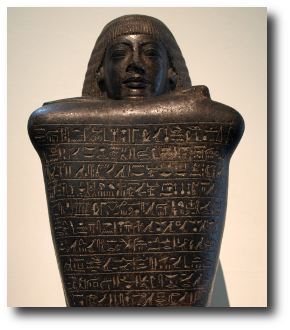
Artwork : This statue is not of the mythical Nyarlathotep, but of Amenhotep, the High Steward of Memphis, c. 1400 BC. It is published under the GNU Free Documentation License and comes to us via Wikimedia Commons.
Nyarlathotep… the crawling chaos… I am the last… I will tell the audient void….
I do not recall distinctly when it began, but it was months ago. The general tension was horrible. To a season of political and social upheaval was added a strange and brooding apprehension of hideous physical danger; a danger widespread and all-embracing, such a danger as may be imagined only in the most terrible phantasms of the night. I recall that the people went about with pale and worried faces, and whispered warnings and prophecies which no one dared consciously repeat or acknowledge to himself that he had heard. A sense of monstrous guilt was upon the land, and out of the abysses between the stars swept chill currents that made men shiver in dark and lonely places. There was a daemoniac alteration in the sequence of the seasons — the autumn heat lingered fearsomely, and everyone felt that the world and perhaps the universe had passed from the control of known gods or forces to that of gods or forces which were unknown.
And it was then that Nyarlathotep came out of Egypt. Who he was, none could tell, but he was of the old native blood and looked like a Pharaoh. The fellahin knelt when they saw him, yet could not say why. He said he had risen up out of the blackness of twenty-seven centuries, and that he had heard messages from places not on this planet. Into the lands of civilisation came Nyarlathotep, swarthy, slender, and sinister, always buying strange instruments of glass and metal and combining them into instruments yet stranger. He spoke much of the sciences — of electricity and psychology — and gave exhibitions of power which sent his spectators away speechless, yet which swelled his fame to exceeding magnitude. Men advised one another to see Nyarlathotep, and shuddered. And where Nyarlathotep went, rest vanished; for the small hours were rent with the screams of nightmare. Never before had the screams of nightmare been such a public problem; now the wise men almost wished they could forbid sleep in the small hours, that the shrieks of cities might less horribly disturb the pale, pitying moon as it glimmered on green waters gliding under bridges, and old steeples crumbling against a sickly sky.
I remember when Nyarlathotep came to my city — the great, the old, the terrible city of unnumbered crimes. My friend had told me of him, and of the impelling fascination and allurement of his revelations, and I burned with eagerness to explore his uttermost mysteries. My friend said they were horrible and impressive beyond my most fevered imaginings; and what was thrown on a screen in the darkened room prophesied things none but Nyarlathotep dared prophesy, and in the sputter of his sparks there was taken from men that which had never been taken before yet which shewed only in the eyes. And I heard it hinted abroad that those who knew Nyarlathotep looked on sights which others saw not.
It was in the hot autumn that I went through the night with the restless crowds to see Nyarlathotep; through the stifling night and up the endless stairs into the choking room. And shadowed on a screen, I saw hooded forms amidst ruins, and yellow evil faces peering from behind fallen monuments. And I saw the world battling against blackness; against the waves of destruction from ultimate space; whirling, churning, struggling around the dimming, cooling sun. Then the sparks played amazingly around the heads of the spectators, and hair stood up on end whilst shadows more grotesque than I can tell came out and squatted on the heads. And when I, who was colder and more scientific than the rest, mumbled a trembling protest about “imposture” and “static electricity,” Nyarlathotep drove us all out, down the dizzy stairs into the damp, hot, deserted midnight streets. I screamed aloud that I was not afraid; that I never could be afraid; and others screamed with me for solace. We swore to one another that the city was exactly the same, and still alive; and when the electric lights began to fade we cursed the company over and over again, and laughed at the queer faces we made.
I believe we felt something coming down from the greenish moon, for when we began to depend on its light we drifted into curious involuntary marching formations and seemed to know our destinations though we dared not think of them. Once we looked at the pavement and found the blocks loose and displaced by grass, with scarce a line of rusted metal to shew where the tramways had run. And again we saw a tram-car, lone, windowless, dilapidated, and almost on its side. When we gazed around the horizon, we could not find the third tower by the river, and noticed that the silhouette of the second tower was ragged at the top. Then we split up into narrow columns, each of which seemed drawn in a different direction. One disappeared in a narrow alley to the left, leaving only the echo of a shocking moan. Another filed down a weed-choked subway entrance, howling with a laughter that was mad. My own column was sucked toward the open country, and presently I felt a chill which was not of the hot autumn; for as we stalked out on the dark moor, we beheld around us the hellish moon-glitter of evil snows. Trackless, inexplicable snows, swept asunder in one direction only, where lay a gulf all the blacker for its glittering walls. The column seemed very thin indeed as it plodded dreamily into the gulf. I lingered behind, for the black rift in the green-litten snow was frightful, and I thought I had heard the reverberations of a disquieting wail as my companions vanished; but my power to linger was slight. As if beckoned by those who had gone before, I half-floated between the titanic snowdrifts, quivering and afraid, into the sightless vortex of the unimaginable.
Screamingly sentient, dumbly delirious, only the gods that were can tell. A sickened, sensitive shadow writhing in hands that are not hands, and whirled blindly past ghastly midnights of rotting creation, corpses of dead worlds with sores that were cities, charnel winds that brush the pallid stars and make them flicker low. Beyond the worlds vague ghosts of monstrous things; half-seen columns of unsanctified temples that rest on nameless rocks beneath space and reach up to dizzy vacua above the spheres of light and darkness. And through this revolting graveyard of the universe the muffled, maddening beating of drums, and thin, monotonous whine of blasphemous flutes from inconceivable, unlighted chambers beyond Time; the detestable pounding and piping whereunto dance slowly, awkwardly, and absurdly the gigantic, tenebrous ultimate gods — the blind, voiceless, mindless gargoyles whose soul is Nyarlathotep.
If you’re a fan of H.P.Lovecraft you may recognise and hopefully enjoy seeing this. If you’re unaware of H.P.Lovecraft, then peel the rime off your eyeballs and get into this world of ultimate, sanity-blasting cosmic horror…
Artwork created by Gustave Doré for an 1884 illustrated edition of “The Raven”. It is in the public domain, and comes to us courtesy of Wikimedia Commons.
This essay details the writing of Edgar Allan Poe’s most famous poem, “The Raven”. Although flash fiction isn’t poetry, it strives for the same “unity of effect” that Poe tries to obtain in his work.
Some have said that Poe must have written this as satire, since it’s a little too precise and methodical in its approach to creative work; however, I think our own short-short work might benefit from thinking about these types of issues, even if our choices are different.
I have made very minor typographical changes to the original.
— Ed.
Charles Dickens, in a note now lying before me, alluding to an examination I once made of the mechanism of Barnaby Rudge, says — “By the way, are you aware that Godwin wrote his Caleb Williams backwards? He first involved his hero in a web of difficulties, forming the second volume, and then, for the first, cast about him for some mode of accounting for what had been done.”
I cannot think this the precise mode of procedure on the part of Godwin — and indeed what he himself acknowledges, is not altogether in accordance with Mr. Dickens’ idea — but the author of Caleb Williams was too good an artist not to perceive the advantage derivable from at least a somewhat similar process. Nothing is more clear than that every plot, worth the name, must be elaborated to its denouement before anything be attempted with the pen. It is only with the denouement constantly in view that we can give a plot its indispensable air of consequence, or causation, by making the incidents, and especially the tone at all points, tend to the development of the intention.
There is a radical error, I think, in the usual mode of constructing a story. Either history affords a thesis — or one is suggested by an incident of the day — or, at best, the author sets himself to work in the combination of striking events to form merely the basis of his narrative-designing, generally, to fill in with description, dialogue, or autorial comment, whatever crevices of fact, or action, may, from page to page, render themselves apparent.
I prefer commencing with the consideration of an effect. Keeping originality always in view — for he is false to himself who ventures to dispense with so obvious and so easily attainable a source of interest — I say to myself, in the first place, “Of the innumerable effects, or impressions, of which the heart, the intellect, or (more generally) the soul is susceptible, what one shall I, on the present occasion, select?” Having chosen a novel, first, and secondly a vivid effect, I consider whether it can be best wrought by incident or tone — whether by ordinary incidents and peculiar tone, or the converse, or by peculiarity both of incident and tone — afterward looking about me (or rather within) for such combinations of event, or tone, as shall best aid me in the construction of the effect.
I have often thought how interesting a magazine paper might be written by any author who would — that is to say, who could — detail, step by step, the processes by which any one of his compositions attained its ultimate point of completion. Why such a paper has never been given to the world, I am much at a loss to say — but, perhaps, the autorial vanity has had more to do with the omission than any one other cause. Most writers — poets in especial — prefer having it understood that they compose by a species of fine frenzy — an ecstatic intuition — and would positively shudder at letting the public take a peep behind the scenes, at the elaborate and vacillating crudities of thought — at the true purposes seized only at the last moment — at the innumerable glimpses of idea that arrived not at the maturity of full view — at the fully-matured fancies discarded in despair as unmanageable — at the cautious selections and rejections — at the painful erasures and interpolations — in a word, at the wheels and pinions — the tackle for scene-shifting — the step-ladders, and demon-traps — the cock’s feathers, the red paint and the black patches, which, in ninety-nine cases out of a hundred, constitute the properties of the literary histrio.
I am aware, on the other hand, that the case is by no means common, in which an author is at all in condition to retrace the steps by which his conclusions have been attained. In general, suggestions, having arisen pell-mell are pursued and forgotten in a similar manner.
For my own part, I have neither sympathy with the repugnance alluded to, nor, at any time, the least difficulty in recalling to mind the progressive steps of any of my compositions, and, since the interest of an analysis or reconstruction, such as I have considered a desideratum, is quite independent of any real or fancied interest in the thing analysed, it will not be regarded as a breach of decorum on my part to show the modus operandi by which some one of my own works was put together. I select “The Raven” as most generally known. It is my design to render it manifest that no one point in its composition is referable either to accident or intuition — that the work proceeded step by step, to its completion, with the precision and rigid consequence of a mathematical problem.
Let us dismiss, as irrelevant to the poem, per se, the circumstance — or say the necessity — which, in the first place, gave rise to the intention of composing a poem that should suit at once the popular and the critical taste.
We commence, then, with this intention.
The initial consideration was that of extent. If any literary work is too long to be read at one sitting, we must be content to dispense with the immensely important effect derivable from unity of impression — for, if two sittings be required, the affairs of the world interfere, and everything like totality is at once destroyed. But since, ceteris paribus, no poet can afford to dispense with anything that may advance his design, it but remains to be seen whether there is, in extent, any advantage to counterbalance the loss of unity which attends it. Here I say no, at once. What we term a long poem is, in fact, merely a succession of brief ones — that is to say, of brief poetical effects. It is needless to demonstrate that a poem is such only inasmuch as it intensely excites, by elevating the soul; and all intense excitements are, through a psychal necessity, brief. For this reason, at least, one-half of the Paradise Lost is essentially prose — a succession of poetical excitements interspersed, inevitably, with corresponding depressions — the whole being deprived, through the extremeness of its length, of the vastly important artistic element, totality, or unity of effect.
It appears evident, then, that there is a distinct limit, as regards length, to all works of literary art — the limit of a single sitting — and that, although in certain classes of prose composition, such as Robinson Crusoe (demanding no unity), this limit may be advantageously overpassed, it can never properly be overpassed in a poem. Within this limit, the extent of a poem may be made to bear mathematical relation to its merit — in other words, to the excitement or elevation-again, in other words, to the degree of the true poetical effect which it is capable of inducing; for it is clear that the brevity must be in direct ratio of the intensity of the intended effect — this, with one proviso — that a certain degree of duration is absolutely requisite for the production of any effect at all.
Holding in view these considerations, as well as that degree of excitement which I deemed not above the popular, while not below the critical taste, I reached at once what I conceived the proper length for my intended poem — a length of about one hundred lines. It is, in fact, a hundred and eight.
My next thought concerned the choice of an impression, or effect, to be conveyed: and here I may as well observe that throughout the construction, I kept steadily in view the design of rendering the work universally appreciable. I should be carried too far out of my immediate topic were I to demonstrate a point upon which I have repeatedly insisted, and which, with the poetical, stands not in the slightest need of demonstration — the point, I mean, that Beauty is the sole legitimate province of the poem. A few words, however, in elucidation of my real meaning, which some of my friends have evinced a disposition to misrepresent. That pleasure which is at once the most intense, the most elevating, and the most pure is, I believe, found in the contemplation of the beautiful. When, indeed, men speak of Beauty, they mean, precisely, not a quality, as is supposed, but an effect — they refer, in short, just to that intense and pure elevation of soul — not of intellect, or of heart — upon which I have commented, and which is experienced in consequence of contemplating the “beautiful.” Now I designate Beauty as the province of the poem, merely because it is an obvious rule of Art that effects should be made to spring from direct causes — that objects should be attained through means best adapted for their attainment — no one as yet having been weak enough to deny that the peculiar elevation alluded to is most readily attained in the poem. Now the object Truth, or the satisfaction of the intellect, and the object Passion, or the excitement of the heart, are, although attainable to a certain extent in poetry, far more readily attainable in prose. Truth, in fact, demands a precision, and Passion, a homeliness (the truly passionate will comprehend me), which are absolutely antagonistic to that Beauty which, I maintain, is the excitement or pleasurable elevation of the soul. It by no means follows, from anything here said, that passion, or even truth, may not be introduced, and even profitably introduced, into a poem for they may serve in elucidation, or aid the general effect, as do discords in music, by contrast — but the true artist will always contrive, first, to tone them into proper subservience to the predominant aim, and, secondly, to enveil them, as far as possible, in that Beauty which is the atmosphere and the essence of the poem.
Regarding, then, Beauty as my province, my next question referred to the tone of its highest manifestation — and all experience has shown that this tone is one of sadness. Beauty of whatever kind in its supreme development invariably excites the sensitive soul to tears. Melancholy is thus the most legitimate of all the poetical tones.
The length, the province, and the tone, being thus determined, I betook myself to ordinary induction, with the view of obtaining some artistic piquancy which might serve me as a key-note in the construction of the poem — some pivot upon which the whole structure might turn. In carefully thinking over all the usual artistic effects — or more properly points, in the theatrical sense — I did not fail to perceive immediately that no one had been so universally employed as that of the refrain. The universality of its employment sufficed to assure me of its intrinsic value, and spared me the necessity of submitting it to analysis. I considered it, however, with regard to its susceptibility of improvement, and soon saw it to be in a primitive condition. As commonly used, the refrain, or burden, not only is limited to lyric verse, but depends for its impression upon the force of monotone — both in sound and thought. The pleasure is deduced solely from the sense of identity — of repetition. I resolved to diversify, and so heighten the effect, by adhering in general to the monotone of sound, while I continually varied that of thought: that is to say, I determined to produce continuously novel effects, by the variation of the application of the refrain — the refrain itself remaining for the most part, unvaried.
These points being settled, I next bethought me of the nature of my refrain. Since its application was to be repeatedly varied it was clear that the refrain itself must be brief, for there would have been an insurmountable difficulty in frequent variations of application in any sentence of length. In proportion to the brevity of the sentence would, of course, be the facility of the variation. This led me at once to a single word as the best refrain.
The question now arose as to the character of the word. Having made up my mind to a refrain, the division of the poem into stanzas was of course a corollary, the refrain forming the close to each stanza. That such a close, to have force, must be sonorous and susceptible of protracted emphasis, admitted no doubt, and these considerations inevitably led me to the long o as the most sonorous vowel in connection with r as the most producible consonant.
The sound of the refrain being thus determined, it became necessary to select a word embodying this sound, and at the same time in the fullest possible keeping with that melancholy which I had pre-determined as the tone of the poem. In such a search it would have been absolutely impossible to overlook the word “Nevermore.” In fact it was the very first which presented itself.
The next desideratum was a pretext for the continuous use of the one word “nevermore.” In observing the difficulty which I had at once found in inventing a sufficiently plausible reason for its continuous repetition, I did not fail to perceive that this difficulty arose solely from the preassumption that the word was to be so continuously or monotonously spoken by a human being — I did not fail to perceive, in short, that the difficulty lay in the reconciliation of this monotony with the exercise of reason on the part of the creature repeating the word. Here, then, immediately arose the idea of a non-reasoning creature capable of speech, and very naturally, a parrot, in the first instance, suggested itself, but was superseded forthwith by a Raven as equally capable of speech, and infinitely more in keeping with the intended tone.
I had now gone so far as the conception of a Raven, the bird of ill-omen, monotonously repeating the one word “Nevermore” at the conclusion of each stanza in a poem of melancholy tone, and in length about one hundred lines. Now, never losing sight of the object — supremeness or perfection at all points, I asked myself — “Of all melancholy topics what, according to the universal understanding of mankind, is the most melancholy?” Death, was the obvious reply. “And when,” I said, “is this most melancholy of topics most poetical?” From what I have already explained at some length the answer here also is obvious — “When it most closely allies itself to Beauty: the death then of a beautiful woman is unquestionably the most poetical topic in the world, and equally is it beyond doubt that the lips best suited for such topic are those of a bereaved lover.”
I had now to combine the two ideas of a lover lamenting his deceased mistress and a Raven continuously repeating the word “Nevermore.” I had to combine these, bearing in mind my design of varying at every turn the application of the word repeated, but the only intelligible mode of such combination is that of imagining the Raven employing the word in answer to the queries of the lover. And here it was that I saw at once the opportunity afforded for the effect on which I had been depending, that is to say, the effect of the variation of application. I saw that I could make the first query propounded by the lover — the first query to which the Raven should reply “Nevermore” — that I could make this first query a commonplace one, the second less so, the third still less, and so on, until at length the lover, startled from his original nonchalance by the melancholy character of the word itself, by its frequent repetition, and by a consideration of the ominous reputation of the fowl that uttered it, is at length excited to superstition, and wildly propounds queries of a far different character — queries whose solution he has passionately at heart — propounds them half in superstition and half in that species of despair which delights in self-torture — propounds them not altogether because he believes in the prophetic or demoniac character of the bird (which reason assures him is merely repeating a lesson learned by rote), but because he experiences a frenzied pleasure in so modelling his questions as to receive from the expected “Nevermore” the most delicious because the most intolerable of sorrows. Perceiving the opportunity thus afforded me, or, more strictly, thus forced upon me in the progress of the construction, I first established in my mind the climax or concluding query — that query to which “Nevermore” should be in the last place an answer — that query in reply to which this word “Nevermore” should involve the utmost conceivable amount of sorrow and despair.
Here then the poem may be said to have had its beginning — at the end where all works of art should begin — for it was here at this point of my preconsiderations that I first put pen to paper in the composition of the stanza:
“Prophet!” said I, “thing of evil! prophet still if bird or devil! By that Heaven that bends above us — by that God we both adore, Tell this soul with sorrow laden, if, within the distant Aidenn, It shall clasp a sainted maiden whom the angels name Lenore — Clasp a rare and radiant maiden whom the angels name Lenore.” Quoth the Raven — “Nevermore.”
I composed this stanza, at this point, first that, by establishing the climax, I might the better vary and graduate, as regards seriousness and importance, the preceding queries of the lover, and secondly, that I might definitely settle the rhythm, the metre, and the length and general arrangement of the stanza, as well as graduate the stanzas which were to precede, so that none of them might surpass this in rhythmical effect. Had I been able in the subsequent composition to construct more vigorous stanzas I should without scruple have purposely enfeebled them so as not to interfere with the climacteric effect.
And here I may as well say a few words of the versification. My first object (as usual) was originality. The extent to which this has been neglected in versification is one of the most unaccountable things in the world. Admitting that there is little possibility of variety in mere rhythm, it is still clear that the possible varieties of metre and stanza are absolutely infinite, and yet, for centuries, no man, in verse, has ever done, or ever seemed to think of doing, an original thing. The fact is that originality (unless in minds of very unusual force) is by no means a matter, as some suppose, of impulse or intuition. In general, to be found, it must be elaborately sought, and although a positive merit of the highest class, demands in its attainment less of invention than negation.
Of course I pretend to no originality in either the rhythm or metre of the “Raven.” The former is trochaic — the latter is octametre acatalectic, alternating with heptametre catalectic repeated in the refrain of the fifth verse, and terminating with tetrametre catalectic. Less pedantically the feet employed throughout (trochees) consist of a long syllable followed by a short, the first line of the stanza consists of eight of these feet, the second of seven and a half (in effect two-thirds), the third of eight, the fourth of seven and a half, the fifth the same, the sixth three and a half. Now, each of these lines taken individually has been employed before, and what originality the “Raven” has, is in their combination into stanza; nothing even remotely approaching this has ever been attempted. The effect of this originality of combination is aided by other unusual and some altogether novel effects, arising from an extension of the application of the principles of rhyme and alliteration.
The next point to be considered was the mode of bringing together the lover and the Raven — and the first branch of this consideration was the locale. For this the most natural suggestion might seem to be a forest, or the fields — but it has always appeared to me that a close circumscription of space is absolutely necessary to the effect of insulated incident — it has the force of a frame to a picture. It has an indisputable moral power in keeping concentrated the attention, and, of course, must not be confounded with mere unity of place.
I determined, then, to place the lover in his chamber — in a chamber rendered sacred to him by memories of her who had frequented it. The room is represented as richly furnished — this in mere pursuance of the ideas I have already explained on the subject of Beauty, as the sole true poetical thesis.
The locale being thus determined, I had now to introduce the bird — and the thought of introducing him through the window was inevitable. The idea of making the lover suppose, in the first instance, that the flapping of the wings of the bird against the shutter, is a “tapping” at the door, originated in a wish to increase, by prolonging, the reader’s curiosity, and in a desire to admit the incidental effect arising from the lover’s throwing open the door, finding all dark, and thence adopting the half-fancy that it was the spirit of his mistress that knocked.
I made the night tempestuous, first to account for the Raven’s seeking admission, and secondly, for the effect of contrast with the (physical) serenity within the chamber.
I made the bird alight on the bust of Pallas, also for the effect of contrast between the marble and the plumage — it being understood that the bust was absolutely suggested by the bird — the bust of Pallas being chosen, first, as most in keeping with the scholarship of the lover, and secondly, for the sonorousness of the word, Pallas, itself.
About the middle of the poem, also, I have availed myself of the force of contrast, with a view of deepening the ultimate impression. For example, an air of the fantastic — approaching as nearly to the ludicrous as was admissible — is given to the Raven’s entrance. He comes in “with many a flirt and flutter.”
Not the least obeisance made he — not a moment stopped or stayed he, But with mien of lord or lady, perched above my chamber door.
In the two stanzas which follow, the design is more obviously carried out: —
Then this ebony bird, beguiling my sad fancy into smiling By the grave and stern decorum of the countenance it wore, “Though thy crest be shorn and shaven, thou,” I said, “art sure no craven, Ghastly grim and ancient Raven wandering from the Nightly shore — Tell me what thy lordly name is on the Night’s Plutonian shore?” Quoth the Raven — “Nevermore.”
Much I marvelled this ungainly fowl to hear discourse so plainly, Though its answer little meaning — little relevancy bore; For we cannot help agreeing that no living human being Ever yet was blessed with seeing bird above his chamber door — Bird or beast upon the sculptured bust above his chamber door, With such name as “Nevermore.”
The effect of the denouement being thus provided for, I immediately drop the fantastic for a tone of the most profound seriousness — this tone commencing in the stanza directly following the one last quoted, with the line,
But the Raven, sitting lonely on that placid bust, spoke only, etc.
From this epoch the lover no longer jests — no longer sees anything even of the fantastic in the Raven’s demeanour. He speaks of him as a “grim, ungainly, ghastly, gaunt, and ominous bird of yore,” and feels the “fiery eyes” burning into his “bosom’s core.” This revolution of thought, or fancy, on the lover’s part, is intended to induce a similar one on the part of the reader — to bring the mind into a proper frame for the denouement — which is now brought about as rapidly and as directly as possible.
With the denouement proper — with the Raven’s reply, “Nevermore,” to the lover’s final demand if he shall meet his mistress in another world — the poem, in its obvious phase, that of a simple narrative, may be said to have its completion. So far, everything is within the limits of the accountable — of the real. A raven, having learned by rote the single word “Nevermore,” and having escaped from the custody of its owner, is driven at midnight, through the violence of a storm, to seek admission at a window from which a light still gleams — the chamber-window of a student, occupied half in poring over a volume, half in dreaming of a beloved mistress deceased. The casement being thrown open at the fluttering of the bird’s wings, the bird itself perches on the most convenient seat out of the immediate reach of the student, who amused by the incident and the oddity of the visitor’s demeanour, demands of it, in jest and without looking for a reply, its name. The raven addressed, answers with its customary word, “Nevermore” — a word which finds immediate echo in the melancholy heart of the student, who, giving utterance aloud to certain thoughts suggested by the occasion, is again startled by the fowl’s repetition of “Nevermore.” The student now guesses the state of the case, but is impelled, as I have before explained, by the human thirst for self-torture, and in part by superstition, to propound such queries to the bird as will bring him, the lover, the most of the luxury of sorrow, through the anticipated answer, “Nevermore.” With the indulgence, to the extreme, of this self-torture, the narration, in what I have termed its first or obvious phase, has a natural termination, and so far there has been no overstepping of the limits of the real.
But in subjects so handled, however skillfully, or with however vivid an array of incident, there is always a certain hardness or nakedness which repels the artistical eye. Two things are invariably required — first, some amount of complexity, or more properly, adaptation; and, secondly, some amount of suggestiveness — some under-current, however indefinite, of meaning. It is this latter, in especial, which imparts to a work of art so much of that richness (to borrow from colloquy a forcible term), which we are too fond of confounding with the ideal. It is the excess of the suggested meaning — it is the rendering this the upper instead of the under-current of the theme — which turns into prose (and that of the very flattest kind), the so-called poetry of the so-called transcendentalists.
Holding these opinions, I added the two concluding stanzas of the poem — their suggestiveness being thus made to pervade all the narrative which has preceded them. The under-current of meaning is rendered first apparent in the line-
“Take thy beak from out my heart, and take thy form from off my door!” Quoth the Raven, “Nevermore!”
It will be observed that the words, “from out my heart,” involve the first metaphorical expression in the poem. They, with the answer, “Nevermore,” dispose the mind to seek a moral in all that has been previously narrated. The reader begins now to regard the Raven as emblematical — but it is not until the very last line of the very last stanza that the intention of making him emblematical of Mournful and never-ending Remembrance is permitted distinctly to be seen:
And the Raven, never flitting, still is sitting, still is sitting, On the pallid bust of Pallas just above my chamber door; And his eyes have all the seeming of a demon that is dreaming, And the lamplight o’er him streaming throws his shadow on the floor; And my soul from out that shadow that lies floating on the floor Shall be lifted — nevermore.
An incredible essay. It does seem rather like satire, but as you say it doesn’t seem to matter much given how much value it has, especially to aspiring writers. The two biggest takeaways for me were the part where he states, perhaps satirically, that originality and innovation are more a matter of hard work than natural ability or intuition (“In general, to be found, it must be elaborately sought, and although a
positive merit of the highest class, demands in its attainment less of
invention than negation.”) If this is satire, it would be like Poe saying leave the art to the real artists, so you almost hope it’s not in which case he’s probably being overly humble. Poe was obviously a gifted and exceptional figure. The second best part to me is where he’s explaining that good art (storytelling) cannot be too obvious and straightforward. There must be some subtle complexity to it (readers are adults after all) and an underlying moral that can be detected indirectly. It’s a fine line though, and drifting into polemic is another danger to avoid. This is something I lack as an amateur, what I’m getting at, in terms of point or plot, is too easily detected. This gets at what’s so hard about writing well. And it pinpoints why fiction is such a high art. The highest form of art there is in my view. Final takeaway: The Raven is an incredible work.
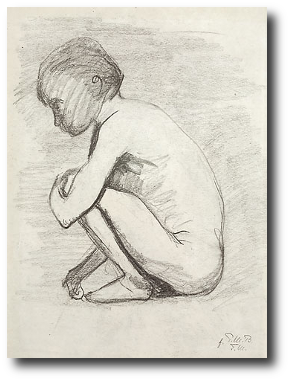
Artwork : Hockender Mädchenakt, c. 1898, by Paula Modersohn-Becker. This work is in the public domain and comes to us via Wikimedia Commons.
Wheee. The death baby goes, wheee. It also gurgles something awful. We have a problem with them in the town, not the town proper but right outside. The death babies have gotten brave in recent years, crawling right up to the gardens and even to the homes.
Nobody knows where they come from, only that when one of us dies and we put the body in the ground, a new death baby will be found wandering out of the wilderness. They look the same kind of cute as any baby, the only difference being the skin. Their leathery skin, near as anyone can tell, is impenetrable. Death babies don’t feel pain, death babies don’t die.
Girls, grown women even, are afraid to go out alone at night. They fear one of the death babies will latch on and then they’ll spend the rest of their days stuck with the thing. What is the world coming to?
Take Emma. She got her first death baby when she was a child herself. She mistook it for a rabbit, caressing the top of the baby’s head. If you show a death baby any affection, any at all, that baby bonds to you. It will never leave you alone. Emma ran home. Later that night, she heard the baby scratching at her window. Her parents tried everything, including tying a rock to the baby and throwing it in the pond — it showed up at their door three days later.
Emma finally accepted the death baby, keeping it with her always or locking it in her chest to get a short break. Emma was also one of the town’s few beauties, her hair a dark wave of ringlets and her eyes a warming green. But for the death baby, she’d have married before her eighteenth birthday, instead of her twenties. Her husband, too disturbed by continually finding the death baby nestled between them, left, though not before leaving her pregnant.
As the birth neared, Emma, in love with the life growing inside her, tried one last time to lose her death baby. She tied its tiny limbs together and placed it in a bag at the bottom of her chest and filled it with rocks. She paid a merchant to take the chest to her farthest route and dump it in some still water.
The baby was born and christened Eleanor. Men ten years her junior courted Emma, cooing over the beautiful baby. Emma lived on the edge of town in a little blue house with Eleanor. Three months after the birth, Emma found the death baby sitting on Eleanor’s chest, laughing its baby laugh, its elbows pressed into the pillow over Eleanor’s face.
They buried Eleanor in the family plot, and Emma sat tear-soaked by the marker, refusing to leave. A day and night, she stayed. Then she saw the shape crawling free of the brambles by the cemetery, a baby. “Eleanor,” she called. It was not, but the death baby came to her. She whispered the name again and cradled the death baby in her lap.
Emma had two death babies then. The “twins” she took to calling them. Her family just shook their heads at the mention of her name. What was there to do? People began to talk about crazy Emma and her death babies. She took in another one, they said. And it was true. She began to collect them.
We watched her roll a wheelbarrow through town full of them. She haunted the edges of the forest, the night after a funeral, waiting on her next child. Her neighbors moved for the endless sound, a hum of death baby babble. Some talked about taking measures, but others of us said she was doing the town a favor, taking in the pests.
Soon the death babies just seemed to know where to go. We kept away from the house as it slowly fell apart and the grounds grew up around it, as if the wilderness were taking it back. We were at first relieved seeing less and less of the death babies, but sad to sacrifice the lovely Emma for that relief, and soon we just took it for granted.
Then, one day, a commotion drew everyone out of their homes, though night was coming on and we were draining out the stresses of the day. Even before the sight, the sound of the death babies and people murmuring and crying and shouting preceded it. No one could count the numbers of the death babies crawling through the main street, one almost on top of another in their slow procession. And on top of the mass of the death babies rode the limp body of Emma, looking as old as a woman could look, but still beautiful, her full hair all gone white and loose, but fanned among the babies like a glorious curtain. No one would touch her, afraid any sign of affection would be misconstrued by the death babies, so the parade continued through the streets, us following as the death babies bore Emma away. They disappeared into the wilderness where we would not go, just as all the light left the sky.
Now, they are everywhere, the death babies. They cry more. The death babies look for someone else to love them. We are building a wall, a very tall wall.
Her mother had taught her that each meal, each dish made with her own fingers was a gift. You should cook with your loved one in mind, Sophie, her mother used to say, and strive for the best.
So Sophie had. Each meal was a feast, a gift of love.
Harold ate each with gusto, complimenting her, and never missing a meal.
Two cakes and a batch of cookies sat on the countertop. A frenzy of baking, Harold would say when he got home. You’re the best cook in the country. Too bad you never share it with anyone.
She would smile, as she always did, and say, I share it with you.
All of her ingredients were on the counter, next to the soufflé dish, lightly dusted with sugar. The three egg whites and their tablespoon of sugar were beaten until they formed stiff peaks. The semisweet chocolate and four tablespoons of sugar were melted and cooling in a stainless steel bowl. She had only to beat in the egg yolks. A few more ingredients, a bit of time.
Behind her, the trial of the President played in the background, CNN commentators evaluating this, evaluating that. Last night, some reporter said things had been difficult for the First Family in August, after Hillary learned that Bill had lied.
Sophie remembered the vacation the next day — August 18th, her wedding anniversary, the day before the President’s birthday. How the first lady had used her daughter to keep her distance from her husband, how plain it was that Hillary was very, very angry.
Disgraced, not just in private, but in public too.
Like the time that Harold put his arm around Anna Armbruster and kissed her cheek. The day he had said to his best friend, out of Sophie’s hearing he thought, that he had nearly placed all of Sophie’s inheritance in private accounts. Divorcing lawyers, he had once said, was one of the most difficult tasks of all.
Almost as difficult, she thought, as divorcing a President of the United States.
Thirteen years he had slept with Anna, starting the month after he and Sophie married. She had thought the marriage had been for love; he had married her for money. All those years, all those meals, for money.
On January 17, the day the presidential scandal broke, she had bought white powdered cleanser with cash at an out-of-town grocery. The warning on the box was plain: poison if swallowed.
On August 20th, she had bought two powdered sugar boxes for the pantry. On September 15th, she had opened them and dumped the sugar into her garbage disposal. Then she had mixed the sugar with the powdered cleanser. She had resealed the boxes, using a glue she bought with cash and then threw away along with the cleanser tube. She replaced the powered sugar boxes in the pantry, and made a point of cooking no sweets for guests.
She had used a different box for her Christmas baking. She would use “sugar” from the new boxes to sprinkle the soufflé when it was done.
She stirred in the egg yolks, then mixed a third of the egg whites into the chocolate. Carefully she folded the rest of the whites into the mixture, and spooned the whole mess into the soufflé dish.
Then she double-checked herself. Timer set at 25 minutes, the open box of confectioner’s sugar beside the stove.
She rinsed out her mixer, then examined the cakes. A white cake and a marble cake. Harold had a fondness for chocolate soufflé. Her frenzy of baking would last the week, or so she would tell him.
The cakes needed frosting. He loved butter frosting, more than he loved her. He would come home at night, just for dinner, and then return to the office. She had always thought it a sign of his devotion — and it had been. Devotion to her cooking. All the while, living a lie.
She would have forgiven him if he had loved her. She would have forgiven him, even if he had humiliated her for decades to come, even if her humiliation were part of the historical record, even if it were grounds for impeachment. She would have forgiven him.
But the detective’s report made forgiveness impossible.
Damn Oregon. If it had been a community property state, Sophie wouldn’t have to do this. But if it had been a community property state, she wouldn’t have the excuse.
She poured in the powder and sugar, along with the milk, melted butter, and vanilla. The frosting was gluey, so she added more milk, making a glaze. She’d have to apologize to Harold for the glaze, saying she didn’t know why her frosting hadn’t worked this time. He wouldn’t care. He would eat piece after piece, and if he didn’t like it, he would eat the soufflé, which she would share with him.
After twenty-five minutes, the soufflé was puffed. She dusted it with confectioner’s sugar and smiled as she heard Harold’s car door slam outside. Just in time.
Dinner already on the table, desserts at the ready. She would have some too, just enough soufflé to get sick, maybe damage her throat. A small price to pay, really, when the net gains were so high. Another inheritance, this time from her husband. A return of her own money. And — perhaps — if this made the news, a suit against the store, or the powdered sugar manufacturer.
She shut off the television. Enough of other people’s problems.
The door opened, and Harold came in, looking trim and tailored. “Is dinner ready?” he asked. “I have to go back at seven.” Then he sniffed and grinned. “You went on a baking frenzy.”
“I did.” She smiled at him. “And I thought of you the entire time.”
TRANSCRIPT OF VOICEMAIL BOX: Joselin Rose Clark.329.501.1225
ORIGINAL DATE: Fri, Dec 21, 2018
INCIDENT NO. 056-0004584-12(DB)
FILE CLASS: 50006 TRANSCRIBER: NW, #49453
[Transcript Begins]
08:24:19
Hey Josie, it’s Henry. Just making sure you’re okay. I don’t know how bad it was for you, or if you even felt it, but I’d say that had to be at least a seven. Books and dishes are everywhere. Still have power though, so that’s good. Nothing on the news yet. Anyhow, just give me a call back. Or a text or whatever.
08:29:41
Hey Josie, still nothing on the news. I’m wondering if maybe it was just something local, like a gas line exploding or something. I saw some neighbors walking around in the street. I thought about going out there too, but… you know… anyhow, call me back.
08:33:12
Josie, Henry. Not to be panicky and all Mom about it, but I wish you would give me a call back. Something just isn’t right. I can’t find anything online about what happened. One of the neighbors got in his car and took off down the street like a crazy person. Almost hit a little girl… she looks okay though. The cat is acting strange. She keeps pawing at the air. I dunno. It’s weird. Okay, so give me a call.
08:36:40
Josie. Me again. Okay. Just-
08:36:55
Josie. I got cut off. Signal sounds weird and the air is looking kinda green. I bet it was a gas thing and now more is leaking out. No one’s on the street now. The furnace is making a humming noise. I’m going to go turn it off just to be safe.
08:39:01
Josie. [unintelligible] the basement. I don’t know if you can hear. There’s a door, Josie. A door in the wall. I’ve lived here twelve years and now there’s just a fucking door that wasn’t there before.. It’s uh… [unintelligible] with a big handle right in the middle. What the fuck is happening? Is this the gas? I don’t… [unintelligible]… too weird, Josie. I’m going to try and leave.
08:42:34
Hey Josie. I didn’t leave. I tried, but… Princess went in the basement when I came up. I’ve been trying to call her. She’s meowing. I don’t know. I want to shut the door but then she’d be… I think the humming is getting louder.
08:45:47
[static] Josie… [unintelligible] … ment. Princess isn’t here. I don’t know where she is. The door is [unintelligible] me. I can hear it. It’s so loud. Can you hear it… [static]… just watching it.
13:32:12
I’m going to open the door, Josie. I was looking for Princess, and then I realized I was just sitting in front of the door… watching it. I don’t know how long. A long time I think. I’m going back down. It’s not humming, Josie. It’s singing.
13:38:16
Josie. Josie. I wish you could see it. It goes on forever. It’s like space, but, but gray. There are clouds and people I can’t see. It’s everything. It’s everything and… and not everything. I can step through the door and not be everything too. I wish you were here. I’m not scared, Josie. I’m not. Take care of Princess for me if you find her. Tell Mom, okay? [static]
The Door took a hold of me by 08:29:41, when Josie still did not answer, and held me tight in its grip till the end. At first I thought that something happened to Josie. Then I imagined all kinds of emergencies. But then by 13:32:12, I knew.
This stayed with me, so I had to write about it.
Submissions lorem ipsum dolor sit amet consectetur. At dignissim neque amet proin sodales vulputate dolor elit. At dignissim neque amet proin sodales vulputate dolor elit.


Comments